Photorefractive damage significantly limits the performance of lithium niobate waveguides used in nonlinear optical devices. Nina A. Lange, René Pollmann, and Michael Rüsing, all from the Institute for Photonic Quantum Systems at Paderborn University, alongside colleagues including Michael Stefszky, Maximilian Protte and Raimund Ricken, have investigated photorefractive effects at both high and cryogenic temperatures to address this critical issue. Their research details how photorefraction impacts phase-matching spectra in sum-frequency generation experiments, and importantly, presents a novel solution utilising an auxiliary light source to restore spectral properties and mitigate pyroelectric effects, a technique particularly valuable for cryogenic operation and energy-constrained applications like those found in space. This work offers a crucial alternative to traditional high-temperature management strategies, broadening the scope for lithium niobate waveguide technology in diverse and demanding environments.
Cryogenic photorefraction in lithium niobate waveguides enables enhanced
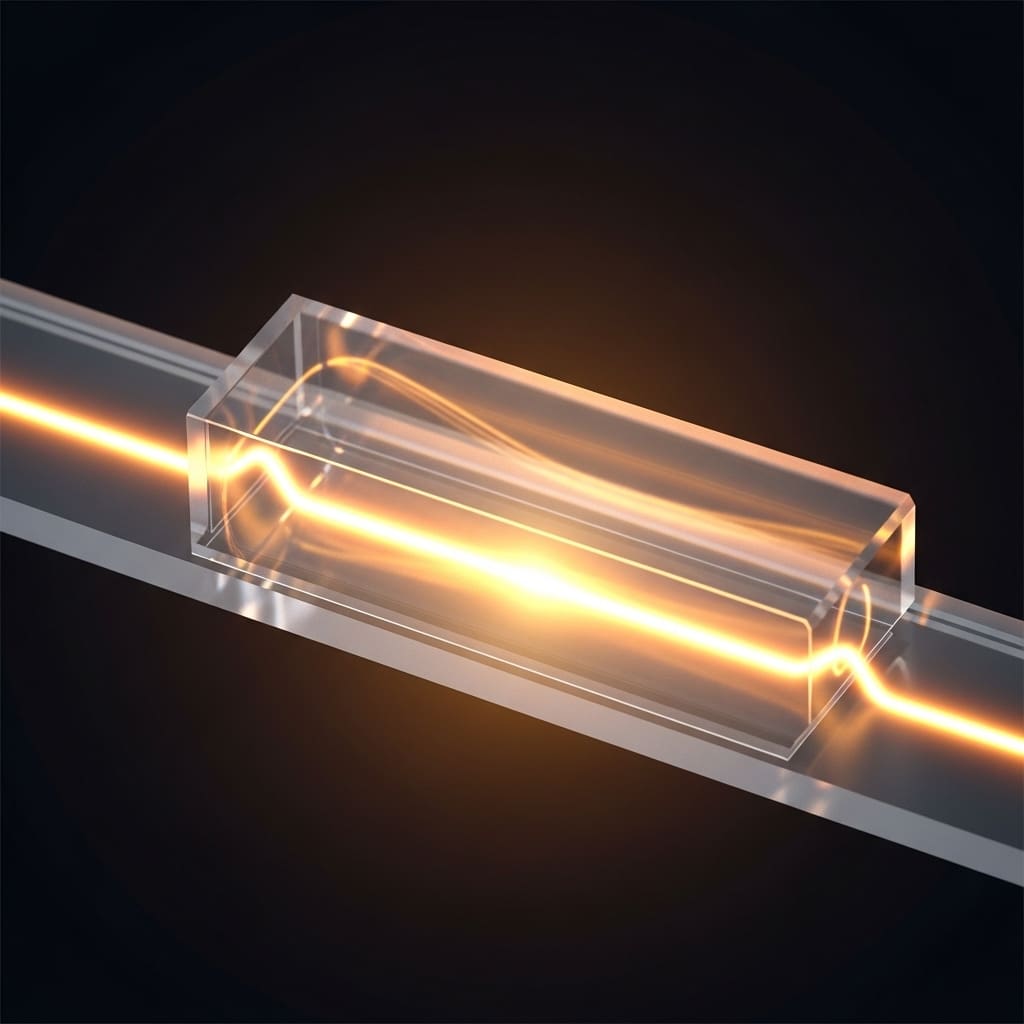
The team achieved a breakthrough by implementing an auxiliary light source within the same waveguide, effectively restoring phase-matching spectra degraded by photorefraction and simultaneously reducing pyroelectric effects. This innovative technique offers a pathway to maintain spectral precision and efficiency in lithium niobate devices operating at cryogenic temperatures, a significant advancement for specialized applications like superconducting nanowire detector integration and space-based platforms. Experiments involved meticulously studying the phase-matching spectra of sum-frequency generation, comparing performance at high temperatures and within cryogenic conditions to quantify the impact of photorefraction. The researchers proved that the auxiliary light source successfully counteracts photorefractive distortions, enabling stable and predictable device operation across a wider range of optical power levels and environmental conditions.
This research establishes an alternative method for photorefraction management, circumventing the need for high-temperature operation and opening possibilities for energy-constrained applications. The study unveils a solution applicable not only to cryogenic environments but also to scenarios with tight energy budgets, such as those encountered in space applications. By restoring phase-matching spectra and mitigating pyroelectric effects, the auxiliary light source effectively enhances the stability and performance of lithium niobate waveguides. The team’s findings are particularly relevant to the burgeoning field of integrated photonics, where lithium niobate is increasingly used for complex circuits demanding high efficiency and spectral control.
Furthermore, the work addresses a fundamental limitation in nonlinear optics , the inherent weakness of nonlinear interactions requiring strong optical fields , by enabling reliable operation even at high power levels. This innovative approach allows for consistent phase-matching conditions and spectral characteristics, crucial for efficient and predictable operation of devices used in quantum computing, advanced sensing, and secure communication. This advancement promises to unlock the full potential of lithium niobate as a versatile platform for scalable, high-performance photonic circuits, paving the way for more robust and reliable quantum and nonlinear optical technologies.
Scientists Method
Scientists investigated the impact of photorefractive effects on phase-matching spectra in lithium niobate waveguides, conducting sum-frequency generation experiments at both high and cryogenic temperatures. The research team meticulously fabricated titanium in-diffused periodically-poled lithium niobate (Ti:PPLN) waveguides on congruent, z-cut lithium niobate substrates, initiating the process by lithographically structuring 80nm titanium strips with widths ranging from 5 to 7μm. These strips underwent a diffusion process at approximately 1060°C for 4 hours, followed by periodic poling via electric field application using lithographically defined electrodes, resulting in waveguides exhibiting a mode field diameter of approximately 5 to 10μm dependent on width and wavelength. Multiple waveguides with varied poling periods and widths were integrated onto each chip, enabling precise phase-matching condition adjustments.
Experiments at elevated temperatures employed a pulsed laser alongside a continuous-wave (CW) laser to induce sum-frequency generation within the Ti:PPLN waveguide, with the generated beam’s spectrum analysed using a spectrometer. Conversely, cryogenic experiments utilized two CW lasers for sum-frequency generation, filtering the resultant beam spectrally before measuring its power with a power meter, this setup was housed within a cryostat maintaining a temperature of 7K. The study pioneered an adaptation of the “optical cleaning” method, initially proposed by Kosters et al, to mitigate photorefractive effects; this involved coupling an auxiliary 532nm laser beam directly into the waveguide alongside the pump light for the nonlinear process. This innovative approach was tested on both high-temperature and cryogenic samples, representing typical use cases with high peak powers and weak quantum signals versus relatively low power CW-driven sum-frequency generation, respectively. The team carefully selected these samples to exemplify scenarios where photorefraction significantly impacts spectral characteristics, the auxiliary beam aimed to restore phase-matching spectra disrupted by photorefraction and reduce pyroelectric effects, offering a novel solution compatible with cryogenic environments and energy-constrained applications like space-based systems. This method achieves suppression of photorefraction at cryogenic temperatures, demonstrating its effectiveness and paving the way for improved integration of Ti:PPLN with cryogenic components.
Photorefractive damage mitigated in lithium niobate waveguides
Scientists have achieved a breakthrough in managing photorefractive damage in lithium niobate (LN) waveguides, a critical issue limiting performance in nonlinear optical devices. The research details a novel approach to mitigate photorefraction, even in challenging cryogenic environments where traditional high-temperature solutions are inapplicable. Experiments revealed that photorefractive effects significantly impact the phase-matching spectra of sum-frequency generation (SFG) processes at both high and cryogenic temperatures. The team measured phase-matching spectra for SFG using titanium-diffused periodically-poled lithium niobate (Ti:PPLN) waveguides, focusing on spectral response as a sensitive indicator of photorefractive influence.
At room temperature (320 K) up to 470 K, a typical pulsed-operation sample demonstrated photorefractive effects at high peak powers, while a separate sample studied at cryogenic temperatures (7 K) exhibited photorefractive onset even at relatively low continuous-wave (CW) power levels. Data shows that the photorefractive threshold, the maximum permissible operating power, is substantially reduced at lower temperatures, causing perturbations to the refractive index distribution. Results demonstrate a successful adaptation of the “optical cleaning” method, employing an auxiliary 532nm light source coupled into the waveguide alongside the SFG pump beams. This auxiliary beam effectively restores phase-matching spectra impacted by photorefraction and reduces pyroelectric effects, enabling stable operation at cryogenic temperatures.
Measurements confirm that this technique is compatible with cryogenic operation, offering an alternative route for photorefraction management applicable to space applications and other scenarios with tight energy budgets. The breakthrough delivers a solution for suppressing photorefraction across a wide temperature range, from room temperature down to cryogenic levels. Tests prove that the auxiliary light source manipulates trapped charge carriers, addressing both pyroelectric variations in spontaneous polarization and the reduced photorefractive threshold at low temperatures. This work provides essential insights for advancing the integration of Ti:PPLN with cryogenic components, as well as guiding the use of Ti:PPLN platforms in nonlinear-optical devices, paving the way for more robust and efficient optical systems.
Photorefraction control via temperature variation is a promising
Scientists have extensively investigated lithium niobate for its role in nonlinear optical devices, including systems based on sum- and difference-frequency generation and spontaneous parametric down-conversion. A major limitation of lithium niobate waveguides is the photorefractive effect, which restricts maximum operating power and alters nonlinear spectral responses. To address this challenge, researchers examined how photorefraction modifies phase-matching spectra during sum-frequency generation at both elevated and cryogenic temperatures.
Their results show that operating at high temperatures can mitigate photorefractive damage by enhancing charge carrier mobility; however, this strategy is incompatible with cryogenic environments required for many quantum photonics applications. To overcome this limitation, the team introduced a novel photorefraction management approach suitable for cryogenic operation, employing an auxiliary light source to restore phase-matching spectra while simultaneously reducing pyroelectric effects. Experiments demonstrated partial reversibility of photorefractive damage in cryogenically cooled waveguides, with a measurable blue shift persisting despite green laser coupling, indicating incomplete recovery of the original charge carrier distribution. The authors note that, under the current auxiliary laser parameters, photorefraction is not fully reversible at cryogenic temperatures. They suggest that future work should focus on optimizing the suppression protocol through pulsed illumination, alternative wavelengths, and precise control of optical power and exposure duration.
Further theoretical investigation of cryogenic material parameters and bi-polaron energy levels could guide the selection of optimal auxiliary laser conditions, while the application of external electric fields or conductive coatings may enhance charge relaxation and enable a reliable in-situ healing procedure. Effective control of photorefraction in cryogenic lithium niobate waveguides would significantly expand the applicability of this material in advanced quantum photonics platforms.
👉 More information
🗞 Photorefraction Management in Lithium Niobate Waveguides: High-Temperature vs. Cryogenic Solutions
🧠 ArXiv: https://arxiv.org/abs/2601.15817