Analytic expansions of dynamic spin correlations have been computed for Heisenberg models with spin lengths of 1/2 and 1. A computational algorithm generates coefficients up to 12th order in J/T, enabling calculation of static and dynamic magnetic susceptibilities, validated on the Heisenberg chain and triangular lattice.
Understanding the magnetic properties of materials requires detailed knowledge of how electron spins interact and fluctuate. Researchers are continually refining methods to model these interactions, particularly at higher temperatures where conventional computational approaches become challenging. A new analytical technique extends high-temperature expansion methods – traditionally used to calculate thermodynamic properties – to directly compute the dynamic spin-spin correlator, a quantity describing how spin fluctuations propagate through a material. This advancement facilitates the calculation of magnetic susceptibilities and opens avenues for determining the dynamic structure factor, a crucial measure of magnetic excitation spectra. This work is presented by Ruben Burkard and Björn Sbierski, both from the Institut für Theoretische Physik, Universität Tübingen, alongside Benedikt Schneider from the Department of Physics and Arnold Sommerfeld Center for Theoretical Physics, Ludwig-Maximilians-Universität München, and the Munich Center for Quantum Science and Technology (MCQST), in their article “Dyn-HTE: High-temperature expansion of the dynamic Matsubara spin correlator”.
The researchers have made pre-computed expansion coefficients, up to 12th order, publicly available, enabling calculations for a wide range of magnetic materials and lattice structures. They validated their approach using the well-studied S=1/2 Heisenberg chain and the triangular lattice model.
High-Temperature Series Expansion Now Calculates Dynamic Magnetic Behaviour
Researchers have refined high-temperature series expansion (HTSE) techniques to calculate dynamic spin correlations in magnetic materials, moving beyond the calculation of static properties to encompass frequency-dependent behaviour. This advancement provides a new analytical tool for investigating complex magnetic systems.
HTSE is a method used to approximate the behaviour of quantum many-body systems at finite temperature by expanding the partition function – a central quantity in statistical mechanics – as a series in powers of $J/T$. Here, J represents the strength of the magnetic coupling between spins, and T is the absolute temperature. Traditionally, HTSE has been limited to calculating static, or time-independent, properties.
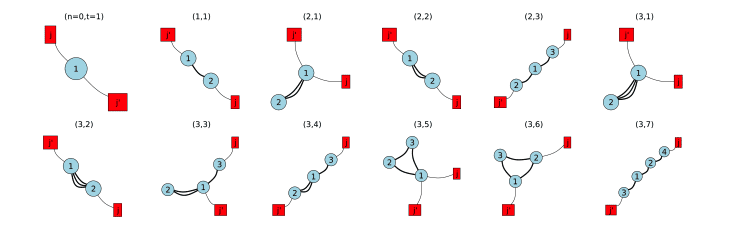
This new work details a fully analytical algorithm to compute expansion coefficients for the dynamic Matsubara spin-spin correlator – a function describing how the spins at different locations are correlated over time in imaginary time. The team focused on Heisenberg models – a standard model in magnetism – with spin lengths of 1/2 and 1, generating coefficients up to 12th order in J/T.
Critically, these pre-computed coefficients are openly available via a dedicated GitHub repository, facilitating reproducibility and wider application within the condensed matter physics community.
The researchers successfully calculated static, momentum-resolved susceptibilities – a measure of how easily a material magnetises in response to an external field – for arbitrary site-pairs and wavevectors. They validated the algorithm’s accuracy by applying it to the well-studied spin-1/2 Heisenberg chain and the triangular lattice model.
The analytic frequency dependence inherent in the expansion is particularly important. It allows for stable analytic continuation to the real-frequency dynamic structure factor. The dynamic structure factor describes how the magnetic scattering intensity varies with energy and momentum, and is directly comparable to experimental data obtained from neutron scattering and other techniques.
The team implemented the calculations in the Julia programming language, chosen for its performance and suitability for numerical computation. This work establishes a robust framework for investigating dynamic magnetic properties in frustrated systems – materials where competing magnetic interactions prevent a simple ordered state – enabling more accurate modelling and interpretation of experimental observations.
Future investigations could leverage this framework to explore more complex models, including those with multiple exchange interactions or incorporating effects beyond the Heisenberg interaction. This development addresses a key challenge in understanding strongly correlated materials, particularly those exhibiting magnetic frustration.
👉 More information
🗞 Dyn-HTE: High-temperature expansion of the dynamic Matsubara spin correlator
🧠 DOI: https://doi.org/10.48550/arXiv.2505.23699