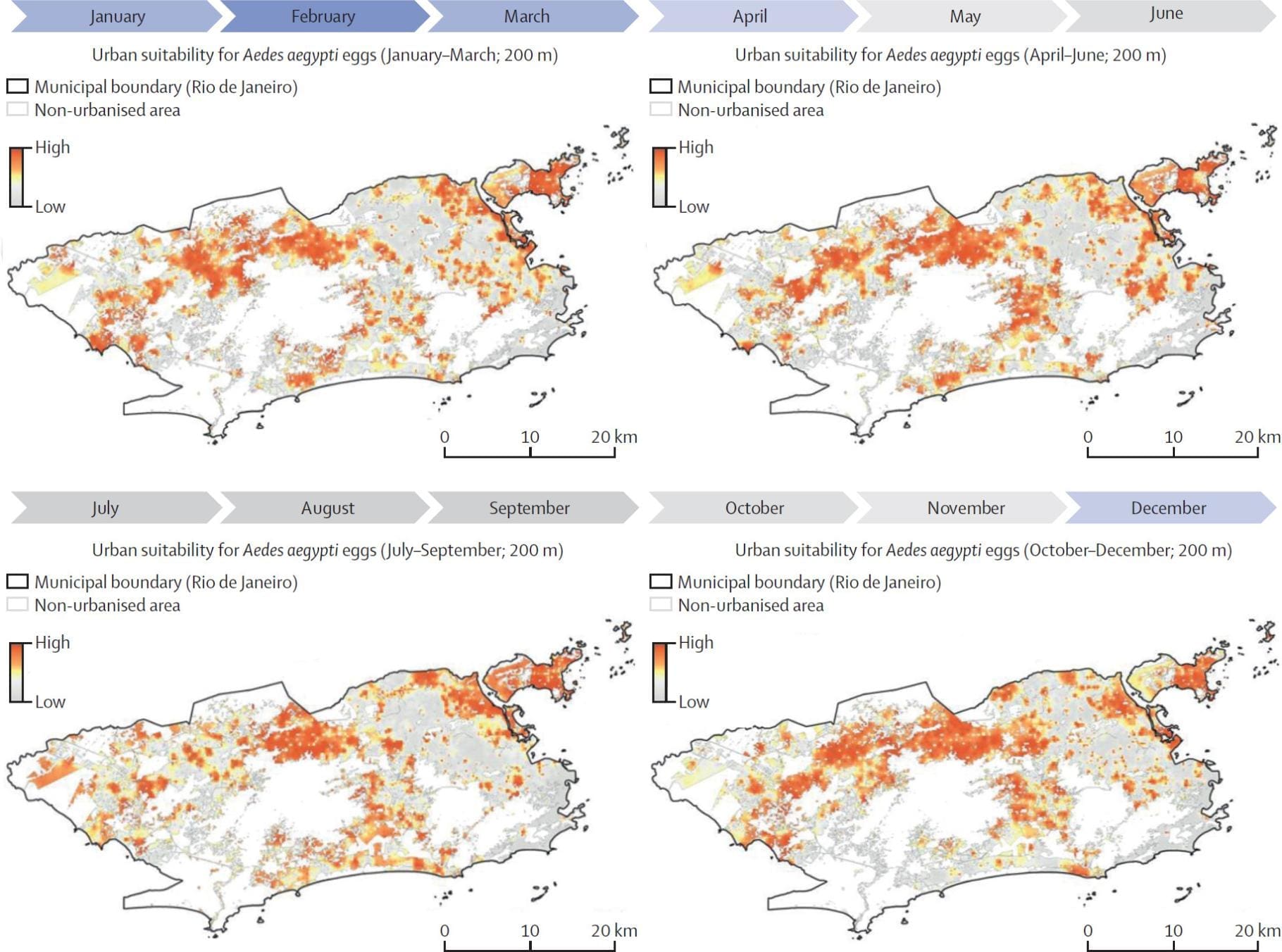
Researchers have developed a spatially continuous environmental suitability map for Aedes aegypti mosquitoes, vectors of diseases including dengue fever and Zika, utilising openly available geodata and Bayesian modelling. The study, conducted across Rio de Janeiro with contributions from international research groups and funding from the German and Austrian Science Funds, demonstrates the potential to model up to 75 per cent of observed spatial variation in mosquito presence using 79 environmental indicators derived from satellite and street view imagery. This approach, detailed in The Lancet Planetary Health, offers a method for targeted vector control by predicting breeding sites with increased precision, particularly in urban environments where conventional monitoring systems struggle to capture habitat variability, given the mosquito’s limited flight range of under 1,000 metres.
A novel methodology combines remote sensing, Bayesian statistics, and spatio-temporal modeling to comprehensively assess and predict Aedes aegypti mosquito distribution, offering an advancement in vector-borne disease control. The system accurately identifies environmental drivers influencing mosquito distribution, facilitating the development of long-term vector control strategies and informed public health decision-making. This methodology provides a data-driven framework for prioritizing areas for intervention and evaluating the impact of vector control programs.
Researchers meticulously integrated diverse data sources to enhance the predictive power and robustness of the model. The system integrates freely available geospatial data with robust statistical frameworks, enabling proactive surveillance and targeted interventions in diverse urban environments. Researchers from diverse fields collaborated to develop and validate the methodology, underscoring the importance of interdisciplinary collaboration in addressing complex public health challenges.
The study leverages high-resolution satellite imagery and street-level views to quantify key urban landscape metrics – including building density, vegetation cover, and impervious surface prevalence – all demonstrably linked to mosquito presence and breeding sites. Spatio-temporal modeling assesses the dynamic relationship between breeding site availability and climatic factors, providing insights into seasonal population variations and potential outbreak prediction based on environmental conditions. This dynamic approach enables proactive surveillance and targeted interventions, reducing the burden of mosquito-borne diseases.
Bayesian modeling provides a framework for incorporating uncertainty inherent in remotely sensed data and field-collected entomological measurements, generating predictive maps with associated confidence intervals. This probabilistic approach allows public health agencies to assess the reliability of spatial predictions and prioritize areas for intervention. Researchers meticulously validated the model’s performance using independent datasets and field observations, demonstrating its reliability and accuracy in diverse urban environments.
The methodology’s scalability and adaptability make it suitable for application in a wide range of urban environments. Researchers demonstrated the model’s effectiveness in diverse geographic regions, highlighting its global applicability. Scalability allows for monitoring large geographic areas, providing a comprehensive overview of mosquito populations and identifying emerging hotspots, essential for effective vector control and disease prevention.
The transferability of this methodology is enhanced by reliance on openly available geodata, reducing financial and logistical barriers to implementation for public health agencies in resource-limited settings. The research team actively promotes the open-source availability of the model and associated data, encouraging further development and adaptation by researchers and public health practitioners. This commitment to open science fosters collaboration and accelerates the translation of research findings into practical applications.
Beyond predictive mapping, the methodology provides a platform for evaluating the impact of vector control programs. The methodology’s capacity to identify environmental drivers influencing mosquito distribution facilitates the development of long-term vector control strategies. The model consistently outperformed traditional static habitat suitability maps, providing more accurate predictions of mosquito distribution and outbreak risk.
The study’s findings have significant implications for public health policy and resource allocation. The study underscores the importance of interdisciplinary collaboration in addressing complex public health challenges. This methodology provides a data-driven framework for prioritizing areas for intervention and evaluating the impact of vector control programs.
More information
External Link: Click Here For More