

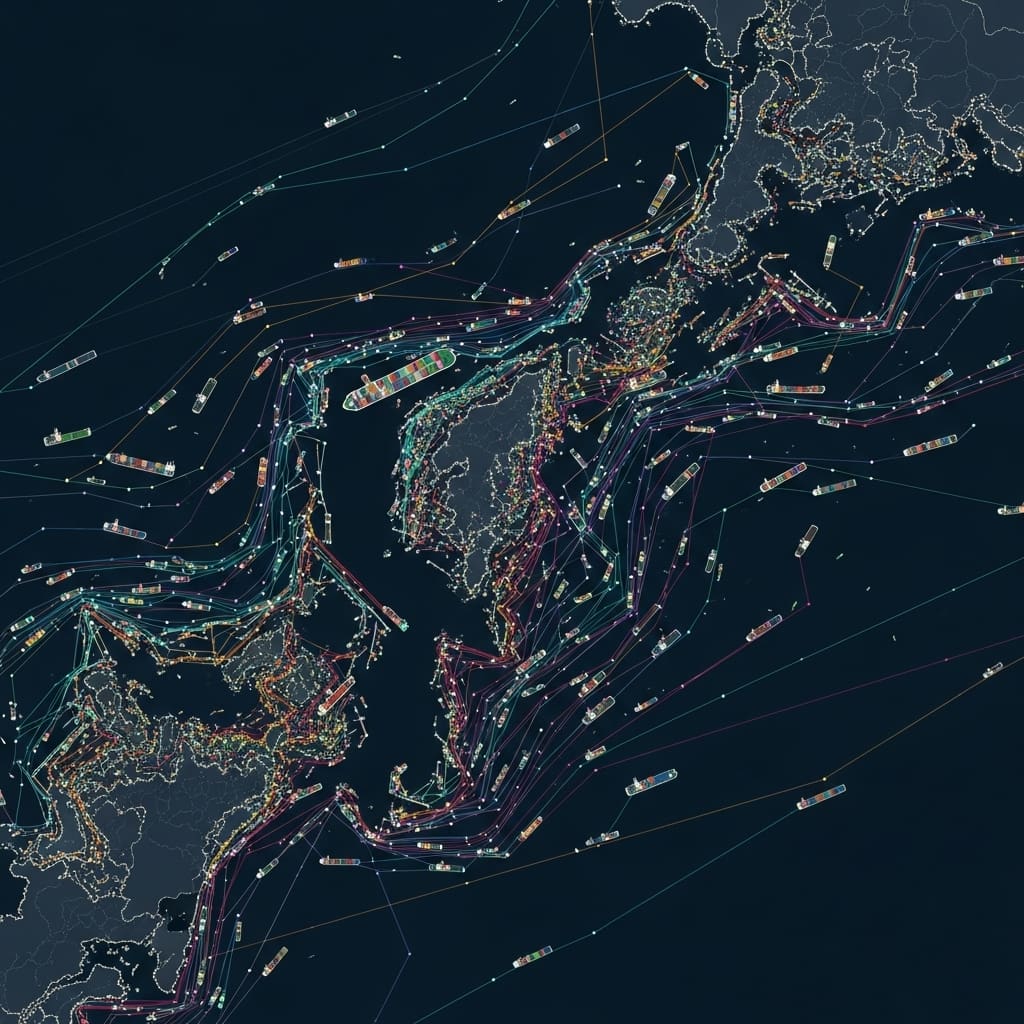
Scientists are increasingly utilising openly available Automatic Identification System (AIS) data to understand vessel activity and port dynamics, offering valuable insights for economic monitoring and maritime management. Moritz Hütten from GRID Inc, alongside colleagues, present a high-resolution map of vessel movements within Tokyo Bay, Japan, analysing three months of data from 2024. Their work demonstrates the potential of open-access AIS to accurately reconstruct port activity , identifying 161 active berths , with a precision comparable to official statistics. This research is significant because it reveals an accelerating trend towards fewer, larger vessels operating in the bay and, uniquely, shows how radio signal ‘shadows’ can pinpoint the locations of AIS receiver stations in complex urban landscapes.
This innovative approach leverages the increasing availability of open-access AIS data to provide detailed insights into maritime traffic and port operations. The study establishes a clear correlation between vessel size and traffic patterns, offering valuable data for port authorities and shipping operators to optimise logistical planning and infrastructure development. This detailed analysis of vessel movements provides a robust foundation for understanding the evolving dynamics of maritime trade in the region.
Furthermore, the research unveils a novel method for localising passive AIS receiver stations in dense urban environments by analysing radio shadows within the vessel data. These shadows, created by tall buildings obstructing signal transmission, provide crucial information about receiver locations, enhancing the accuracy of vessel tracking and data analysis. The team achieved precise localisation of these stations, demonstrating the potential for improved maritime surveillance and safety measures. This breakthrough reveals a previously untapped resource within existing AIS data, offering a cost-effective solution for expanding and refining maritime monitoring networks. The work opens new avenues for monitoring economic trends, supporting decision-making for shipping and port operators, and improving overall maritime safety. By accurately mapping vessel traffic and berth activity, this research provides a valuable tool for optimising port efficiency and resource allocation.
AIS Data Reconstruction of Tokyo Bay Vessels reveals
The study harnessed open-access data spanning 91 days, from 29 July to 27 October 2024, collecting 6,881,633 position-report messages from AIS-A vessels operating within a 1344 km2 region of interest. Researchers maintained an uninterrupted subscription to the aisstream. io data stream, capturing messages with one-second timestamp precision, latitude and longitude to six decimal places, MMSI numbers, and reported speed over ground. The work employed a defined region of interest, demarcated by lines connecting lighthouses, Tsurugisaki and Susaki for the outer bay, and Ashikashima and Myogane Cape for the northern limit. This spatial definition excluded river traffic and Tateyama Bay activity, focusing analysis solely on vessels within Tokyo Bay itself. Data processing involved filtering for position reports from moving vessels, identified by a navigational status of zero, and static data from 3325 unique Maritime Mobile Service Identity (MMSI) numbers. By analysing areas of signal occlusion between vessels and receivers, scientists reconstructed receiver positions in the dense urban environment, demonstrating a novel application of AIS data.
Tokyo Bay vessel activity mapped with AIS shows
Measurements confirm these vessels had an average gross tonnage of 23,783. The study meticulously tracked vessel movements, establishing a comprehensive dataset of maritime activity within a densely populated urban region. Data shows the team collected a total of 6,881,633 position-report messages from AIS-A vessels during the 91-day monitoring period. These messages, stored with one-second timestamp precision, included latitude, longitude, MMSI number, and speed over ground, enabling detailed reconstruction of vessel trajectories. Analysis of message distribution in space and time, as illustrated in accompanying figures, revealed patterns of vessel concentration and temporal fluctuations in activity.
The team also observed that radio shadows in the vessel data could reveal the precise locations of inherently passive receiver stations. Furthermore, the work identified that these radio shadows, caused by signal occlusion from buildings, can be used for the reconstruction of AIS receiver positions. The study provides recent estimates of vessel activity in Tokyo Bay, alongside assessments of their uncertainties, by comparison to historical data. Results demonstrate the potential for utilising readily accessible AIS data to enhance maritime domain awareness and support informed decision-making for port authorities and shipping operators. The breakthrough delivers a cost-effective and high-resolution method for monitoring vessel traffic and infrastructure utilisation.
Tokyo Bay vessel traffic from AIS data
Analysing data from August to October 2024, researchers achieved 30-metre spatial resolution and approximately one-minute temporal precision in mapping vessel movements. This research confirms that open-access AIS data, including contributions from amateur radio operators, can provide insights comparable to governmental and proprietary sources. The developed algorithm is adaptable across various spatial scales and incorporates a density-thresholding approach for identifying ports, anchorages, and berths. Authors acknowledge limitations related to underestimation of activity due to unaccounted vessels and suggest future analyses incorporate data from AIS-B vessels and Synthetic Aperture Radar (SAR) observations. Furthermore, they note that cellphone data could offer another avenue for monitoring vessel activity.
👉 More information
🗞 High-Resolution Mapping of Port Dynamics from Open-Access AIS Data in Tokyo Bay
🧠 ArXiv: https://arxiv.org/abs/2601.20211