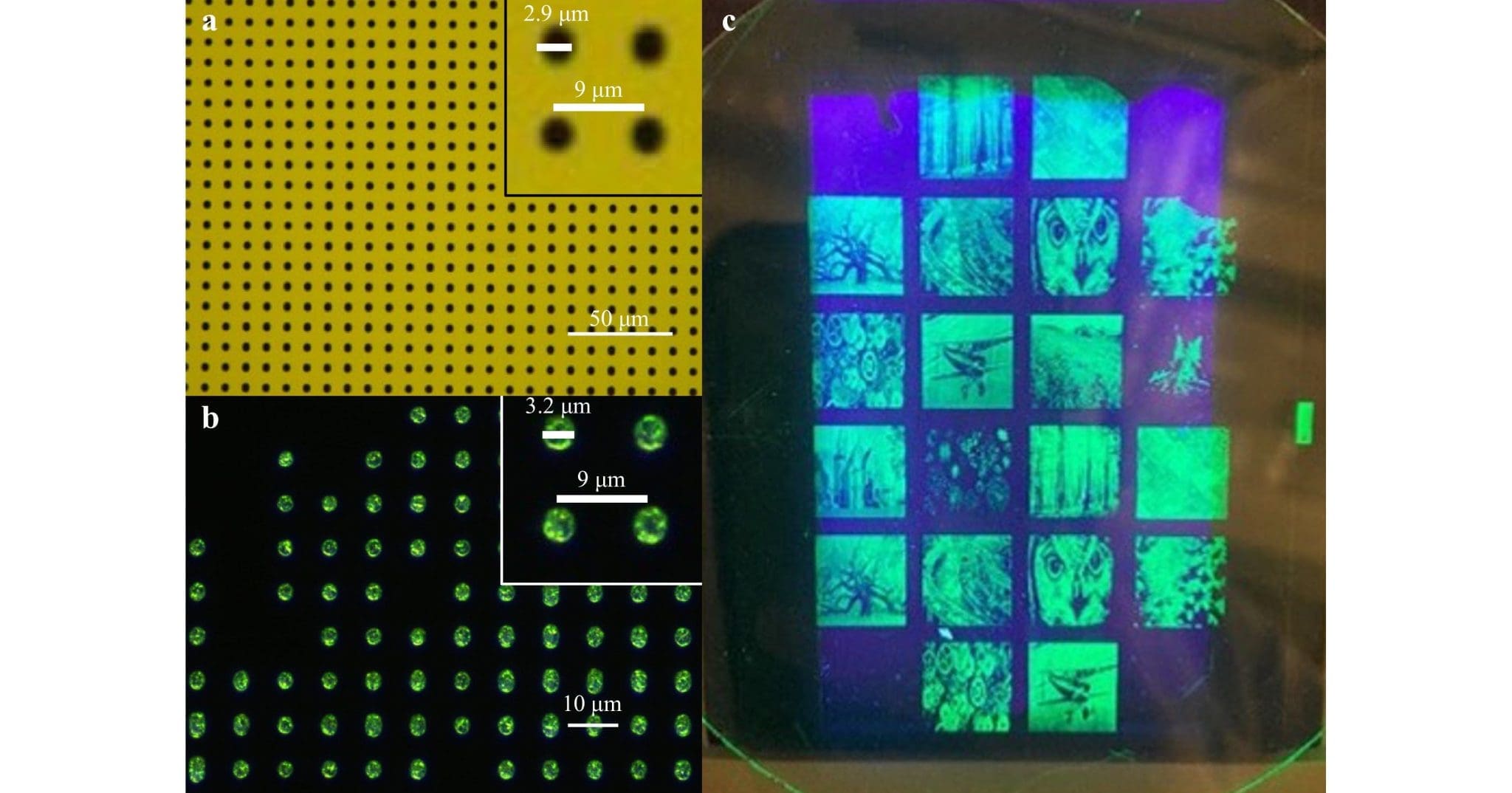
The research presents a novel high-resolution photolithographic method for patterning quantum dot (QD) color converter thin films using parylene as an intermediate layer. This innovative approach enables precise dry lift-off of unwanted QDs without the need for solvents, thereby preserving their optical properties and ensuring high performance. The technique achieves pattern resolutions close to 1 micrometer, demonstrating compatibility with various QD types, such as green perovskite and red CdSe/ZnS quantum dots. This versatile method holds significant potential for applications in display technologies and optoelectronic devices, offering a scalable and efficient solution for integrating high-quality QDs into advanced materials systems.
The integration of photolithographic techniques utilizing perylene as an intermediate material presents a promising avenue for advancements in semiconductor manufacturing. This method employs a dry lift-off procedure, minimizing solvent use and contamination, and achieves a resolution of approximately 1 micrometer. Such precision is particularly beneficial for applications in displays and sensors, where exact patterns are crucial.
This technique supports both single-colour and multi-colour variants in quantum dots. Quantum dots, known for their ability to emit light at specific wavelengths when excited, offer enhanced color accuracy and efficiency in displays. The use of InP as a less toxic alternative to cadmium-based quantum dots underscores environmental and safety considerations, aligning with current trends towards sustainable materials.
Scalability remains a challenge, especially in roll-to-roll processes, which are pivotal for producing flexible electronics. However, successful adaptation could lead to cost-effective manufacturing of quantum dot displays or sensors. Ensuring long-term stability under real-world conditions is critical, as degradation from heat, light, or moisture can compromise product longevity.
Transitioning to quantum computing, the article highlights the potential of leveraging principles like superposition and entanglement. These phenomena enable qubits to perform complex computations beyond classical capabilities. While companies like IBM and Google have increased qubit counts, challenges such as high error rates and decoherence persist. Research focuses on improving coherence times and developing robust error correction methods.
Quantum supremacy, demonstrated for specific tasks, signifies a niche advantage but broader applications await refinement. Potential uses in optimization, cryptography, and materials science are notable, though widespread adoption is hindered by the need for specialized infrastructure and expertise.
The article emphasizes the importance of collaboration between academia, industry, and government to address technical barriers and unlock quantum computing’s full potential. This synergistic approach not only advances manufacturing techniques but also paves the way for transformative technologies across various sectors.
More information
DOI: https://doi.org/10.37188/lam.2025.015