

The pursuit of efficient thermoelectric materials, capable of converting heat directly into electrical energy and vice versa, receives considerable attention due to potential applications in waste heat recovery and solid-state refrigeration. Recent research focuses on materials exhibiting low-dimensional electronic behaviour within a three-dimensional crystalline structure, a characteristic that can enhance electrical conductivity and reduce thermal conductivity. Øven A. Grimenes, from the Department of Mechanical Engineering and Technology Management at the Norwegian University of Life Sciences, Ole M. Løvvik of SINTEF Sustainable Energy Technology, and Kristian Berland, also from the Norwegian University of Life Sciences, investigate this phenomenon in the full-Heusler compound NaTlSb. Their work, detailed in the article ‘Exceptional thermoelectric properties in Na TlSb enabled by quasi-1D band structure’, utilises first-principles calculations to demonstrate that despite a high density of electronic states, scattering rates remain surprisingly low. This is attributed to the unique interplay of delocalised energy surfaces, effective screening from free carriers, and the preservation of electron velocity, ultimately predicting a thermoelectric figure of merit reaching 4.4 at 600 K, a promising result for future energy technologies.
Na₂TlSb attracts increasing attention as a potential material for waste heat recovery and solid-state energy conversion, prompting detailed investigations into its electronic properties. Recent research focuses on understanding the mechanisms governing electron transport within this compound, revealing surprisingly low scattering rates despite a high density of states and carrier velocities, establishing a strong foundation for predicting its thermoelectric potential.
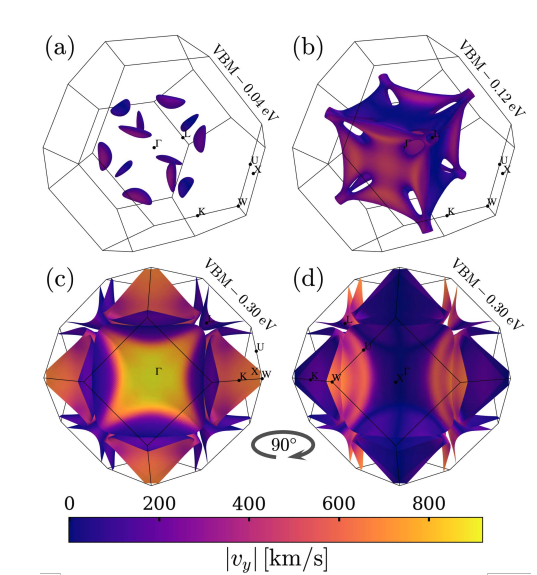
Na₂TlSb exhibits an intriguing combination of electronic characteristics reminiscent of lower-dimensional systems, due to its unique band structure. This structure features intersecting two-dimensional pockets forming a box-like valence band, promising favourable properties for thermoelectric applications. A high density of states (DOS), which represents the number of available energy states for electrons, and high carrier velocities are desirable, but the potential for increased electronic scattering necessitates a detailed understanding of the underlying transport mechanisms.
The observed low scattering rates arise from a
The observed low scattering rates arise from a complex interplay of factors governing electron transport. Researchers meticulously examine the role of delocalized energy isosurfaces, which facilitate large momentum scattering paths while simultaneously reducing wavefunction overlap, thereby lowering the probability of scattering events. Furthermore, the material exhibits substantial free-carrier screening, effectively mitigating the impact of scattering. A significant portion of scattering occurs within the flat regions of the energy isosurfaces, preserving a nearly constant electron group velocity and minimising effective relaxation rates. Consequently, Na₂TlSb achieves high carrier mobility, a crucial factor for efficient thermoelectric performance, and these findings build upon previously reported ultra-low thermal conductivity values. Thermal conductivity refers to a material’s ability to conduct heat, and lower values are desirable for thermoelectric applications to maintain a temperature difference.
Calculations demonstrate that Na₂TlSb exhibits a thermoelectric figure of merit (zT) ranging from 2.4 at 300 K to a peak of 4.4 at 600 K, suggesting it represents a promising candidate for efficient energy conversion applications. The figure of merit, zT, is a dimensionless number that quantifies the efficiency of a thermoelectric material; higher values indicate better performance. Detailed analysis supports these conclusions, including calculations of free-carrier screening, deformation potentials, and the impact of excluding screening effects, confirming the intricate relationship between the material’s band structure, scattering mechanisms, and ultimately, its thermoelectric potential. Deformation potential describes the change in energy levels due to lattice distortion, influencing scattering rates.
This combination yields a high carrier mobility, a key characteristic for efficient charge transport, and the observed high mobility, coupled with the material’s high DOS and a beneficial DOS profile, results in excellent electron transport properties.
Future research will focus on optimizing the material’s
Future research will focus on optimizing the material’s composition and microstructure to further enhance its thermoelectric performance. Scientists plan to explore different doping strategies and nanostructuring techniques to reduce thermal conductivity and increase the power factor, which is proportional to the square of the Seebeck coefficient and electrical conductivity. They also intend to investigate the long-term stability and reliability of Na₂TlSb-based thermoelectric devices under various operating conditions. The ultimate goal is to develop a cost-effective and environmentally friendly thermoelectric generator that can efficiently convert waste heat into electricity. This work represents a significant step towards realizing the full potential of thermoelectric materials for sustainable energy applications, and the findings pave the way for the development of next-generation thermoelectric devices with improved performance and durability.
🗞 Exceptional thermoelectric properties in Na TlSb enabled by quasi-1D band structure
🧠 DOI: https://doi.org/10.48550/arXiv.2506.22167


