Quantum detector tomography is a technique that characterizes the measurement process in quantum mechanics. It aims to reconstruct Positive Operator Valued Measures (POVMs) by mapping the detector response to a complete set of input states. High-performance computing (HPC) can assist in quantum tomography tasks by developing open-source customized algorithms, enabling quantum tomography on a large-scale quantum photonic detector. The future of quantum detector tomography lies in its ability to reconstruct quantum objects up to a system size of 10^12 elements, enabling the reconstruction of large-scale quantum sources, processes, and detectors used in computation and sampling tasks.
What is Quantum Detector Tomography and What Is It Important?
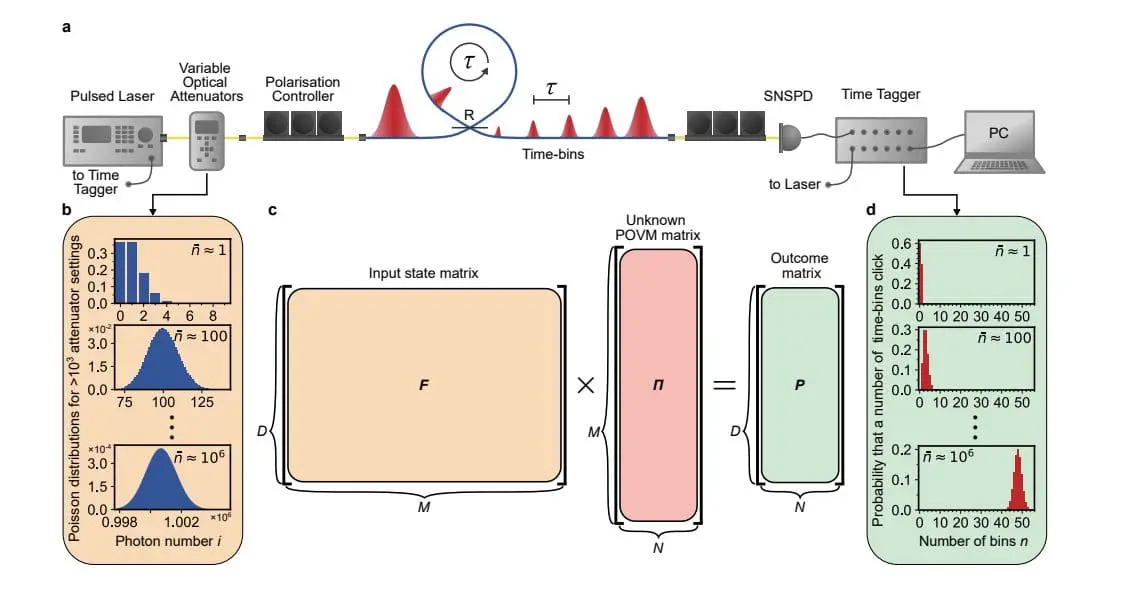
Quantum detector tomography is a technique that provides a consistent quantum mechanical characterization of the measurement process. This approach to characterizing experiments is particularly attractive as it offers a model-free method to connect the underlying quantum mechanics of systems to the measurement results we observe. The aim of a tomography experiment is to reconstruct the set of Positive Operator Valued Measures (POVMs) by mapping the detector response to a tomographically complete set of input states, i.e., the set of input states that span the full outcome space of the detector.
The size of the problem is governed by the dimensionality of the Hilbert space occupied by the set of input states and the number of outcomes. In order to be tomographically complete, the Hilbert space spanned by the input states is necessarily at least as large as the outcome space. In general, the size of the set of POVMs is then M^2N for non-phase sensitive detectors this reduces to MN. The challenge is thus to devise techniques to reconstruct POVMs covering ever larger system sizes to enable state-of-the-art quantum optics experiments.
Up to now, almost all detector tomography experiments have described detectors with few outcomes (N<10) covering a relatively small Hilbert space (M<100), where approaches such as semidefinite programming and maximum likelihood estimation could be readily applied with standard computing hardware. Alternatively, data pattern tomography can be used to characterize a relevant subset of the detector’s outcome space.
How Can High-Performance Computing Assist in Quantum Tomography Tasks?
High-performance computing (HPC) is a well-established field which has great potential to assist in quantum tomography tasks, provided the benefits of parallelization can be reconciled with the constraints imposed by the quantum mechanical objects to be reconstructed. By developing open-source customized algorithms using high-performance computing, quantum tomography on a mega-scale quantum photonic detector covering a Hilbert space of 10^6 can be performed.
This requires finding 10^8 elements of the matrix corresponding to the positive operator valued measure (POVM), the quantum description of the detector, and is achieved in minutes of computation time. Moreover, by exploiting the structure of the problem, highly efficient parallel scaling can be achieved, paving the way for quantum objects up to a system size of 10^12 elements to be reconstructed using this method.
More recently, numerical approaches using convex optimization solvers have been pursued to interrogate larger system sizes. This approach has been applied to high-performance computing hardware, as investigated by Liu et al., using simulated data. Their results suggested an upper limit of system size MN of the order 10^5 based on available computational resources.
What are the Practical Limits of Quantum Detector Tomography?
While classical computational approaches cannot perform like-for-like computations of quantum systems beyond a certain scale, classical high-performance computing may nevertheless be useful for precisely these characterization and certification tasks. However, just because the computational complexity class suggests that the problem is easy for a classical computer, still the question arises what the practical limits of this approach are.
In the case of phase-sensitive detectors, the size of the matrix required to map the Hilbert space dimension M becomes M^2, significantly increasing the computational resource requirements. In this context, the largest tomographic reconstruction to date has been performed on a phase-sensitive photon counter, requiring the reconstruction of 18*10^6 elements.
What is the Future of Quantum Detector Tomography?
The future of quantum detector tomography lies in the ability to reconstruct quantum objects up to a system size of 10^12 elements. This shows that a consistent quantum mechanical description of quantum phenomena is applicable at everyday scales. More concretely, this enables the reconstruction of large-scale quantum sources, processes, and detectors used in computation and sampling tasks, which may be necessary to prove their non-classical character or quantum computational advantage.
Photonic quantum computing paradigms are built around large-scale generation, manipulation, and measurement of quantum light. At sufficient scale, the computations these devices perform cannot be verified by conventional computing. Therefore, techniques such as quantum tomography are used to characterize the device and verify its underlying quantum mechanical structure without performing the full Boson sampling task.
In conclusion, the development of scalable quantum detector tomography by high-performance computing is a significant advancement in the field of quantum mechanics. It not only provides a consistent quantum mechanical characterization of the measurement process but also paves the way for the reconstruction of large-scale quantum sources, processes, and detectors used in computation and sampling tasks.
Publication Date: 2024-04-03
Authors: Timon Schapeler, Robert Schade, Michael Lass, Christian Plessl, et al.
Source: arXiv (Cornell University)
DOI: https://doi.org/10.48550/arxiv.2404.02844