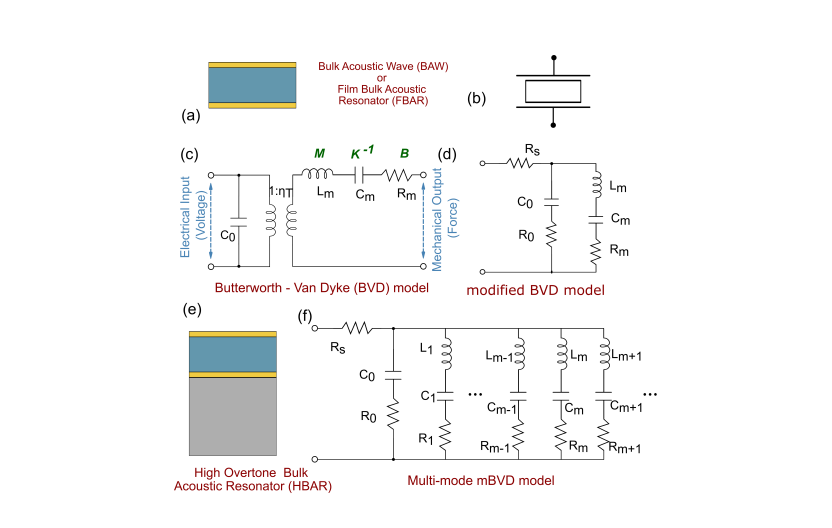
High overtone bulk acoustic resonators (HBARs) offer exceptional performance in radio frequency applications, but accurately modelling their complex behaviour has remained a significant challenge for researchers. Vikrant J. Gokhale and Brian P. Downey, from the US Naval Research Laboratory, now present a comprehensive equivalent circuit model that overcomes these limitations. Their model uniquely incorporates the physical components of an HBAR, including the piezoelectric transducer and substrate, and critically, accounts for imperfections at the interface between them, which influence the resonator’s response. The team demonstrates the model’s power by simultaneously fitting measured data from 61 modes of a GaN/NbN/sapphire HBAR, extracting key parameters with high accuracy, and establishing a scalable framework for future designs of advanced oscillators, filters, and integrated circuits.
Quantum Acoustics For New Physics Searches
Scientists are exploring the potential of high overtone bulk acoustic resonators (HBARs) as sensitive detectors for new physics, pushing the boundaries of precision measurement. These devices, known for their numerous sharp resonance modes across a wide frequency range, offer a unique platform for searching for subtle signals beyond the Standard Model of particle physics. Researchers are developing innovative methods to model and characterize HBARs, improving their ability to detect extremely weak interactions and explore previously inaccessible phenomena. A key challenge in utilizing HBARs lies in accurately modeling their complex behavior, traditionally requiring significant computational resources.
Scientists have now developed a new equivalent circuit model that comprehensively characterizes HBARs, capturing the interplay between the piezoelectric transducer, substrate, and the crucial interface between them. This model uses a combination of fixed, periodic, and constrained virtual lumped-element branches, minimizing complexity while retaining a clear link to the physical device. The team successfully demonstrated the model’s validity by simultaneously fitting measured data from 61 modes of a GaN/NbN/sapphire HBAR spanning a 1GHz range, accurately extracting parameters such as quality factors and coupling coefficients. This compact and scalable model can easily incorporate multiple transducer overtones, distinct transducers, and spurious modes, offering a versatile framework for analyzing complex HBAR-based devices.
Researchers have also extended the model to accommodate multiple transducers on the same substrate, enabling broader operating envelopes and the integration of transducers with differing materials. Further advancements include incorporating higher-order transducer modes, recognizing that piezoelectric transducers, like other resonators, possess overtones. By utilizing higher envelopes at higher frequencies, the HBAR cavity operates in a regime where phonon loss scales favorably with both frequency and cooling, potentially benefiting applications like quantum acoustics. This work delivers a powerful tool for designing classical HBAR-based oscillators, filters, and integrating HBARs into complex circuits, paving the way for more efficient and insightful HBAR design and analysis.
Compact HBAR Model Captures Multimode Behavior
Scientists have developed a new equivalent circuit model for high overtone bulk acoustic resonators (HBARs), devices exhibiting numerous sharp resonance modes across a wide frequency range. This work addresses the challenge of accurately modeling the complex behavior of HBARs, traditionally requiring extensive computational resources. The team successfully fitted measured data from 61 modes of a GaN/NbN/sapphire HBAR spanning a 1GHz range, simultaneously extracting key modal parameters including quality factors and coupling coefficients. The breakthrough lies in a compact model that retains clear links to the physical components of the HBAR: the piezoelectric transducer, the substrate acting as a multimode cavity, piezoelectric coupling, and the crucial interface between transducer and substrate.
By strategically using fixed, periodic, or constrained virtual lumped-element branches, the model minimizes complexity while accurately representing the device’s characteristics. This approach allows for scalable modeling, easily accommodating multiple transducer overtones, distinct transducers, and spurious modes within the same framework. Experiments demonstrate the model’s ability to analyze various perturbations to the HBAR’s normal operating state, highlighting its versatility for design and analysis. The new model provides a foundation for fitting large datasets, and is well-suited for integration with advanced computational techniques, including physics-informed machine learning. This achievement delivers a powerful tool for designing classical HBAR-based oscillators, filters, and integrating HBARs into complex circuits. The model’s compact form and physical basis offer significant advantages over existing methods, paving the way for more efficient and insightful HBAR design and analysis.
Compact HBAR Model Fits 61 Resonance Modes
Scientists have developed a new equivalent circuit model for high overtone bulk acoustic resonators (HBARs), devices exhibiting numerous sharp resonance modes across a wide frequency range. The model accurately represents the physical components of the HBAR, including the piezoelectric transducer, substrate, and the interface between them, while also addressing the inherent imperfections that influence the resonance spectrum. Researchers successfully demonstrated the model’s validity by simultaneously fitting measured data from 61 modes of a GaN/NbN/sapphire HBAR spanning a 1GHz range, extracting key parameters such as quality factors and coupling coefficients. The resulting model is both compact and scalable, leveraging internal relationships within the HBAR to accommodate multiple transducer overtones, distinct transducers, and spurious modes.
Beyond fitting existing data, the model facilitates analysis of various perturbations to the HBAR’s operating state, offering a versatile tool for device design and circuit integration. While acknowledging some uncertainty in separating individual circuit element values, the team highlights the model’s ability to accurately represent overall device loss. Future work intends to combine this model with deep learning techniques to improve data fitting, parameter extraction, and analysis of large datasets.
👉 More information
🗞 A comprehensive equivalent circuit model for high overtone bulk acoustic resonators (HBARs)
🧠 ArXiv: https://arxiv.org/abs/2509.21640