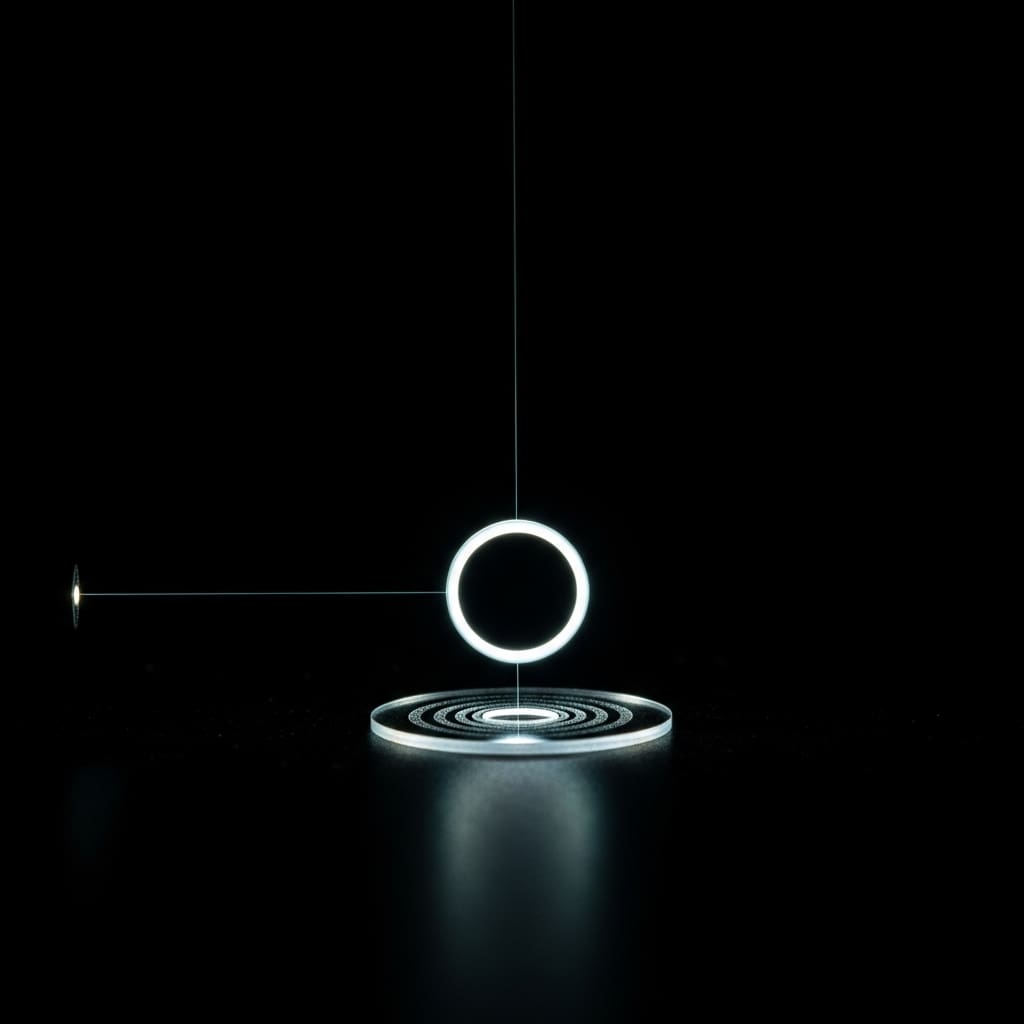
Harnessing light’s unique properties allows scientists to manipulate matter with increasing precision, and a new technique promises enhanced control over light beams for a range of applications. Brijesh Kumar Mishra, from the Central University of Rajasthan, and colleagues demonstrate a method for creating hollow light beams using specifically shaped cylindrical vector beams, effectively producing a ring of light with a dark centre. This approach utilises a combination of lenses and diffractive elements to redistribute beam energy, offering control over the beam’s width and maintaining a consistent dark core even when focused with different lenses. The ability to create such beams, which avoid intense central light, significantly improves possibilities for particle or atom trapping, precise ablation, and advanced optical applications like information encoding, ultimately leading to enhanced contrast and resolution in various scientific fields.
This is achieved using radially polarized light and an amplitude mask, allowing the width of the bright ring to be tuned while maintaining a constant size for the dark core, regardless of the focusing lens used. These beams are valuable for applications like optical trapping and microscopy, where a central region free of intense light is beneficial. The technique relies on manipulating the amplitude of light with a specialized mask and utilizing the unique properties of radially polarized light, a type of cylindrical vector beam.
By considering the full wave nature of light, rather than simplified approximations, the team accurately modeled beam behavior, particularly with high numerical aperture lenses. This approach enables precise control over the beam’s characteristics and potential applications. The most significant finding is the stable dark core size, which remains unchanged despite variations in the focusing lens’s numerical aperture. This stability is crucial for consistent optical trapping and imaging. Furthermore, the width of the surrounding bright ring can be adjusted, providing control over the beam’s focusing characteristics and the strength of the trapping potential.
This versatile amplitude mask functions effectively across a range of numerical apertures. Potential applications for these hollow beams include optical trapping of microscopic particles, manipulation of cold atoms, improved contrast in microscopy, and potentially even optical communication and laser material processing. This research presents a valuable tool for a variety of optical applications, offering a robust and controllable method for generating hollow beams.
Hollow Beam Generation via Vector Diffraction
Researchers have created a new method for generating hollow beams using higher-order cylindrical vector modes, systematically varying the radial index while maintaining a fixed azimuthal index. This technique works effectively with both radial and azimuthal polarization, offering flexibility in experimental design. The team combined a focusing lens with a computer-generated hologram, an amplitude mask with alternating opaque and transparent regions, to sculpt the light beam. The study utilized vector diffraction theory to analyze how the amplitude mask redistributes beam energy, creating the desired hollow beam profile.
This approach enables precise control over the beam width and maintains a uniform dark core size, even when focusing the beam through lenses with varying numerical apertures and across different modes. The width of the high-intensity ring can be tuned by adjusting the numerical aperture of the focusing lens, providing a dynamic control parameter. Experiments demonstrate the method’s suitability for advanced optical manipulation, including trapping particles or atoms while minimizing exposure to intense central light. This capability improves image contrast and resolution, facilitates localized ablation or heating, and enables the guidance of atoms with reduced thermal effects. The technique also holds potential for advanced optical communications and sensing, establishing a robust platform for generating hollow beams with unprecedented control and precision.
Hollow Laser Beams via Diffractive Optics
Scientists have developed a new method for generating hollow laser beams, characterized by a dark central region surrounded by a bright ring of light, using higher-order cylindrical vector modes. The research team created these beams by varying the radial index of the light while maintaining a fixed azimuthal index, demonstrating that the method functions identically with both radial and azimuthal polarization. This innovative approach utilizes a focusing lens combined with a specially designed diffractive element, a hologram containing alternating opaque and transparent regions, to redistribute beam energy and form the hollow structure. Experiments revealed that the dark core size of these hollow beams remains consistently stable throughout the beam cross section and across all modes investigated, confirming the effectiveness of the amplitude modulation in preserving the hollow-beam structure.
However, the width of the high-intensity ring is dependent on the numerical aperture of the focusing lens, decreasing as the numerical aperture increases. This breakthrough delivers precise control over the beam width and intensity distribution, enabling tunable hollow intensity distributions and opening possibilities for applications such as particle and atom trapping, ring-shaped ablation, and advanced information encoding. This work demonstrates a robust and versatile technique for manipulating light with potential in diverse fields including microscopy, optical communication, and laser material processing.
Hollow Beams Independent of Lens Aperture
This research presents a novel method for creating hollow beams, characterized by a central region of zero intensity surrounded by a bright ring, using high-order radially polarised beams and a specially designed amplitude mask. The team successfully demonstrated that this technique generates hollow beams with controllable ring widths and a consistently sized dark core, irrespective of the numerical aperture of the focusing lens. This independence from numerical aperture represents a significant advancement, allowing for stable hollow beam formation across a range of optical systems. The results demonstrate precise control over the spatial intensity distribution of cylindrical vector beams, offering potential benefits for diverse applications including optical trapping, cold atom manipulation, microscopy, and laser material processing. While the method’s performance relies on accurate fabrication of the amplitude mask, future work could explore its application in more complex optical systems and with different types of particles or atoms. This work establishes a robust and versatile approach to hollow beam generation, paving the way for improved contrast and resolution in imaging, and more efficient manipulation of microscopic objects.
👉 More information
🗞 Generation of hallow vector beam by high-order cylindrical vector beams
🧠 ArXiv: https://arxiv.org/abs/2512.21057