
A team of scientists has proposed and implemented a scheme to prepare a ‘magic state’ on a superconducting qubit array using error correction. This is a fundamental principle of fault-tolerant quantum computing. The scheme produces better magic states than those that can be prepared using the individual qubits of the device. The yield of magic states can be increased using adaptive circuits, which change depending on the outcome of mid-circuit measurements. This could reduce the number of physical qubits needed in large-scale quantum-computing architectures.
“We can complete a universal set of logic gates by producing special resources called magic states. It is therefore important to produce high-fidelity magic states to conduct algorithms while introducing a minimal amount of noise to the computation.”
Authors – Riddhi S. Gupta et al
Magic State Encoding for Quantum Computing
Quantum computing requires error-correcting codes to perform a fundamental set of operations, known as logic gates while isolating the encoded information from noise. A universal set of logic gates can be completed by producing special resources called magic states. The production of high-fidelity magic states is crucial for conducting algorithms while introducing a minimal amount of noise to the computation.
Quantum magic states are a crucial concept in quantum computing, particularly in the context of fault-tolerant quantum computation. They are specialized quantum states that enable certain quantum computations to be performed more efficiently and reliably than would be possible using only the standard set of quantum gates.
New Scheme for Magic State Preparation
A team of researchers, including Riddhi S. Gupta, Neereja Sundaresan, Thomas Alexander, Christopher J. Wood, Seth T. Merkel, Michael B. Healy, Marius Hillenbrand, Tomas Jochym-O’Connor, James R. Wootton, Theodore J. Yoder, Andrew W. Cross, Maika Takita & Benjamin J. Brown, have proposed and implemented a scheme to prepare a magic state on a superconducting qubit array using error correction. Published in Nature, The scheme produces better magic states than those that can be prepared using the individual qubits of the device. This demonstrates a fundamental principle of fault-tolerant quantum computing, namely, that error correction can be used to improve the quality of logic gates with noisy qubits.
The researchers also showed that the yield of magic states can be increased using adaptive circuits, in which the circuit elements are changed depending on the outcome of mid-circuit measurements. This demonstrates an essential capability needed for many error-correction subroutines. The prototype developed by the team is expected to be invaluable in the future as it can reduce the number of physical qubits needed to produce high-fidelity magic states in large-scale quantum-computing architectures.
Magic State Distillation
The researchers distilled magic states to complete a universal set of fault-tolerant logic gates needed for large-scale quantum computing with low-density parity-check code architectures. High-fidelity magic states are produced by processing noisy input magic states with fault-tolerant distillation circuits. It is expected that a considerable number of the qubits of a quantum computer will be occupied performing magic-state distillation schemes and, as such, it is valuable to find ways of reducing its cost.
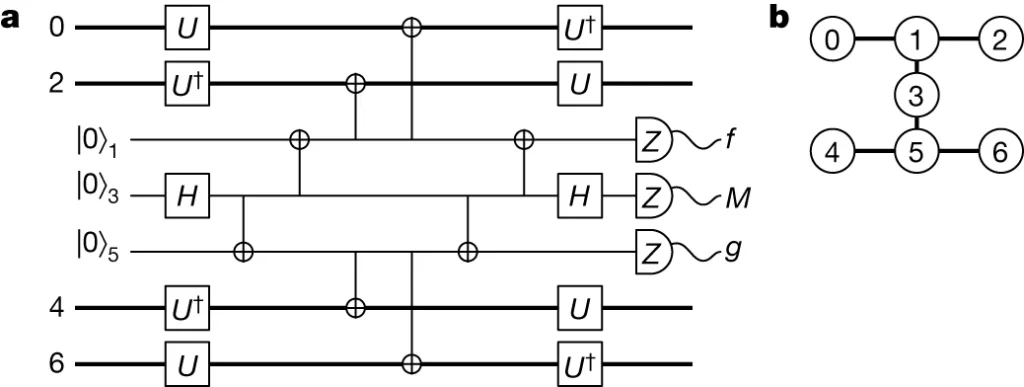
The team proposed and implemented an error-suppressed encoding circuit to prepare a state that is input to magic-state distillation using a heavy-hexagonal lattice of superconducting qubits. The circuit prepares an input magic state, which they call a CZ state, encoded on a four-qubit error-detecting code. The circuit is capable of detecting any single error during state preparation, as such, the infidelity of the encoded state is suppressed.
Logical Tomography and Magic-State Preparation
The researchers prepared the CZ state encoded on a distance-2 error-detecting code, in which the distinct bit strings label orthogonal computational basis states over two qubits. They presented a sequence of measurements that prepare the input magic state and, in tandem, identify a single error that may have occurred during the preparation procedure. As they can detect a single error, they expect the infidelity of the output state to be suppressed.
“We find that our scheme produces better magic states than those that can be prepared using the individual qubits of the device. This demonstrates a fundamental principle of fault-tolerant quantum computing, namely, that we can use error correction to improve the quality of logic gates with noisy qubits.”
Authors – Riddhi S. Gupta et al
Quick Summary
Scientists have proposed and implemented a scheme to prepare a ‘magic state’ on a superconducting qubit array using error correction, which is crucial for running large-scale algorithms on a quantum computer. This method not only improves the quality of logic gates with noisy qubits, but also increases the yield of magic states using adaptive circuits, potentially reducing the number of physical qubits needed in large-scale quantum-computing architectures.
- A team of researchers, including Riddhi S. Gupta, Neereja Sundaresan, Thomas Alexander, Christopher J. Wood, Seth T. Merkel, Michael B. Healy, Marius Hillenbrand, Tomas Jochym-O’Connor, James R. Wootton, Theodore J. Yoder, Andrew W. Cross, Maika Takita & Benjamin J. Brown, have proposed and implemented a scheme to prepare a ‘magic state’ on a superconducting qubit array using error correction.
- This scheme is crucial for large-scale quantum computing as it allows for the performance of a fundamental set of operations, called logic gates while minimising the introduction of noise to the computation.
- The team’s scheme produces better magic states than those that can be prepared using the individual qubits of the device, demonstrating a fundamental principle of fault-tolerant quantum computing.
- The researchers also showed that the yield of magic states can be increased using adaptive circuits, where the circuit elements are changed depending on the outcome of mid-circuit measurements.
- This work is significant as it can reduce the number of physical qubits needed to produce high-fidelity magic states in large-scale quantum-computing architectures.
“We believe that our prototype will be invaluable in the future as it can reduce the number of physical qubits needed to produce high-fidelity magic states in large-scale quantum-computing architectures.”
Authors – Riddhi S. Gupta et al