

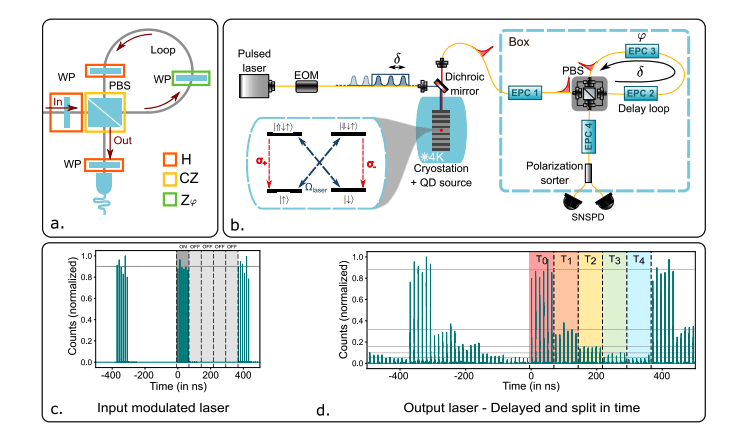
Photonic linear cluster states are pivotal in advancing quantum computing and communication, offering a robust framework for entanglement distribution. A collaborative effort led by Daniel Valentin Guichard, Leonid Vidro, Dario A. Fioretto, and colleagues from institutions including the Centre for Nanosciences and Nanotechnologies CNRS in France and the Racah Institute of Physics in Israel has made significant strides in this field. Their research, titled Monitoring the generation of photonic linear cluster states with partial measurements, presents a novel approach utilizing a resource-efficient optical circuit integrated with a quantum memory.
This setup employs single-photon sources derived from semiconductor quantum dots, enabling scalable entanglement generation. The team’s innovative method incorporates real-time control through partial measurements, enhancing the practicality of measurement-based quantum computing. Their findings demonstrate successful entanglement at various rates, underscoring the scalability and efficiency of their approach, thus advancing the potential for practical quantum technologies.
The experiment combines HOM interference with higher-order correlations to study multi-photon entanglement. The experiment investigates multi-photon entanglement by combining Hong-Ou-Mandel (HOM) interference with higher-order correlation measurements and partial post-selection.
Using the HOM effect and delay loops, entangled states were created via post-selected measurements. The experiment employs the Hong-Ou-Mandel (HOM) effect, a quantum interference phenomenon where two indistinguishable photons entering a beam splitter simultaneously exit together in one output port. Achieving a high HOM visibility of 82.7%, the setup demonstrates strong control over photon states and apparatus. This precision is critical for studying entanglement, as it ensures reliable interference effects necessary for detecting quantum correlations.
The experiment uses delay loops to manipulate photons’ paths to create entangled states, enabling precise temporal control. Post-selection is applied to discard unwanted output configurations, ensuring only relevant entangled states are analyzed. This method enhances the reliability of entanglement verification by focusing on specific outcomes that meet predefined criteria. Partial post-selection is particularly effective in handling photon loss in a 3-photon setup, maintaining the integrity of entanglement detection despite potential losses.
The high HOM visibility underscores the experiment’s robust control over interference effects, a key factor in creating and detecting entangled states. The use of partial post-selection demonstrates an effective strategy for maintaining experimental integrity in complex setups with potential photon loss. These methodological choices not only enhance the reliability of entanglement detection but also provide insights into optimizing quantum state verification techniques for future research.
The HOM effect achieves 82.7% entanglement via loop-delay.
The Hong-Ou-Mandel (HOM) effect plays a crucial role in quantum phenomena, particularly in creating entangled states through a loop-delay setup. This setup ensures that two photons arrive simultaneously at a beam splitter, facilitating the HOM effect and resulting in a characteristic dip in coincidence counts when their delay is zero.
In this context, the loop-delay setup involves delaying one photon’s path using an optical delay line, achieving high visibility of 82.7%. This demonstrates effective control over timing and phase, essential for precise quantum state manipulation. The creation of entangled states leverages post-selection to discard unsuccessful outcomes, enhancing the quality of the resulting states by focusing on specific configurations.
Multi-photon measurements are conducted using a six-photon observable involving Xφ and Z measurements, which relate to polarization states and phase shifts. These observables influence interference patterns, with varying φ affecting expected outcomes and suggesting its role in quantum state manipulation. Post-selection patterns, as illustrated in figures S3, highlight scenarios such as photon loss or successful entanglement in both 2-photon and 3-photon setups.
Key findings underscore the HOM effect’s role in creating entangled states through controlled interference and the importance of post-selection in maintaining experimental fidelity. The complex observables influenced by phase shifts warrant further study to fully understand their implications.
The progress of the HOM experiment points to scalable quantum technologies.
The Hong-Ou-Mandel (HOM) experiment successfully demonstrated multi-photon entanglement with a HOM visibility of 82.7%, indicating successful quantum optical interference despite minor imperfections likely due to timing inaccuracies or polarization mismatches. The use of electro-optic modulators and a delay loop setup ensured precise photon control, crucial for achieving simultaneous arrival at the beam splitter.
The experiment measured multi-photon observables, revealing entanglement through coherent behavior, though lower visibility in complex observables suggested potential noise or inefficiencies in the photon source. Post-selection enhanced confidence in observed correlations by filtering specific outcomes, despite reducing overall visibility due to discarded patterns and possible photon losses.
Future work could focus on improving photon source efficiency, reducing noise, and optimizing phase modulation with EOMs. These advancements aim to enhance visibility in complex observables and scalability towards practical quantum technologies like teleportation and secure communication.
🗞 Monitoring the generation of photonic linear cluster states with partial measurements
🧠 DOI: https://doi.org/10.48550/arXiv.2505.01929


