

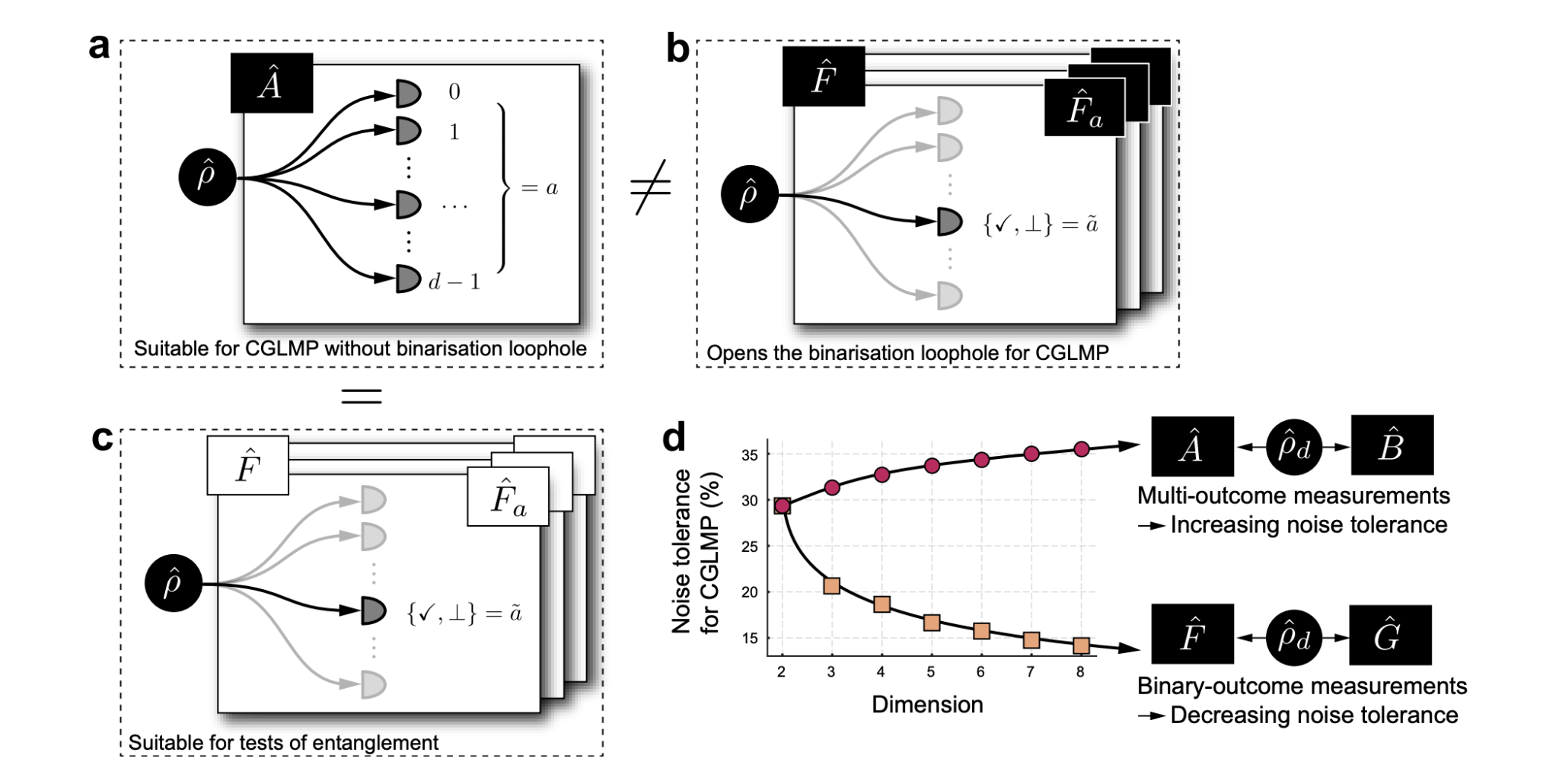
The fundamental principles underpinning quantum mechanics permit correlations between particles that defy classical explanation, a phenomenon known as nonlocality. Demonstrating this nonlocality requires rigorous tests, often utilising Bell inequalities, but extending these tests to complex, high-dimensional quantum systems presents significant experimental challenges. A key difficulty lies in performing measurements that genuinely probe multiple outcomes simultaneously, avoiding what is termed the ‘binarisation loophole’ where seemingly multi-outcome measurements are, in effect, combinations of simpler, binary choices. Researchers from Heriot-Watt University and Paderborn University, alongside colleagues at Lund University, now report a method to circumvent this limitation, utilising the joint spectral intensity of entangled photons. In their article, Observing High-dimensional Nonlocality using Multi-Outcome Spectral Measurements, Kiki Dekkers, Laura Serino, Nicola D’Alessandro, Abhinandan Bhattacharjee, Benjamin Brecht, Armin Tavakoli, Christine Silberhorn and Jonathan Leach detail how they successfully violate a specific Bell inequality, the CGLMP inequality, up to dimension eight, effectively closing the binarisation loophole and simplifying the requirements for future quantum communication protocols.
Novel Methodology Addresses High-Dimensional Measurement Loopholes
Researchers report a novel methodology for rigorously testing Bell inequalities, a cornerstone of quantum mechanics, in complex, high-dimensional quantum systems. The work addresses a persistent challenge known as the binarization loophole, which arises when high-dimensional quantum states are measured using only binary, or two-valued, outcomes. This simplification can falsely suggest quantum non-locality, even if it does not genuinely exist. The binarization loophole represents a significant obstacle to definitively proving the existence of quantum phenomena that cannot be explained by classical physics.
Violating the CGLMP Inequality in Higher Quantum Dimensions
The team demonstrates the violation of the Collins, Gisin, Linden, Massar, and Popescu (CGLMP) inequality, a specific type of Bell inequality, up to dimension eight. Dimension in this context refers to the number of distinct quantum states that can be distinguished in a measurement. The CGLMP inequality is particularly sensitive to loopholes arising from limited measurement choices. Researchers achieve this by analysing the joint spectral intensity of entangled photons, a measure of the correlation between the photons’ quantum states.
The experimental results yield a very low p-value of 1.35 x 10⁻³⁴, providing strong statistical evidence supporting the existence of quantum non-locality. A low p-value indicates a very small probability that the observed results occurred by chance, strengthening the conclusion that quantum effects are genuinely present. Interestingly, the study reveals that increasing the number of measurement settings beyond two does not substantially improve the observed violation of the inequality. This suggests a practical limit to the benefit of increasing experimental complexity, and offers a pathway to simplifying the implementation of high-dimensional quantum protocols.
Significance for Quantum Cryptography and Computing Future
This new approach represents a significant advancement in the field, removing a key technological barrier to the development and testing of high-dimensional quantum systems. These systems are crucial for applications such as quantum cryptography and quantum computing, where the ability to encode and process information in multiple dimensions offers substantial advantages.
👉 More information
🗞 Observing High-dimensional Nonlocality using Multi-Outcome Spectral Measurements
🧠 DOI: https://doi.org/10.48550/arXiv.2506.20796


