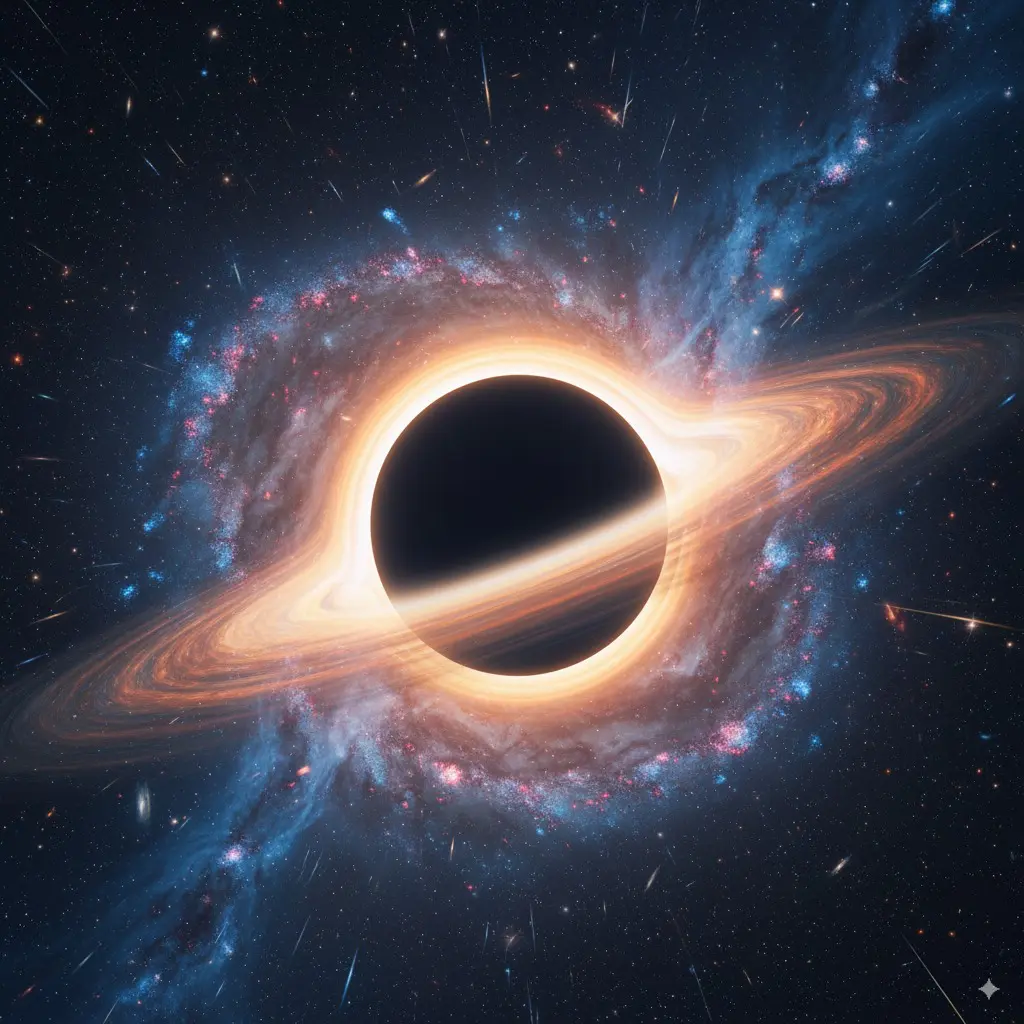
The nature of spacetime within black holes represents a fundamental challenge to modern physics, and a new theoretical framework proposes a surprising role for the Higgs field in resolving this puzzle. Itzhak Bars from the University of Southern California leads research suggesting that the Higgs field, typically considered a minor component of the universe, actually governs the interior spacetime of black holes. This work demonstrates that in regions of extreme gravity, the Higgs field behaves in a radically different way than previously thought, dynamically extending spacetime beyond the point of singularity and preventing the complete breakdown of physics. By incorporating a refined interplay between the Standard Model and General Relativity, this approach not only offers a potential solution to the black hole puzzle but also opens new avenues for understanding the very early universe and the fundamental forces that govern it.
This extension, dominated by antigravity effects, reshapes the structure of spacetime and allows for new pathways for matter and information. The combined framework of the Standard Model and General Relativity typically fails to account for these phenomena due to its inherent geodesic incompleteness, but a refined, locally conformal-symmetric formulation, denoted i(SM+GR), naturally incorporates these effects.
Two-Time Physics and Spacetime Restructuring
This research presents a novel cosmological model unifying gravity, antigravity, black hole physics, and quantum information theory. The foundation is the concept of two-time physics, proposing spacetime is described by two time coordinates, fundamentally restructuring the relationship between time and space to resolve singularities and create a universe without boundaries. The model emphasizes local scale invariance and conformal symmetry, linking this to the Higgs field’s role in generating mass, suggesting the Higgs field isn’t just a mechanism for mass generation, but a fundamental architect of spacetime itself.
Unlike standard cosmology, this model treats antigravity as a real physical phenomenon, a natural consequence of two-time physics and spacetime geometry, particularly within black holes. The goal is a mathematically and physically complete universe, without singularities or boundaries, achieved through two-time physics and the inclusion of antigravity, resolving the black hole information paradox by proposing information isn’t lost, but transferred to other regions of spacetime, including antigravity sectors within black holes.
The model proposes the Higgs field is a fundamental component of spacetime geometry, determining its curvature and topology. Introducing a second time coordinate alters the mathematical description of spacetime, allowing for the resolution of singularities and the inclusion of antigravity. The interior of a black hole isn’t a singularity, but a region where antigravity becomes dominant, creating an antigravity sector, containing an Anti-de Sitter (AdS) space, suggesting a deep connection between black holes, holography, and quantum gravity.
Drawing on the ER=EPR conjecture, entanglement plays a crucial role in connecting different regions of spacetime, including the interiors of black holes. The author invokes Weyl geometry to describe the spacetime structure and incorporate the antigravity sectors, utilizing mathematical tools to describe the dynamics of spacetime and interactions between fields.
The model provides a mechanism for preserving information that falls into a black hole, transferring it to antigravity sectors through entanglement, upholding the principle of unitarity in quantum mechanics. It predicts observable effects on astrophysical phenomena, such as galactic rotation curves and gravitational lensing, potentially testable through observations, and is consistent with cyclic cosmology, suggesting deviations in spacetime curvature could explain the observed effects attributed to dark matter and dark energy.
This is a highly ambitious and speculative paper attempting to address fundamental problems in physics, including the nature of gravity, resolving singularities, and preserving information. Its strengths include novelty, a mathematically rigorous framework, consistency with theoretical concepts like conformal symmetry and holography, and testable predictions, but it relies on unproven assumptions and currently lacks empirical evidence. Overall, this paper represents a significant contribution to theoretical physics, offering a novel approach to solving challenging problems in our understanding of the universe.
Higgs Field Dynamically Resolves Spacetime Singularities
Scientists have developed a refined theoretical framework, denoted i(SM+GR), that addresses fundamental limitations within the standard model of particle physics combined with general relativity. This new approach proposes a profoundly different behavior for the Higgs field in regions of extreme gravity, such as those near black holes or at the very beginning of the universe, playing a dynamic role in shaping spacetime itself, potentially resolving the issue of geodesic incompleteness.
By incorporating this dynamic interplay between the Higgs field and spacetime, the framework achieves geodesic completeness, extending spacetime beyond singularities, allowing for the possibility of traversing singularities and predicting the existence of antigravity effects, reshaping the causal structure of spacetime and enabling new pathways for matter and information. The model suggests a cyclic universe scenario, driven by the dynamics of the Higgs field, with an infinite sequence of big crunches and big bangs separated by brief antigravity phases.
Analysis of the antigravity region reveals that as antigravity strength approaches its maximum, quantities related to the gravitational constant diverge, indicating a strong influence on spacetime curvature. Importantly, the framework predicts that signals originating within the visible universe can propagate both into black holes and beyond the cosmological horizon, although laboratory observers within the visible region would never witness these passages due to the diverging time required to cross the horizons.
Dynamic Gravity Resolves Singularities, Completes Spacetime
This research proposes a refinement to the standard model of particle physics combined with general relativity, denoted i(SM+GR), that addresses the issue of geodesic incompleteness, the inability to fully describe spacetime beyond singularities such as those found within black holes. The framework introduces a dynamic interplay between the Higgs field and spacetime.
🗞 The Higgs Field Governs the Interior Spacetime of Black Holes
🧠 ArXiv: https://arxiv.org/abs/2509.06800