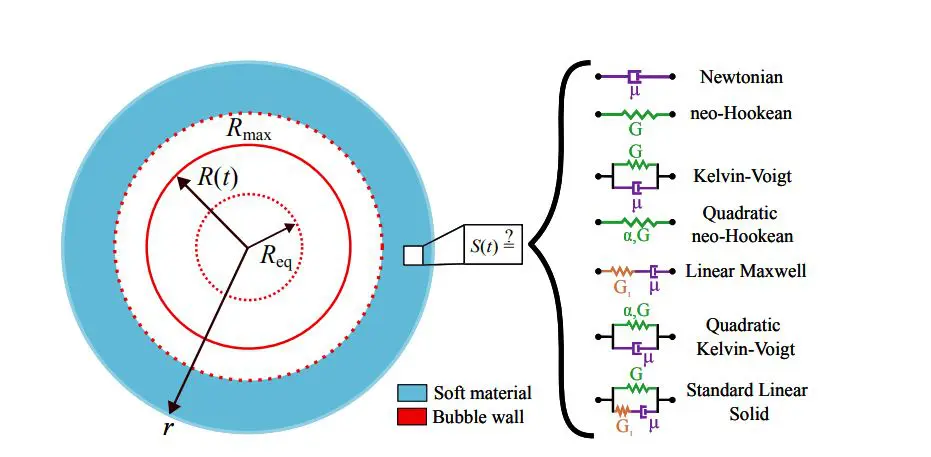
Characterising soft materials under extreme, rapid deformation is a significant challenge in both engineering and medical research, yet understanding their behaviour is crucial for designing effective technologies and simulating biological tissues. Victor Sanchez, Sawyer Remillard, and colleagues from Brown University, alongside Bachir A. Abeid from the University of Michigan, Lehu Bu, Spencer H. Bryngelson from Georgia Institute of Technology, and Jin Yang from The University of Texas at Austin, have developed a new method to overcome these limitations. Their research introduces a hierarchical Bayesian model selection technique applied to data from inertial microcavitation rheometry, a method for probing material properties at very high speeds. This approach accurately identifies the most appropriate model to describe the behaviour of these materials, while also quantifying uncertainty and favouring simpler explanations, and successfully reproduces experimental data for materials including gelatin, fibrin, polyacrylamide, and agarose, demonstrating consistent results across different laboratories.
Microbubble Dynamics Reveal Material Stiffness
This research pioneers a novel technique, Inertial Microcavitation Rheometry (IMR), for characterizing soft, tissue-like materials under extremely high strain rates, exceeding 10^3s^{-1}. The method utilizes laser-induced microbubbles within transparent hydrogels to precisely probe material properties at these extreme rates, overcoming limitations of conventional techniques. Researchers address challenges with inertial effects and signal transmission by focusing on the dynamics of these microbubbles. To overcome measurement noise and parameter uncertainty, scientists developed a sophisticated probabilistic model selection process.
This method explores a range of constitutive models to identify the most credible representation of the material during cavitation, quantifying model plausibility using a weighted Gaussian likelihood with a hierarchical noise scale. Crucially, the team implemented physically informed priors to penalize overly complex models and promote simpler, more robust solutions. A precomputed grid of simulations provides initial guesses for material parameter values, accelerating the model selection process. Synthetic tests successfully recovered expected models and parameters, and experimental data from gelatin, fibrin, polyacrylamide, and agarose demonstrated the method’s ability to reproduce observed data with credible models. Researchers addressed longstanding challenges in accurately measuring these materials by developing a hierarchical Bayesian model selection method, identifying the most credible model to describe the complex oscillations of laser-induced microcavitation bubbles within soft hydrogels. The team implemented a weighted Gaussian likelihood with a hierarchical noise scale, enabling precise quantification of uncertainty in model plausibility, and incorporated physically informed priors to favor simpler, more robust models. By utilizing a precomputed grid of simulations, the method efficiently estimates initial values for Maximum A Posteriori (MAP) material parameters, and synthetic tests successfully recovered ground-truth models and expected parameters.
Experiments using gelatin, fibrin, polyacrylamide, and agarose demonstrated that MAP simulations accurately reproduce experimental data, and a cross-institutional comparison of 10% gelatin confirmed consistent constitutive model selection. The IMR technique models bubble dynamics using the Keller, Miksis equation, coupled with equations describing energy balance and mass transfer, and utilizes a numerical resolution of 100 points inside the bubble for forward simulations. Researchers non-dimensionalized the governing equations for comparison across materials and experimental conditions. This probabilistic method offers a valuable tool for dynamic rheometry, providing interpretable parameter estimates and crucial uncertainty diagnostics for soft matter and polymer materials research.
Bayesian Model Selection for Soft Material Properties
This research presents a novel hierarchical Bayesian method for characterizing the mechanical properties of soft materials, such as hydrogels, under extremely high strain rates. By combining large-scale simulations with statistically grounded model selection, the team developed a technique that accurately identifies the most credible constitutive model from a range of possibilities, effectively addressing challenges inherent in measuring these properties. The approach utilizes physically informed priors to guide the model selection process and penalize overly complex models, ensuring a balance between accuracy and simplicity. Tests using synthetic data demonstrate the method’s ability to correctly recover the generating models and parameters, while analyses of gelatin, fibrin, polyacrylamide, and agarose confirm its effectiveness with real-world materials. Notably, a comparison of gelatin samples from different institutions yielded consistent results, highlighting the method’s reliability and transferability. This probabilistic method offers a valuable tool for dynamic rheometry, providing not only interpretable parameter estimates but also crucial uncertainty diagnostics for soft matter and polymer materials research.
🗞 Hierarchical Bayesian constitutive model selection for high-strain-rate soft material characterization
🧠 ArXiv: https://arxiv.org/abs/2511.16794