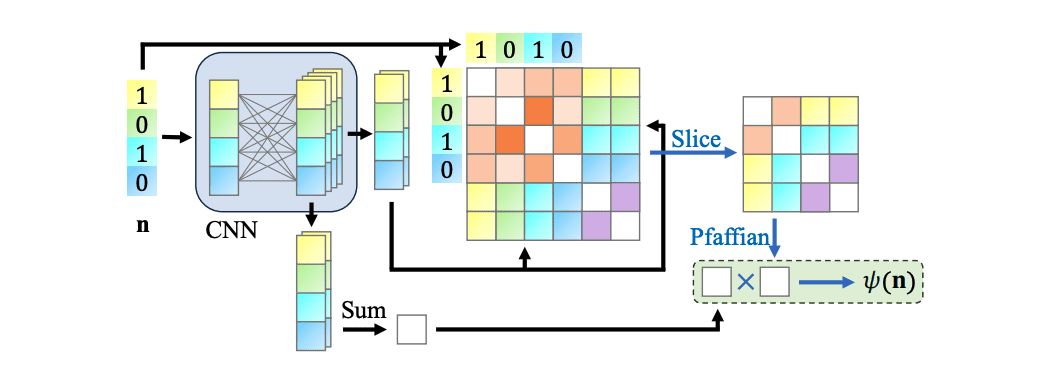
Understanding the behaviour of interacting fermions presents a significant challenge in modern physics, with implications for phenomena such as unconventional superconductivity. Ao Chen, Zhou-Quan Wan, and Anirvan Sengupta, all from the Center for Computational Quantum Physics at the Flatiron Institute, alongside colleagues including Antoine Georges from Collège de France and Christopher Roth, have developed a new approach to simulating these complex systems. Their work introduces the hidden fermion Pfaffian state, a method that uses neural networks to represent the quantum states of interacting fermions, and crucially, accurately captures the pairings essential for superconductivity. This advancement offers a scalable and highly accurate way to model both unpaired and superconducting phases, potentially unlocking new insights into materials exhibiting unconventional superconductivity and offering a powerful tool for future research in the field.
Simulating Strongly Interacting Fermions Presents Challenges
Understanding the behavior of strongly interacting fermions presents a significant challenge in modern condensed matter physics, particularly when seeking to unravel the mysteries of unconventional superconductivity. These materials exhibit remarkable properties arising from the complex interactions between electrons, often displaying subtle differences in energy that are difficult to predict. This sensitivity demands computational methods with exceptional accuracy, capable of discerning minute energy variations and reliably predicting material behavior. Current approaches to simulating these systems face considerable hurdles.
Traditional methods struggle when extended to higher dimensions, while other techniques can be limited by computational costs or inaccuracies. Recent advances have explored the use of neural networks to represent these systems, offering a more flexible and potentially unbiased approach, though applying this to fermionic systems has proven more challenging than for simpler systems. Researchers have now developed a new approach called hidden fermion Pfaffian states (HFPS), which combines the strengths of neural networks with a mathematical structure called a Pfaffian. Pfaffians are particularly well-suited for describing systems where electrons form pairs, a key characteristic of superconductivity, and can represent a broad range of quantum states.
By incorporating a neural network, the HFPS architecture gains the ability to learn complex correlations and adapt to different system parameters, offering a more expressive and versatile representation of the system’s behavior. This new method demonstrates state-of-the-art accuracy in simulating both attractive and repulsive interactions between electrons, capturing both conventional and unconventional pairing mechanisms. The HFPS architecture is designed to scale efficiently to larger systems, making it a powerful tool for exploring the rich phase diagrams of strongly correlated materials and potentially unlocking new insights into the nature of unconventional superconductivity. This advancement promises to accelerate the discovery and design of novel quantum materials with tailored properties.
Hidden Fermion Pfaffian State Improves Accuracy
Researchers have developed a new approach to modeling the behavior of strongly interacting fermions, a crucial step towards understanding complex phenomena like unconventional superconductivity. This method, termed the hidden fermion Pfaffian state (HFPS), expands upon existing techniques by incorporating ‘hidden’ degrees of freedom into the mathematical description of these particles. By effectively enlarging the space in which the particles are modeled, HFPS can capture more intricate correlations between them, leading to significantly improved accuracy. The core of HFPS lies in its representation of the system’s quantum state.
Unlike traditional methods, HFPS utilizes a Pfaffian, a mathematical function well-suited to describing paired particles, and extends it to include both visible and hidden fermions. This allows the model to represent a wider range of states, including those with unconventional superconducting pairings, and provides a flexible framework for studying systems with complex interactions. The method builds upon earlier work that successfully incorporated hidden fermions to improve the accuracy of calculations. In tests against established methods, HFPS demonstrates a substantial leap in accuracy, often surpassing previous approaches by a factor of ten or more.
This improvement is particularly notable in capturing subtle energy differences between competing phases of matter, which is essential for accurately mapping out the phase diagrams of complex materials. The researchers have successfully applied HFPS to model various phases of a fundamental model in condensed matter physics, including superconducting states, insulating states, and states with striped patterns of charge and spin density. Furthermore, HFPS exhibits promising scalability, meaning it can be applied to larger and more complex systems than many existing methods. This is achieved through a combination of efficient mathematical formulations and the exploitation of symmetries within the system. The ability to simulate larger systems is crucial for understanding materials with long-range correlations, a hallmark of unconventional superconductivity, and for ultimately designing new materials with enhanced properties. The method’s structure also allows for fast updates and leverages translational symmetry, further accelerating simulations and enabling large-scale optimization.
Hidden Fermions Model Strong Correlations and Superconductivity
Researchers have developed a new approach to modelling strongly interacting fermions, called the hidden fermion Pfaffian state (HFPS). This method expands upon existing techniques by applying concepts from Pfaffian wave-functions, which are well-suited to describing superconducting pairings, and incorporating ‘hidden’ fermions to represent complex correlations between particles. The HFPS flexibly represents both unpaired and superconducting phases, offering a versatile tool for studying a wide range of quantum materials. The HFPS demonstrates significant advantages in numerical simulations, achieving state-of-the-art accuracy in modelling the behaviour of electrons in both attractive and repulsive systems.
Importantly, the method can capture both conventional and unconventional superconducting pairings, potentially aiding the understanding of materials exhibiting exotic superconductivity. The researchers also highlight the method’s efficiency, stemming from its ability to leverage symmetries within the system and perform calculations on reduced data sets. The authors acknowledge that the current implementation relies on optimization techniques, which may not always find the absolute lowest energy state of the system. Furthermore, the method’s performance is dependent on the choice of parameters and the size of the hidden fermion space. Future work will focus on improving the optimization process and exploring the potential of HFPS to model even more complex systems, including those with strong disorder or novel pairing mechanisms.
👉 More information
🗞 Neural Network-Augmented Pfaffian Wave-functions for Scalable Simulations of Interacting Fermions
🧠 DOI: https://doi.org/10.48550/arXiv.2507.10705