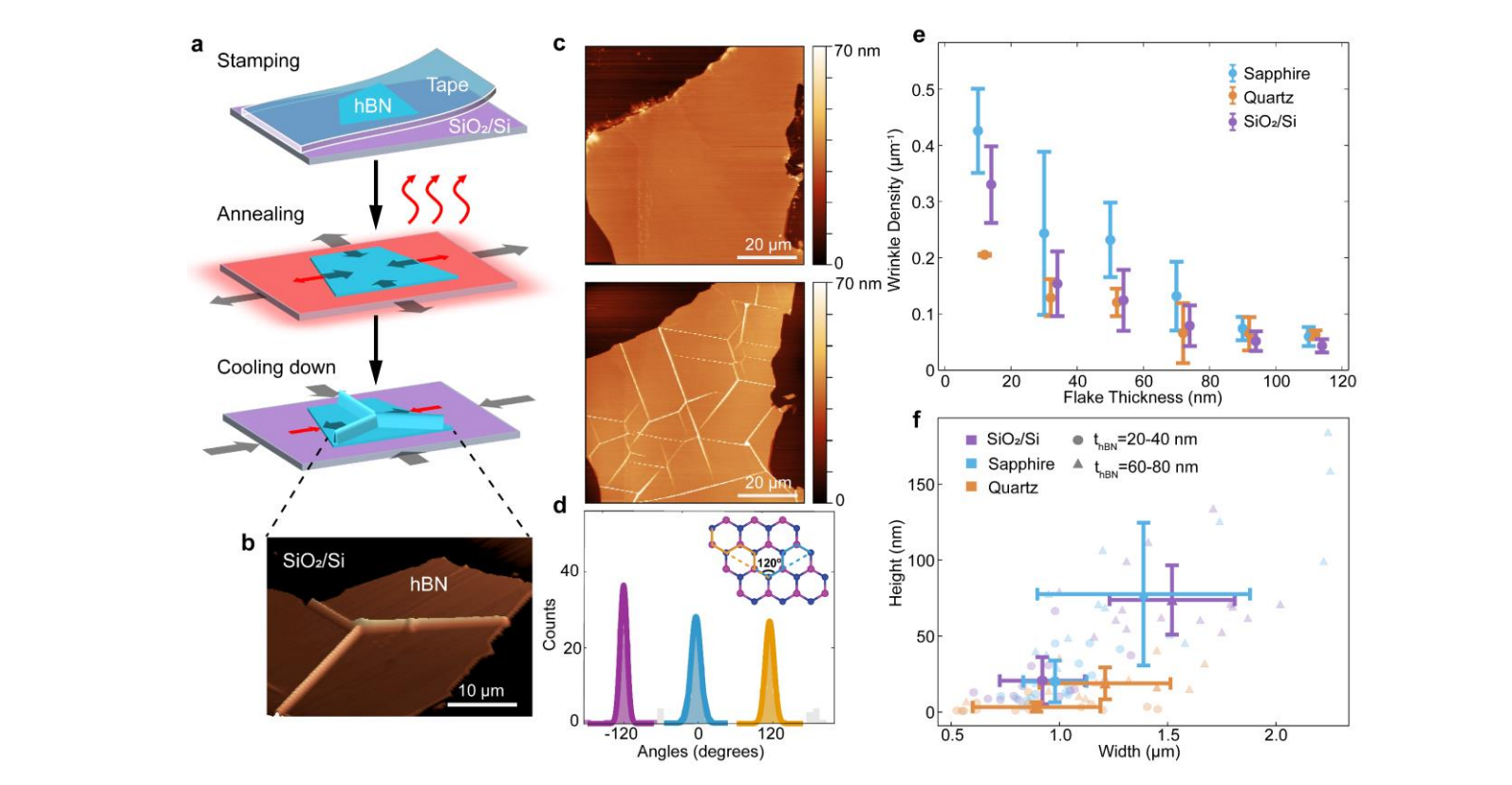
Confining biomolecules to nanoscale channels enhances imaging and sensing capabilities, yet creating these structures remains a significant challenge. Xiliang Yang, Tetsuo Martynowicz, Allard Katan, and colleagues at Delft University of Technology and the Kavli Institute of Nanoscience, working with Kenji Watanabe and Takashi Taniguchi from the National Institute for Materials Science, now demonstrate a novel approach using wrinkles formed within sheets of hexagonal boron nitride. Their research reveals that these thermally induced wrinkles self-assemble into nanochannels capable of stably confining aqueous solutions and, crucially, selectively localising and imaging single DNA molecules. This scalable, lithography-free method provides a new platform for fundamental nanobiology studies and opens exciting possibilities for developing on-chip biomolecule transport and sensing technologies by suppressing background fluorescence and extending imaging times.
HBN Wrinkles Confine and Image DNA
Scientists have successfully created nanoscale channels within hexagonal boron nitride (hBN) flakes by inducing controlled wrinkles, and are using these channels to confine and image biomolecules. By carefully controlling the heating process and flake preparation, the team achieved reproducible wrinkle networks with tunable densities and morphologies. Detailed structural characterization, combined with fluorescence and Kelvin probe force microscopy, confirms that water-based solutions remain stably contained within these nanochannels for over ten hours. Experiments demonstrate that these wrinkles function as one-dimensional confinements for biomolecules, enabling the selective localization and imaging of DNA labelled with ATTO647N.
The researchers achieved this by assembling a graphene/hBN structure, where the graphene layer acts as a quenching mask, suppressing unwanted background fluorescence from both the strained hBN regions and any DNA adsorbed on the surface. This quenching effect operates by absorbing energy, significantly reducing fluorescence intensity as molecules approach the graphene layer. The results show that these wrinkle networks can stably hold aqueous solutions for extended periods, allowing prolonged fluorescence imaging of single-stranded DNA within the nanoconfinement. The density and shape of the wrinkles correlate directly with substrate properties and hBN flake thickness, aligning with established principles of thin-film mechanics. This work provides a scalable, lithography-free method for creating planar nanofluidic confinements fully compatible with single-molecule imaging techniques, opening new possibilities for fundamental studies in nanobiology and the development of on-chip biomolecule transport and sensing applications.
Wrinkled hBN Confines and Images Single Molecules
This research demonstrates that thermally induced wrinkles within hexagonal boron nitride flakes self-assemble into nanochannels capable of confining liquids and biomolecules. Importantly, the team successfully localized and imaged single molecules of DNA within these one-dimensional channels. A graphene layer placed above the wrinkled hBN acts as a quenching mask, effectively suppressing background fluorescence and enabling clear detection of molecules confined within the nanochannels. The strain within the wrinkles not only facilitates confinement but also influences the optical properties of the hBN itself, creating opportunities for integrated optical sensing. Furthermore, the strain-engineered wrinkles provide a natural environment for the formation of light-emitting defects within the nanofluidic architecture. This wrinkle-engineered hBN platform represents a versatile approach uniting strain-tunable optical emission, stable nanofluidic confinement, and selective biomolecule detection, offering a foundation for advanced nanophotonic building blocks, multicolour nanoscale sensors, and integrated lab-on-a-chip devices.
🗞 Wrinkle-Induced Hexagonal Boron Nitride Nanochannels for Biomolecule Localization and Imaging
🧠 ArXiv: https://arxiv.org/abs/2510.26370