The intriguing physics of moiré superlattices, formed when layers of two-dimensional materials align, continues to reveal new possibilities for nanoscale electronic devices. Takuya Iwasaki, from the National Institute for Materials Science in Japan, and Yoshifumi Morita, of Gunma University, alongside their colleagues, investigate the behaviour of hexagonal boron nitride layered with bilayer graphene, demonstrating a unique energy gap that appears even without an external electric field. This research establishes that these moiré superlattices exhibit energy-band characteristics similar to other complex Dirac materials, and crucially, the team develops a method for precisely controlling both the energy gap and carrier density using a novel dual-gating technique. By systematically engineering the energy-band structure, this work highlights the versatility and broad potential of hexagonal boron nitride/bilayer graphene moiré superlattices for future electronic applications.
These structures exhibit an energy gap at the point of charge neutrality, even without an external electric field, a characteristic differing from single-layer graphene and similar to that of rhombohedral multilayer graphene. This research overcomes limitations of earlier graphene devices by encapsulating graphene between layers of hBN, effectively shielding it from environmental disturbances and ensuring clean interfaces.
HBN Encapsulation of Graphene Moiré Superlattices
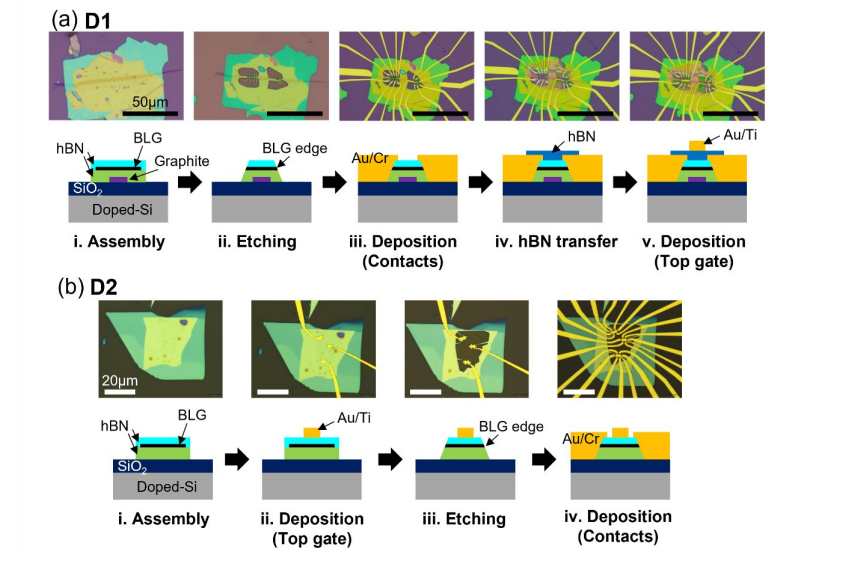
Researchers engineered a novel approach to fabricating and characterizing hBN/BLG moiré superlattices, revealing unique electronic properties at the charge neutrality point. The study employed an hBN encapsulation technique, effectively decoupling graphene from environmental influences like surface charge traps and optical phonons. This process involved layering graphene between two sheets of hBN, utilizing edge-contact methods to minimize scattering and ensure clean interfaces, and employing graphite gate structures for ultra-clean device fabrication. The team systematically investigated BLG, observing parabolic conduction and valence bands that intersect in its energy landscape.
Crucially, researchers demonstrated that applying a perpendicular electric field opens a gap at the charge neutrality point in BLG, a behavior distinct from single-layer graphene and similar to rhombohedral multilayer structures. This control over the energy gap, combined with the creation of hBN/BLG moiré superlattices, enabled systematic engineering of the energy-band structure, allowing for precise manipulation of electronic properties. To create the moiré superlattices, scientists carefully controlled the stacking angle between hBN and BLG, achieving a long-period pattern of approximately 14 nanometers when the angle approached 0°. They developed a theoretical model to accurately calculate the band structure of hBN/BLG moiré systems at arbitrary stacking angles, using a detailed representation of the arrangement of atoms within the superlattice. This detailed analysis revealed a narrow energy band featuring a van Hove singularity, and a non-trivial energy-band topology, demonstrating the potential for novel quantum phenomena.
Dual-Gated Tuning of Graphene Moiré Superlattices
Researchers have achieved precise control over the electronic properties of hBN/BLG moiré superlattices through a novel dual-gated device structure. This work demonstrates that independent tuning of both carrier density and perpendicular displacement field is possible, allowing for systematic engineering of the energy-band structure within the material. The team fabricated devices consisting of layered hBN, BLG, and graphite, employing a refined fabrication process to expose the edge of the BLG for electrical contact. This edge contact method significantly improves metal-graphene contact, minimizing resistance and enhancing device performance.
Measurements of longitudinal and Hall resistivity were conducted on these devices at low temperatures, utilizing a four-terminal method with AC lock-in techniques. The resulting data reveals a clear peak in longitudinal resistivity at a charge neutrality point, corresponding to zero carrier density, and a corresponding sign change in Hall resistivity. Further analysis identified satellite points within the moiré band at specific carrier densities, indicating the corners of the material’s mini energy landscape. The team determined that the area of the moiré unit cell is inversely proportional to the carrier density at which it is occupied by a single charge carrier. By carefully controlling the carrier density, researchers observed distinct switching behavior in both resistivity and Hall effect measurements, corresponding to the filling of the moiré unit cell with increasing numbers of charge carriers, up to a maximum of four, reflecting the energetic degeneracy of electrons’ spin and valley degrees of freedom in graphene. This precise control over the moiré superlattice structure opens new avenues for exploring novel electronic phenomena and designing advanced graphene-based devices.
Electric Field Tuning of Moire Superlattices
This research demonstrates the successful fabrication and characterization of hBN and BLG moiré superlattices, revealing unique electronic properties. The team established that these structures exhibit an energy gap at the charge neutrality point even without an applied electric field, a characteristic differing from single-layer graphene and resembling rhombohedral multilayer systems. Crucially, the application of a perpendicular electric field allows for tuning of this energy gap in the BLG moiré superlattice, offering a pathway to control its electronic behavior. The investigation highlights the non-trivial energy-band topology and narrow energy band, including a van Hove singularity, present within these moiré superlattices. By employing a dual-gated device structure, researchers achieved systematic engineering of the energy-band structure through independent control of displacement field and carrier density. The findings confirm the universality and diversity of physical phenomena occurring within hBN/BLG moiré superlattices, advancing understanding of these two-dimensional materials.
🗞 Hexagonal boron nitride/bilayer graphene moiré superlattices in the Dirac-material family: energy-band engineering and carrier doping by dual gating
🧠 ArXiv: https://arxiv.org/abs/2509.21759