The pursuit of compensated magnetic orders, capable of splitting electronic bands without generating net magnetisation, is rapidly gaining momentum within materials science. Saurav Sachin, Sujit Manna (both from the Department of Physics, Indian Institute of Technology Delhi) and Mathias S. Scheurer (Institute for Theoretical Physics III, University of Stuttgart), alongside Constantin Schrade et al., have investigated heterostructures combining Niobium with different phases of Manganese Platinum to explore this phenomenon. Their research demonstrates a significant impact on Niobium’s superconducting state, revealing a zero-field superconducting diode effect even within compensated and nearly-compensated magnetic orders, achieving efficiencies of up to 50%. This discovery is particularly noteworthy as the diode effect’s sensitivity to magnetic order provides a novel method for probing symmetry, and establishes a new pathway towards dissipationless spintronics and magnetisation-free diode functionality.
Their research demonstrates a significant impact on Niobium’s superconducting state, revealing a zero-field superconducting diode effect even within compensated and nearly-compensated magnetic orders, achieving efficiencies of up to 50%. These “altermagnets”, unlike spin-orbit coupling, exhibit splitting that isn’t a small relativistic correction and, in contrast to ferromagnets, lack net magnetization or large stray fields. Theoretical analysis of the interplay between altermagnetism and superconductivity is now central, while experimental investigations of their coexistence are still in their infancy. The researchers studied heterostructures consisting of Niobium thin films interfaced with the T1 and T2 phases of Manganese-Platinum alloy, focusing on the experimental verification of altermagnetic behaviour in Mn3Pt and its impact on the superconducting properties of adjacent Niobium layers.
The approach involved fabricating thin film heterostructures using magnetron sputtering, followed by detailed characterisation of their structural, magnetic and transport properties. Techniques such as X-ray diffraction, SQUID magnetometry, and electrical resistivity measurements were employed as a function of temperature and magnetic field. This work contributes to the growing body of knowledge surrounding altermagnetism by providing direct experimental evidence for its existence in Mn3Pt thin films, and offers insights into the proximity effects between an altermagnetic material and a conventional superconductor, potentially paving the way for the development of new superconducting devices. The observed modifications to the superconducting transition temperature and critical current density demonstrate a clear interplay between the magnetic and superconducting orders within the heterostructure.
Altermagnetism Inducing Superconducting Diode Effect
Scientists have demonstrated a zero-field superconducting diode effect in heterostructures composed of niobium (Nb) thin films interfaced with the T1 and T2 phases of manganese platinum (Mn3Pt). This breakthrough reveals a non-trivial impact of compensated and nearly-compensated magnetic order on the superconducting state of Nb, achieving diode efficiencies that reach up to 50 percent. Experiments confirm that the observed diode effect is highly sensitive to the specific form of the magnetic order, positioning it as a powerful probe of symmetry within these materials. The research team meticulously studied the complex interplay between magnetic fields, temperature, and the resulting superconducting behaviour, uncovering multiple contributing mechanisms at play.
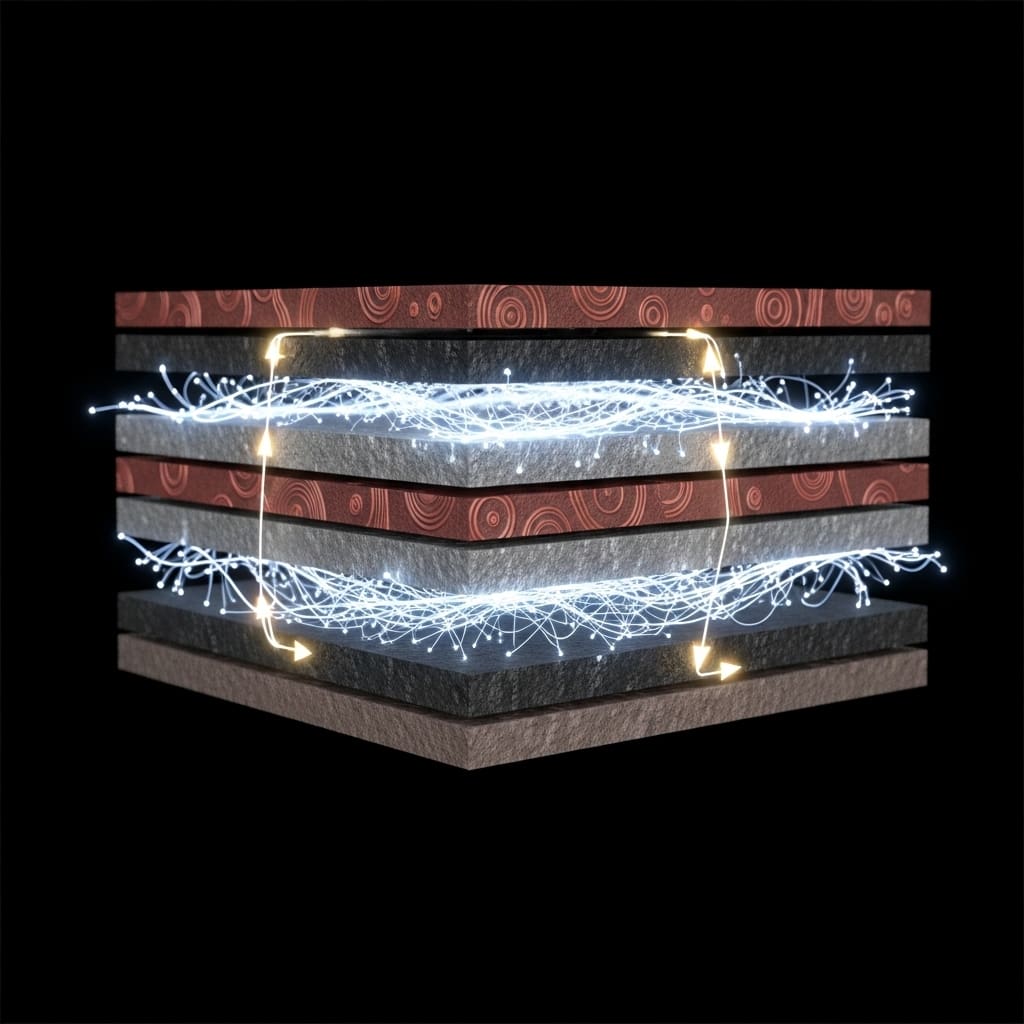
The study focused on the creation of heterostructures where superconducting Nb is proximity-coupled to the non-collinear altermagnet Mn3Pt, a material known to host energetically close T1 and T2 magnetic states. These states, characterized by spins aligned in the kagome (111) plane with a 120-degree relative angle, are nearly degenerate due to their relationship through spin rotation. Measurements reveal that the (111) surface of Mn3Pt retains a point group symmetry, C3v, while the heterostructure itself lacks symmetries protecting spin degeneracy, leading to a non-collinear altermagnetic order at the interface. This unique arrangement allows for spin splitting of electronic bands, potentially admixed with an “antialtermagnetic” component due to broken inversion symmetry.
Results demonstrate that both the T1 and T2 magnetic orders induce a superconducting diode effect, confirming the significant impact of magnetism on the proximitized superconductor. The team recorded a notably larger efficiency along the probed direction for the T1 state, and importantly, this efficiency can be substantially controlled through the application of an external magnetic field. Detailed analysis suggests that the T2 state realizes a symmetry-compensated configuration ideally suited for the diode effect, while the T1 state, exhibiting a small canting and out-of-plane magnetization, also effectively induces the phenomenon. This work establishes a new materials paradigm for dissipationless spintronics and magnetization-free diode functionality. Scientists achieved the first experimental evidence of a zero-field superconducting diode effect, opening avenues for further exploration of non-collinear altermagnetic superconductors and their potential in advanced electronic devices.
The team employed ultra-high vacuum magnetron sputtering to grow the Nb and Mn3Pt thin films on sapphire substrates, ensuring precise control over the material composition and structure. This research demonstrates a significant superconducting diode effect in heterostructures composed of niobium films interfaced with specific phases of manganese platinum. Despite the compensated and nearly-compensated magnetic order within the manganese platinum, a zero-field superconducting diode effect was observed, with efficiencies reaching up to 50%. The magnitude of this effect proved sensitive to the precise form of the magnetic order, suggesting its potential as a tool for probing magnetic symmetry.
These findings establish a novel approach to dissipationless spintronics and magnetization-free diode functionality, opening avenues for energy-efficient superconducting electronics. The authors acknowledge that the observed effect is likely influenced by vortex dynamics and magnetic fields, which could contribute to the superconducting diode effect, and further investigation is needed to fully elucidate the microscopic origins of the nonreciprocity. Future work should focus on exploring other non-collinear altermagnetic superconductors to expand understanding and refine the potential for tunable superconducting diodes.
👉 More information
🗞 Altermagnetic Superconducting Diode Effect in Mn Pt/Nb Heterostructures
🧠 ArXiv: https://arxiv.org/abs/2601.03366