The quest to understand matter under extreme pressure has revealed surprising possibilities, even for traditionally inert gases. Cong Liu, Jordi Boronat, and Claudio Cazorla, from the Physics Department and Research Center in Multiscale Science and Engineering at Universitat Politècnica de Catalunya, investigate the behaviour of helium mixed with heavier rare gases under immense pressure. Their work predicts the formation of stable compounds, including previously unknown structures, at pressures significantly lower than previously thought possible. The team’s calculations demonstrate that these mixtures can exhibit metallic and excitonic insulator phases, and even superionic behaviour where helium ions move freely through the material, offering new insights into energy transport within planetary interiors and potentially revolutionising our understanding of planetary dynamos. This research establishes that combining helium with rare gases provides a viable route to achieving exotic material states under experimentally accessible conditions, opening exciting new avenues for condensed matter physics and planetary science.
Helium Compounds Form Under Extreme Pressure
This research investigates the fascinating chemistry of helium under extreme pressure, specifically its interactions with other noble gases and the potential to form stable compounds. The study challenges the traditional understanding of helium as completely inert, revealing it can combine with other noble gases under immense pressure. Calculations predict specific crystal structures for these helium compounds, indicating a degree of stability, and explore the possibility of superionic phases where helium ions become mobile within a lattice of heavier atoms, potentially leading to interesting conductive properties. These findings have implications for understanding the interiors of giant planets like Uranus and Neptune, where helium, under immense pressure, could participate in chemical reactions and contribute to their magnetic fields and thermal properties. This work demonstrates that helium’s inertness is not absolute, and it becomes reactive under extreme pressure, enabling the formation of novel compounds with potentially significant implications for planetary science and materials science.
High-Pressure Helium-Rare Gas Compound Prediction
Scientists pioneered a comprehensive computational approach to investigate the behavior of helium and rare gas mixtures under extreme pressure, simulating conditions found within planetary interiors. The study employed crystal structure prediction methods combined with first-principles calculations to map the phase diagram of binary helium-rare gas systems up to one terapascal. Researchers systematically explored the stability of various combinations of helium with neon, argon, krypton, and xenon. Rigorous analyses confirmed the structural integrity of predicted phases and identified several previously unknown compounds stable at sub-terapascal pressures, well within the reach of modern high-pressure experiments.
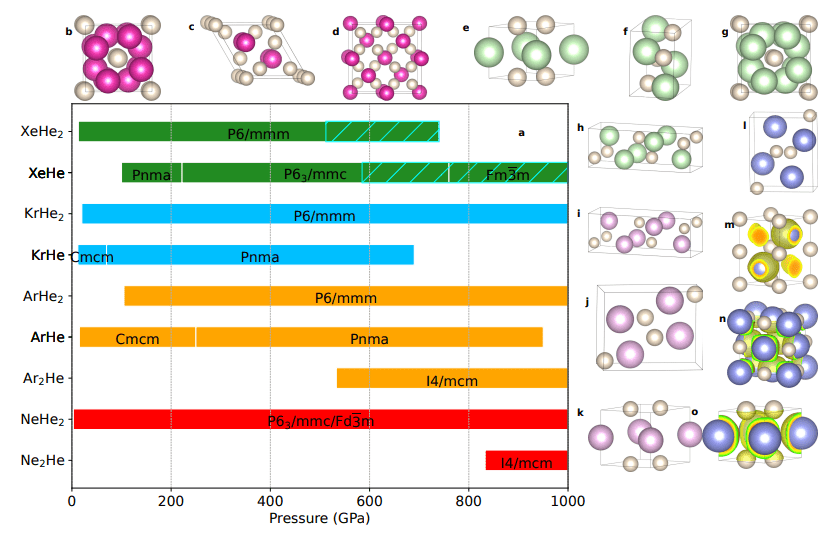
Specifically, the team discovered that compounds of helium and heavier rare gases adopt orthorhombic, hexagonal, and cubic phases that remain stable over wide pressure ranges. The study revealed that helium-xenon systems host metallic and excitonic insulator phases at pressures significantly lower than those required for pure helium, offering a pathway to realize these exotic states experimentally. Furthermore, simulations revealed superionic helium-xenon phases, where helium ions diffuse either anisotropically or isotropically depending on the host lattice. These findings represent the first prediction of helium-based systems that combine metallicity and superionicity, with profound implications for understanding energy transport and planetary dynamo processes.
New Stable Helium-Rare Gas Compounds Discovered
Scientists have mapped the phase diagram of binary helium and rare gas systems, neon, argon, krypton, and xenon, under extreme pressure, reaching up to one terapascal. This work identifies several previously unknown stable compounds, including combinations of helium with argon, krypton, or xenon, which adopt orthorhombic, hexagonal, and cubic phases. These newly discovered phases remain stable across a wide range of pressures, making them accessible to modern high-pressure experiments. The research demonstrates that helium-xenon systems host metallic and excitonic insulator phases at pressures significantly lower than those required for pure helium.
Finite-temperature simulations further reveal superionic phases in helium-xenon compounds, where helium ions diffuse either anisotropically or isotropically, confirming the existence of a mobile helium ion sublattice within the material. This work constitutes the first prediction of helium-based systems that combine metallicity and superionicity, with profound implications for energy transport and planetary dynamo processes. Specifically, the team’s calculations show that these superionic phases could significantly alter heat and charge transfer mechanisms within planetary interiors.
Helium-Rare Gas Compounds at Low Pressure
This research establishes the existence of previously unknown compounds formed between helium and heavier rare gases, stable at pressures significantly lower than those required for pure helium to exhibit similar properties. Through crystal structure prediction and first-principles calculations, scientists identified several new combinations of helium with heavier rare gases, adopting orthorhombic, hexagonal, and cubic structures over broad pressure ranges. Notably, the team discovered that helium-xenon systems can achieve metallic and excitonic insulator phases at pressures significantly lower than those predicted for pure helium. These findings represent the first theoretical prediction of metallic and superionic helium phases within inorganic mixtures, demonstrating that combining helium with heavier rare gases effectively stabilizes exotic quantum states at experimentally accessible pressures. Finite-temperature simulations further revealed superionic phases in helium-xenon compounds, where helium ions diffuse either anisotropically or isotropically, suggesting new mechanisms for energy and charge transport within planetary interiors. This work provides a foundation for future experimental investigation and has implications for understanding the thermal evolution, magnetic field generation, and internal structure of giant planets and exoplanets, as well as offering new avenues for research in condensed matter physics.
👉 More information
🗞 Stabilization of Metallic, Excitonic Insulator, and Superionic Phases in Helium-Rare Gas Compounds at Sub-Terapascal Pressures
🧠 ArXiv: https://arxiv.org/abs/2510.26626