
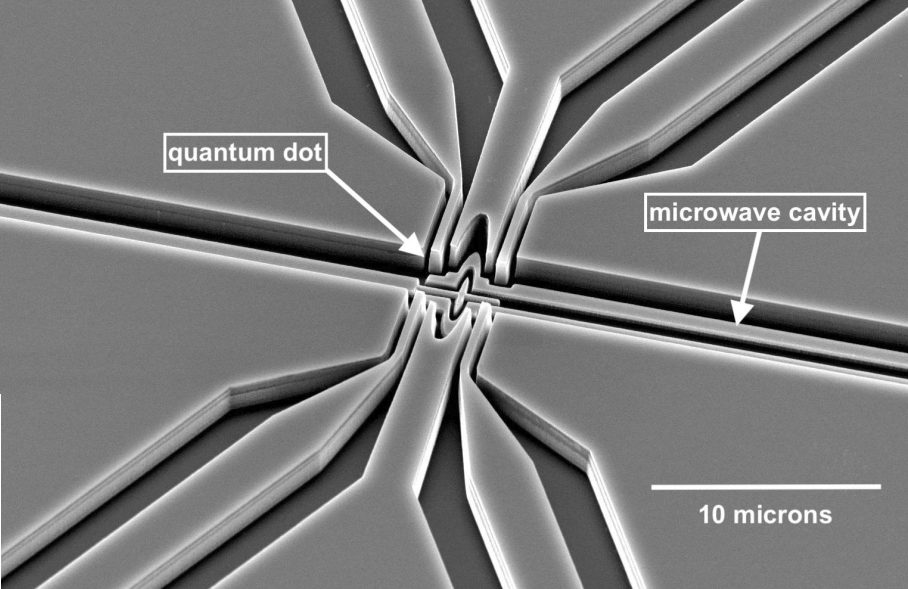
The behaviour of electrons confined to the surface of liquid helium presents a unique platform for exploring fundamental quantum phenomena, offering a comparatively defect-free environment for solid-state investigations. M. I. Dykman and J. Pollanen, alongside colleagues from the Department of Physics and Astronomy at Michigan State University, detail in their paper, ‘Electrons in quantum dots on helium: from charge qubits to synthetic color centers’, how interactions between these electrons and capillary waves – ripples – on the helium surface impact their quantum properties. Their research examines the limitations these interactions impose on the development of charge qubits, and proposes a novel approach to studying colour centres, defects in materials that exhibit distinct optical properties, by leveraging the tunable electron-ripplon coupling found in this system.
Electrons confined to the surface of liquid helium offer a uniquely pure environment for investigating two-dimensional electron systems, distinguished by the absence of material defects commonly found in solid-state materials. This purity allows researchers to study electron behaviour without the complicating influence of imperfections, and the strength of electron-electron interactions and their coupling to the helium surface can be precisely tuned through adjustments to electron density and applied electric fields. This tunability facilitates the exploration of many-body physics, including Wigner crystallisation, a state where electrons arrange themselves in a crystalline lattice due to their mutual repulsion, and unconventional magnetoconductivity, where the electrical conductivity of a material changes in response to a magnetic field in an unexpected manner.
The system’s behaviour arises from the interplay between electron-electron interactions and the coupling to capillary waves, or ripplons, which are quantum excitations of the liquid helium influencing electron dynamics. Researchers are particularly interested in how these interactions affect the potential for utilising electrons as charge qubits, the fundamental building blocks of quantum computation, and understanding the limits imposed by ripplon coupling is crucial for assessing the feasibility of helium-based quantum devices. A charge qubit encodes information in the presence or absence of an electron within a defined region.
This interaction offers a novel approach to studying analogous phenomena observed in solid-state systems, such as colour centres formed by electron defects coupled to phonons, which are quantum units of vibrational energy within a crystal lattice. The tunability distinguishes the helium system, allowing for a detailed exploration of the underlying physics, whereas in solids, the coupling strength is fixed mainly by the material properties. Electrons trapped at the surface of liquid helium present a compelling platform for realising qubits due to the spotless and controllable environment the liquid helium provides. Researchers actively investigate methods to confine these electrons within precisely defined regions, termed electrostatic dots, creating discrete energy levels analogous to atomic orbitals. These energy levels then serve as the ‘0’ and ‘1’ states of a charge qubit, with manipulation achieved through the application of electromagnetic fields.
Recent investigations highlight the significant influence of capillary waves, or ripplons, on the behaviour of these electrons, introducing a novel source of decoherence, the loss of quantum information, limiting the duration of quantum information storage. This coupling strength, however, is not merely a detrimental effect, but is tunable, offering a unique opportunity to explore and manipulate the electron-ripplon interaction, distinguishing the helium-based system from traditional solid-state ‘color centers’ which are defects in a material coupled to lattice vibrations, or phonons.
The methodological approach involves detailed spectroscopic analysis of the electron-ripplon system across a broad range of coupling strengths, with spectroscopy referring to the precise measurement of the energy levels and transitions of the electron as it interacts with the ripplons. By carefully analysing these spectra, researchers can determine the strength of the coupling and its impact on the electron’s quantum coherence, requiring sophisticated experimental techniques, including microwave resonators to manipulate and detect the electron’s state, and ultra-low temperature environments to minimise thermal noise. This ability to vary the coupling strength allows for a qualitative new approach to studying color center physics, offering insights into the fundamental interactions between electrons and bosonic excitations.
Furthermore, the research underscores the importance of understanding and mitigating decoherence mechanisms in any qubit implementation, with conventional relaxation time constraints, which limit the lifetime of the qubit state due to energy loss, being well-studied. The electron-ripplon interaction introduces a different type of decoherence, arising from the coupling to the ripplon field, necessitating the development of new theoretical models and experimental techniques to characterise and suppress this specific decoherence pathway. The findings demonstrate that careful consideration of the surrounding environment and its interactions with the qubit is crucial for realising a scalable and fault-tolerant quantum computer, and the ability to control and manipulate these interactions, as demonstrated with the electron-ripplon system, represents a significant methodological advancement in the field of quantum information processing.
Researchers employ superconducting resonators to couple to the electron qubits, facilitating control and readout of their quantum states. The article highlights the importance of minimising noise and decoherence, the loss of quantum information, to maintain qubit coherence, with current efforts concentrating on refining fabrication techniques and exploring methods for scaling up the system, aiming to create arrays of interconnected electron qubits capable of performing complex quantum computations.
This research demonstrates that electrons trapped at the surface of liquid helium present a viable, though constrained, platform for realising charge qubits, establishing a critical link between electron dynamics and the coupling to capillary waves, known as ripplons, on the helium surface. It finds that strong coupling to these ripplons imposes limitations on the parameters within which stable, functional charge qubits can operate, presenting a distinct constraint beyond conventional relaxation time considerations, and the observed electron-ripplon interaction within an electrostatic dot shares similarities with colour centres formed by electron defects coupled to phonons in solid-state materials.
However, a key distinction lies in the tunability of the coupling strength in the helium system, unlike the fixed coupling in solids, the electron-ripplon interaction can be actively varied, opening avenues for novel investigations into colour centre physics and potentially enabling new approaches to qubit control and coherence. Spectroscopic analysis reveals the behaviour of these synthetic colour centres across a broad range of coupling strengths, providing valuable insights into the fundamental physics governing electron-ripplon interactions and informing the development of strategies to mitigate their impact on qubit performance. The research highlights the importance of carefully controlling the helium environment to optimise qubit coherence and functionality, and future work should focus on developing techniques to minimise the electron-ripplon coupling, potentially through surface treatments or the application of external fields.
Investigating alternative dot geometries and materials could also prove beneficial in reducing unwanted interactions. Exploring the potential for utilising the electron-ripplon interaction as a resource for qubit manipulation and entanglement represents a promising direction for future research. Expanding the study to incorporate multiple qubits and investigating their collective behaviour is crucial for assessing the scalability of this platform, with demonstrating entanglement between multiple electrons on helium and implementing basic quantum algorithms representing significant progress towards realising a functional quantum computer based on this technology. Continued theoretical modelling and experimental validation are essential for refining our understanding of the complex interplay between electrons, ripplons, and qubit performance.
👉 More information
🗞 Electrons in quantum dots on helium: from charge qubits to synthetic color centers
🧠 DOI: https://doi.org/10.48550/arXiv.2507.04159