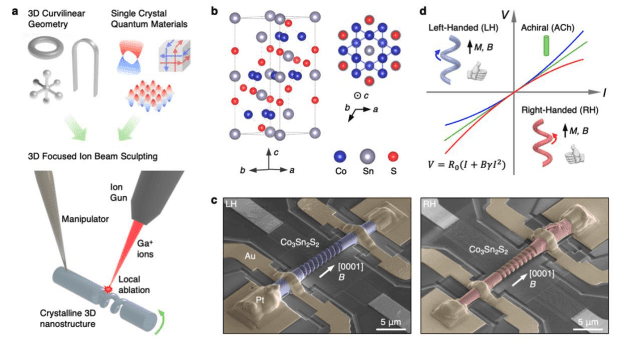
Researchers fabricate helical nanostructures from the magnetic Weyl semimetal Co₃Sn₂S₂, demonstrating nonreciprocal electron transport and a substantial, reversible diode effect without an applied magnetic field. This enhancement arises from quasi-ballistic transport and asymmetrical scattering, also enabling current-induced magnetisation switching.
The manipulation of electron flow without external magnetic fields represents a significant challenge in materials science, with potential applications ranging from more efficient electronics to novel data storage. Researchers are now demonstrating a method to achieve this through precise three-dimensional nanostructuring of materials exhibiting specific electronic properties. A collaborative team, comprising Max T. Birch, Yukako Fujishiro, Ilya Belopolski, and colleagues from RIKEN’s Center for Emergent Matter Science, alongside Masataka Mogi from The University of Tokyo, report their findings in a study titled ‘Nanosculpted 3D helices of a magnetic Weyl semimetal with switchable nonreciprocity’. They detail the fabrication of helical nanostructures from the magnetic Weyl semimetal Co3Sn2S2, a material characterised by its unique electronic band structure and high electron mobility. This precise sculpting induces a non-reciprocal electron transport, meaning electrons flow more easily in one direction than another, and crucially, exhibits a substantial diode effect even without an applied magnetic field, a phenomenon attributed to quasi-ballistic transport and asymmetrical scattering within the nanostructure. Furthermore, the team demonstrates the reverse effect, utilising current to switch the material’s magnetisation, highlighting the potential for functional devices based on this approach.
Researchers successfully fabricate and characterise helical devices from the magnetic Weyl semimetal Co₃Sn₂S₂, demonstrating substantial non-reciprocal electron transport. This phenomenon describes the differing ease with which electrons flow depending on direction, and is achieved by combining a chiral, helical geometry with the material’s intrinsic ferromagnetism, creating asymmetry in electron flow and enabling novel device functionalities. Weyl semimetals are a class of materials exhibiting unique electronic properties, including topologically protected band crossings known as Weyl nodes, which contribute to their unusual transport characteristics.
Detailed measurements confirm an intrinsic anomalous Hall effect within the Co₃Sn₂S₂ material. The anomalous Hall effect is a phenomenon where a voltage develops perpendicular to both the current and the magnetisation within a material, even in the absence of an external magnetic field. Crucially, constant Hall conductivity is observed across varying temperatures and magnetic fields, revealing details of the material’s band structure and the influence of its internal magnetism on electron trajectories. This consistency suggests the effect originates from the material’s inherent properties rather than external influences.
The helical devices exhibit a substantial non-reciprocal response, quantified by a second harmonic voltage generated when current flows through the structure. This indicates a directional dependence in the electrical behaviour and provides a clear signature of asymmetry. Analysis reveals the non-reciprocal response scales quadratically with applied current, suggesting a current-induced mechanism governs the effect and providing insights into the underlying physics driving the observed asymmetry. Researchers employ fitting procedures, utilising polynomial functions, to extract key parameters from the measured data, validating the quantitative analysis and confirming the reliability of the results.
The observed enhancement of the non-reciprocal effect stems from the material’s high carrier mobility and quasi-ballistic transport, allowing electrons to travel distances approaching the curvature of the helix. Quasi-ballistic transport refers to a regime where electrons travel with minimal scattering, preserving their momentum and direction over considerable distances. This leads to increased asymmetrical scattering at the boundaries, amplifying the non-reciprocal response and resulting in a substantial, reversible diode effect even without an applied magnetic field. This diode effect, where current preferentially flows in one direction, is particularly noteworthy as it occurs without the need for traditional semiconductor junctions.
Researchers demonstrate robust non-reciprocal transport properties within the helically-shaped devices, confirming a clear relationship between device geometry, specifically the pitch length of the helix, and the magnitude of the observed non-reciprocity. Measurements of longitudinal and Hall resistances, alongside voltage responses, consistently reveal asymmetric electron transport behaviour dependent on the direction of current flow relative to an applied magnetic field, establishing the directional dependence of electron flow. Specifically, the study establishes a significant, reversible diode effect even in the absence of an external magnetic field, exceeding predictions based on classical self-field mechanisms and highlighting the unique properties of the material and device structure.
👉 More information
🗞 Nanosculpted 3D helices of a magnetic Weyl semimetal with switchable nonreciprocity
🧠 DOI: https://doi.org/10.48550/arXiv.2506.17023