

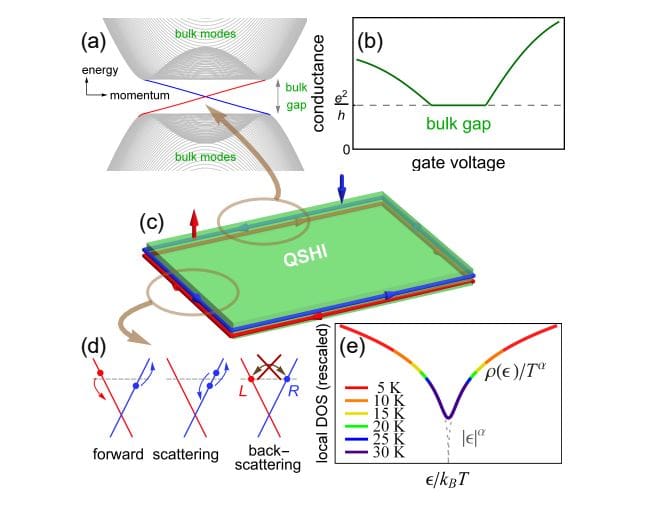
The unusual electronic behaviour at the edges of certain materials, known as helical liquids, presents a fascinating frontier in modern physics, and researchers are now working to fully understand their potential. Chen-Hsuan Hsu of the Institute of Physics at Academia Sinica, alongside Jelena Klinovaja and Daniel Loss from the University of Basel, investigate these intriguing states of matter, focusing on the fundamental properties that govern their behaviour. This work addresses key theoretical challenges that currently limit progress in the field, and aims to unlock a deeper understanding of helical liquids and their ability to host exotic topological zero modes. Achieving this understanding promises to significantly advance both fundamental science and future technological applications by opening up new avenues for exploring novel quantum phenomena.
Spin-Momentum Locking in Topological Materials
This extensive review surveys the current understanding and recent advancements in the field of topological materials, specifically focusing on helical liquids, a state of matter exhibiting robust edge states protected by time-reversal symmetry. These materials are topologically non-trivial, meaning their electronic band structure possesses unique properties stemming from the material’s topology. Helical liquids are characterized by spin-momentum locking, where the direction of an electron’s spin is tied to its direction of motion, leading to robust, dissipationless edge states. These materials hold promise for next-generation electronics due to their potential for low-power consumption and spintronic applications.
Time-reversal symmetry is crucial, protecting the edge states from backscattering and making them robust against imperfections and disorder. Spin-momentum locking is the fundamental property of helical edge states, ensuring electrons with opposite spins travel in opposite directions. Topological protection guarantees the robustness of the edge states, making them less susceptible to scattering from impurities or defects. The review also touches upon the potential for realizing Majorana fermions, particles that are their own antiparticles, of interest for topological quantum computation. The review covers materials exhibiting helical liquid behavior, including quantum wells, early platforms for observing the quantum spin Hall effect, 2D materials like graphene and transition metal dichalcogenides, promising candidates due to their unique electronic properties, and Bi/Sb alloys and Heusler alloys, materials with strong spin-orbit coupling.
Experimental progress includes observing the quantum spin Hall effect, fabricating and characterizing heterostructures, and searching for Majorana fermions. Key challenges remain in achieving high-quality materials, controlling edge state properties, utilizing proximity effects, and exploring the potential of Majorana fermions for quantum computation, as well as understanding the role of electron-electron interactions. In essence, the paper provides a comprehensive overview of the exciting field of topological materials and helical liquids, outlining the fundamental principles, recent advancements, and future prospects for this rapidly evolving area of research. It emphasizes the potential of these materials to revolutionize electronics and quantum computing.
Strain and Gate Control of Helical Liquids
Scientists are actively investigating helical liquids appearing at the boundaries of time-reversal-invariant topological materials, focusing on understanding their unique electronic properties. Research demonstrates the potential for stabilizing topological zero modes within these systems, crucial for exploring novel phenomena and advancing both science and engineering. Experiments reveal that applying strain during fabrication can enlarge the bulk gap, while sweeping gate voltages shapes the potential landscape during measurements, both yielding promising results in quantum spin Hall insulator structures. The team is exploring heterostructures combining quantum spin Hall insulators with other layered materials, such as transition metal dichalcogenides, to induce spin-orbit coupling, nontrivial spin textures, or superconductivity.
Device concepts include Josephson junctions composed of quantum spin Hall insulator rings coupled with superconducting layers, where measurements of the Josephson current while adjusting magnetic flux reveal the topological nature of the junction. Quantum point contacts formed in quantum spin Hall insulators serve as controllable constrictions for probing backscattering and correlation effects when multiple helical edges are brought into proximity. Notably, scientists have demonstrated the potential to stabilize Majorana Kramers pairs by coupling two quantum spin Hall insulator layers to a superconductor, eliminating the need for external magnetic fields. These Majorana modes, obeying non-Abelian statistics protected by time-reversal symmetry, are pivotal for developing topological quantum bits and supporting topological quantum computation, requiring sufficiently strong electron-electron interaction within the helical channels.
Recent work on twisted bilayer MoTe2 demonstrates the potential to form fractional quantum spin Hall insulators, paving the way for fractional parafermion zero modes with enhanced computational capabilities. Furthermore, research indicates that operating these devices in a fractional regime could allow edge states to host parafermion zero modes, characterized by unusual fractional statistics and offering enhanced computational capabilities compared to Majorana zero modes. These diverse approaches confirm that helical liquids serve as versatile building blocks for both fundamental research into correlated quantum matter and the development of quantum technologies.
Helical Liquids and Emerging Quantum States
Recent research highlights the distinctive electronic properties of helical liquids appearing at the boundaries of time-reversal-invariant topological materials, establishing these systems as a promising platform for both fundamental investigations into correlated quantum matter and the development of innovative technologies. Investigations demonstrate that manipulating the structure of two-dimensional nanostructures enhances many-body correlation effects, with evidence suggesting the potential to form fractional quantum states in materials like twisted bilayer MoTe2. These findings underscore the versatility of helical liquids as building blocks for exploring advanced quantum phenomena. The work acknowledges ongoing challenges in identifying optimal material platforms and refining the design of hybrid electronic devices, as well as reconciling theoretical predictions with experimental observations. Future research directions include exploring promising materials such as monolayer WTe2 and bismuthene, and employing techniques like tunneling spectroscopy to verify the helical nature of these systems and identify the origins of topological superconductivity. Combining theoretical approaches, including many-body calculations and machine learning, offers a route toward predictive modeling of these complex correlated topological systems, ultimately paving the way for next-generation quantum electronic devices.
👉 More information
🗞 On the Cutting Edge: Helical Liquids in Time-Reversal-Invariant Topological Materials
🧠 ArXiv: https://arxiv.org/abs/2512.03039


