Researchers have made significant progress in developing new technologies using diamond samples produced by chemical vapor deposition overgrowth on a low-strain mono-crystalline substrate by companies like New Diamond Technologies.
Researchers have unveiled an integrated photonic engine capable of high-speed, programmable atomic control in a move forward for quantum technology. This innovation, published in Nature Communications, addresses long-standing challenges in manipulating atomic and atom-like systems, heralding a new era of scalability and precision in quantum computing and communication.
Precise optical control is vital for manipulating atomic systems, underpinning cutting-edge quantum technologies’ foundations. However, conventional techniques rely heavily on bulk optical components, creating barriers to scalability and long-term stability. These bulky systems are difficult to integrate, limiting the potential for large-scale quantum networks and devices. Although photonic integration has transformed telecom applications, extending this technology to visible wavelengths—crucial for many atomic systems—remains a significant hurdle. Materials capable of operating at visible wavelengths often lack the performance characteristics necessary for efficient modulation.
To address this gap, the research team developed an integrated modulation system using thin-film lithium niobate, a material renowned for its exceptional electro-optic properties and high transparency across visible wavelengths. This innovation allows for gigahertz-rate modulation, a critical requirement for controlling atomic and quantum emitters with pinpoint accuracy.
The new photonic engine integrates these modulators into a single compact chip, providing a scalable, stable solution that bypasses the limitations of traditional optical systems. By consolidating multiple beam modulation channels into one platform, the system enhances both precision and complexity in beam manipulation, which is crucial for advancing quantum computing and information networks.
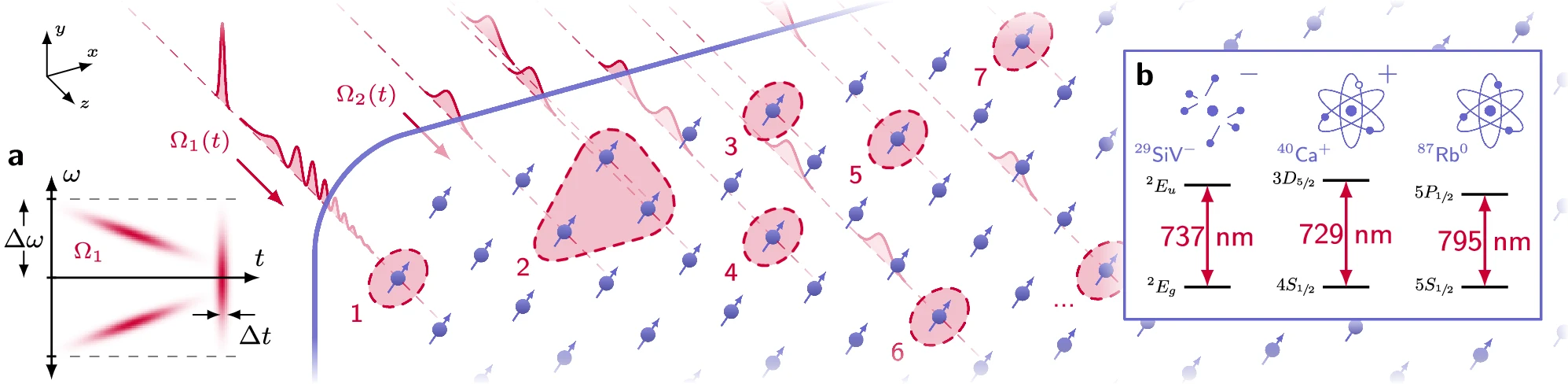
Central to the photonic engine is its combination of integrated modulators and free-space optics. Holography techniques further augment the system by enabling dynamic beam shaping and steering. This capability allows researchers to selectively target individual atoms or quantum emitters with unprecedented accuracy, opening the door to complex control over large atomic arrays.
The ability to dynamically address multiple emitters is crucial in scaling quantum computing systems, where precise control over qubits is necessary for performing operations and maintaining coherence. This flexibility also enables the system to adapt to the stochastic positioning of atom-like emitters, a common challenge in real-world applications.
To demonstrate the system’s effectiveness, the researchers applied the photonic engine to control silicon-vacancy (SiV) centers in diamonds. These SiV centers are promising candidates for quantum information processing due to their exceptional optical properties and robustness. By leveraging the new platform, the team successfully addressed individual SiV centers spatially and spectrally, underscoring the engine’s potential for practical quantum applications.
This photonic innovation represents a significant step toward realizing scalable quantum systems. The compact, integrated design not only reduces the footprint of atomic control systems but also enhances their stability and performance. This advancement is poised to accelerate developments in quantum computing, communication, and sensing technologies.
Looking ahead, the research team plans to explore further integration of the photonic engine with other quantum components, aiming to create fully integrated quantum chips. Additionally, the principles behind this system could extend to other materials and wavelengths, broadening the range of atomic systems that can be manipulated using similar techniques.
The integrated photonic engine for programmable atomic control stands as a milestone in the pursuit of scalable and precise quantum technologies. By bridging the gap between photonic integration and atomic control at visible wavelengths, this research not only pushes the boundaries of what is possible in quantum technology but also lays the groundwork for the next generation of quantum devices. As quantum computing inches closer to practical realization, innovations like this promise transformative technological advancements within reach.
External Link: Click Here For More