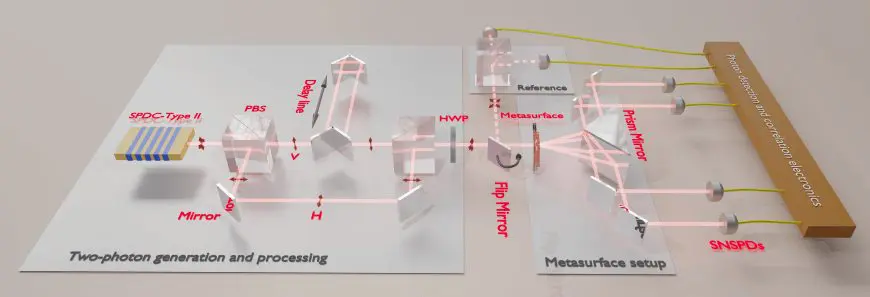
Researchers at the Harvard John A. Paulson School of Engineering and Applied Sciences have demonstrated that metasurfaces – flat devices with nanoscale light-manipulating patterns – can create complex entangled states of photons, achieving quantum operations comparable to those performed by larger optical devices. The team, led by Federico Capasso, utilized graph theory – a mathematical branch representing connections and relationships – to design metasurfaces capable of finely controlling photon properties, addressing the scalability challenges inherent in quantum computing and networking. This approach, detailed in Science, offers robustness to perturbations, cost-effectiveness, and low optical loss, potentially simplifying quantum optical setups and advancing room-temperature quantum technologies. The research was funded by the Air Force Office of Scientific Research (award No. FA9550-21-1-0312) and the National Science Foundation (award No. ECCS-2025158).
Metasurfaces for Quantum Photonics
Researchers at the Harvard John A. Paulson School of Engineering and Applied Sciences (SEAS) have demonstrated that metasurfaces could act as ultra-thin upgrades for quantum-optical chips and setups, potentially consolidating numerous optical components into a single, flat array. This approach could eliminate the need for waveguides and other conventional optical components, offering a potential solution to scalability issues in quantum systems. The research, published in Science, shows that a metasurface can create complex, entangled states of photons to carry out quantum operations comparable to those achieved with larger optical devices.
The team’s designs offer robustness to perturbations, cost-effectiveness, simplicity of fabrication, and low optical loss, representing advances in metasurface quantum optics. Beyond potential applications in room-temperature quantum computers and networks, this work could also benefit quantum sensing or enable lab-on-a-chip capabilities for fundamental science. The research received funding from the Air Force Office of Scientific Research (AFOSR) under award No. FA9550-21-1-0312.
To address the mathematical complexity arising as the number of photons increases, the researchers leveraged graph theory – a branch of mathematics that uses points and lines to represent connections and relationships. By representing entangled photon states as connected lines and points, they were able to visually determine how photons interfere with each other and predict their effects in experiments. While graph theory is used in certain types of quantum computing and quantum error correction, its application to metasurface design and operation is novel.
The work was performed at the Harvard University Center for Nanoscale Systems, supported under National Science Foundation award No. ECCS-2025158, and involved collaboration with the lab of Marko Lonar, whose team specializes in quantum optics and integrated photonics. This collaboration provided crucial expertise and equipment for the research. With this graph-based approach, metasurface design and the optical quantum state become intrinsically linked.
Scaling Quantum Systems with Graph Theory
Every additional photon introduces numerous interference pathways, which in a conventional setup would require a rapidly growing number of beam splitters and output ports. To bring order to this complexity, the researchers leveraged graph theory – a branch of mathematics that uses points and lines to represent connections and relationships. By representing entangled photon states as connected lines and points, they were able to visually determine how photons interfere with each other and predict their effects in experiments.
While graph theory is used in certain types of quantum computing and quantum error correction, its application to metasurface design and operation is novel. This collaboration involved the lab of Marko Lonar, whose team specializes in quantum optics and integrated photonics, providing crucial expertise and equipment.
Neal Sinclair noted that the work offers fresh insight into the understanding, design, and application of metasurfaces, especially for generating and controlling quantum light. With this graph-based approach, metasurface design and the optical quantum state become intrinsically linked.
Implications and Future Research
The research team anticipates that this approach will address the scalability problem currently hindering quantum systems. According to graduate student Kerolos M.A. Yousef, this technology introduces a major technological advantage by enabling the miniaturization of an entire optical setup into a single, stable, and robust metasurface.
Research scientist Neal Sinclair suggests that this work provides new insights into the understanding, design, and application of metasurfaces, particularly in the generation and control of quantum light. He also notes the potential for efficient scaling of optical quantum computers and networks, which has long been a significant challenge compared to other platforms such as superconductors or atoms.
The research received support from federal sources including the Air Force Office of Scientific Research (AFOSR) under award No. FA9550-21-1-0312. Additionally, the work was performed at the Harvard University Center for Nanoscale Systems, supported under National Science Foundation award No. ECCS-2025158.
More information
External Link: Click Here For More
The efficacy of these metasurfaces hinges on the precise geometric control of the electromagnetic wave’s phase front. By patterning subwavelength scatterers, the researchers are effectively implementing generalized Huygens’ principles at the nanoscale. This allows for the deterministic coupling and manipulation of incident photons, converting the macroscopic optical task of complex beam shaping into a purely physical, dielectric structure.
From an operational standpoint, the application of graph theory moves beyond simple visualization; it enables the rigorous characterization of high-dimensional quantum Hilbert spaces. This mathematical framework allows for the mapping of coupled quantum channels, optimizing the metasurface array geometry to minimize decoherence pathways and maximize the fidelity of multi-photon state generation.
The entanglement generated by these devices typically involves controlled nonlinear optical processes, such as Spontaneous Parametric Down-Conversion (SPDC) enhanced by the structured nanophotonics. The metasurface thus acts not merely as a beam director, but as an active, tailored quantum light source, efficiently mediating the interaction necessary to bind the entangled degrees of freedom (e.g., polarization and orbital angular momentum) of multiple photons.
Achieving seamless integration requires addressing the critical issue of broadband tunability. While current demonstrations prove feasibility, scaling these devices across multiple wavelengths—essential for future quantum communication networks—demands developing materials that maintain strong, predictable coupling constants over a wide spectral range, minimizing performance degradation due to resonance effects.