

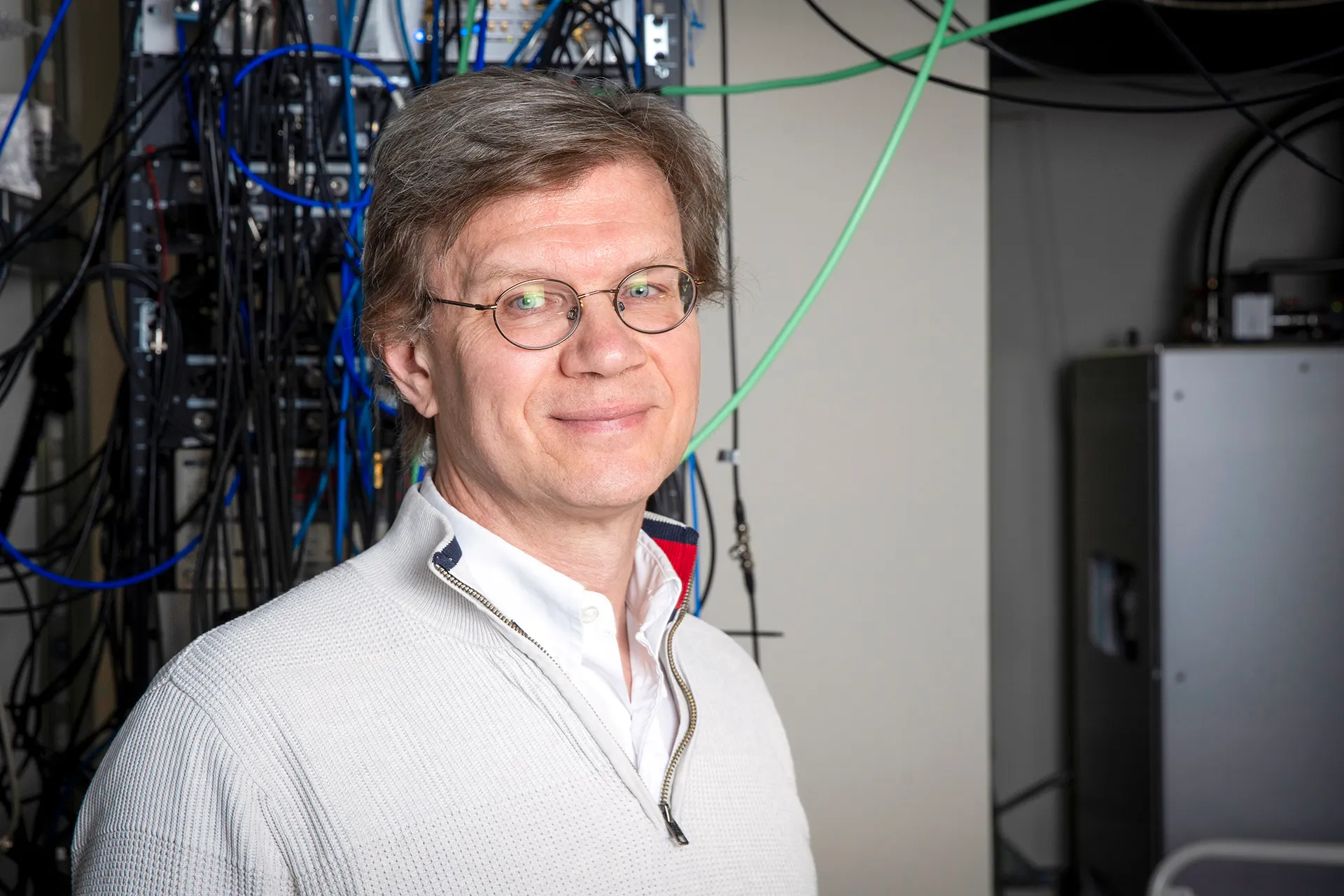
Led by Mikhail Lukin, Joshua and Beth Friedman University Professor, and collaborators Markus Greiner and Vladan Vuletić, Harvard physicists have demonstrated a fault-tolerant quantum system utilizing 448 atomic qubits—a significant step toward practical quantum computation. Published Monday in Nature, the research details an integrated architecture that employs techniques such as quantum teleportation, physical and logical entanglement, and entropy removal to detect and correct errors below a critical performance threshold. This Harvard-led collaboration, involving MIT, QuEra Computing, and NIST, establishes a conceptually scalable framework for building large-scale, error-corrected quantum computers after three decades of pursuit.
Harvard Achieves Breakthrough in Quantum Error Correction
Harvard physicists have achieved a significant breakthrough in quantum error correction, demonstrating a system capable of suppressing errors below a critical threshold. Published in Nature, the research utilizes 448 atomic qubits of rubidium, manipulated with techniques like quantum teleportation and layered error correction circuits. This is pivotal because qubits are inherently unstable, losing information easily; this system marks the first demonstration of an architecture conceptually scalable for building practical, fault-tolerant quantum computers.
The team’s success stems from combining several key mechanisms—physical & logical entanglement, “magic” state preparation, and entropy removal—to create a “fault-tolerant” system. Crucially, the experiment showed error reduction as qubits were added, a key milestone. This contrasts with prior approaches where adding complexity often increased errors. The system operated with impressive stability, with a prior publication in September demonstrating continuous operation of over 3,000 qubits for two hours.
This isn’t just theoretical progress. The Harvard-led collaboration, including researchers from MIT and QuEra Computing, is building towards real-world applications. While challenges remain in scaling to millions of qubits, this work establishes a viable pathway. Successful quantum error correction unlocks the potential of quantum computing for breakthroughs in fields like drug discovery, materials science, and artificial intelligence – areas limited by the capabilities of even the most powerful conventional computers.
Key Mechanisms Enabling Scalable Quantum Computation
Harvard researchers have demonstrated a significant step toward scalable quantum computation by achieving fault-tolerant error correction in a 448-qubit system using neutral rubidium atoms. Crucially, the team suppressed errors below a critical threshold – the point where adding more qubits actually reduces the overall error rate. This was achieved through the combination of key mechanisms including quantum teleportation, physical and logical entanglement, and efficient “entropy removal” – essentially discarding unusable quantum information. This breakthrough addresses a core barrier to building practical quantum computers.
The team’s approach focuses on streamlining error correction, identifying and eliminating unnecessary overhead. By concentrating on core mechanisms, they’ve created a conceptually scalable architecture. Unlike many theoretical proposals, this system emphasizes practical implementation. Researchers utilized lasers to manipulate rubidium atoms, encoding them as qubits. This focus on deep-circuit computation, with multiple layers of error correction, moves beyond simply detecting errors to actively correcting them – vital for complex calculations.
This advance builds on prior work, including a 3,000+ qubit system demonstrating over two hours of continuous operation. It’s important because qubits are inherently unstable, prone to losing information. Correcting these errors is essential for realizing the potential of quantum computers – which could revolutionize fields like drug discovery, materials science, and artificial intelligence. The team’s architecture, combined with recent progress in qubit stability, suggests large-scale, fault-tolerant quantum computation is increasingly within reach.
Quantum Computing: Potential and Existing Hurdles
Quantum computing promises exponential increases in processing power by leveraging qubits—quantum bits—that exploit phenomena like entanglement. Unlike classical bits limited to 0 or 1, qubits can exist in a superposition, dramatically expanding computational possibilities. A system of just 300 qubits, theoretically, could store more information than all particles in the known universe. This potential unlocks breakthroughs in fields like drug discovery, materials science, and cryptography – but building stable, scalable quantum computers remains a significant challenge.
A primary hurdle is quantum error correction. Qubits are incredibly sensitive and prone to losing information, necessitating complex systems to detect and correct errors. Researchers at Harvard recently demonstrated a “fault-tolerant” system using 448 atomic qubits of rubidium, employing techniques like quantum teleportation and layered error correction circuits. Critically, they achieved error suppression below a key threshold—meaning adding more qubits now reduces errors, paving the way for larger, more reliable machines.
This advance builds on decades of theoretical work and experimental refinement. The Harvard team’s system isn’t just about detecting errors; it’s about architecting a scalable system that minimizes overhead and focuses on core mechanisms for deep-circuit computation. Their demonstrated system of over 3,000 qubits sustained operation for over two hours, overcoming atom loss issues – a major obstacle previously. This suggests that the fundamental building blocks for practical quantum computing are finally within reach.
Advancements in Qubit Technology and Platform Research
Harvard researchers have demonstrated a significant step toward practical quantum computing by achieving fault-tolerant error correction in a 448-qubit system using neutral rubidium atoms. Crucially, the team suppressed errors below the critical threshold—meaning adding more qubits actually reduces overall error rates. This was accomplished through techniques like quantum teleportation, physical and logical entanglement, and efficient “entropy removal” from the system, paving the way for scalable, deep-circuit computations.
The research focused on streamlining error correction methods. By identifying and eliminating unnecessary components, the team reduced overhead and accelerated progress toward practical quantum computers. Their system, utilizing laser manipulation of rubidium atom electron configurations, isn’t just about detecting errors, but actively correcting them at a rate that allows for increasing qubit numbers without a proportional increase in instability. This addresses a long-standing barrier to building powerful quantum machines.
Beyond the breakthrough in error correction, the Harvard-led collaboration also recently demonstrated a stable system of over 3,000 qubits operating continuously for over 2 hours – overcoming another significant hurdle: atom loss. These combined advancements, alongside ongoing competition between qubit platforms (like superconducting qubits), suggest that the core elements for realizing large-scale, useful quantum computers are now within reach, bringing the “dream” of quantum computing closer to reality.


