The nature of chaos and how information scrambles within complex systems remains a fundamental question in theoretical physics, with implications for understanding black holes and quantum gravity. Adrita Chakraborty from AGH University of Krakow and Balbeer Singh from the Indian Institute of Technology Kharagpur, along with their colleagues, investigate these phenomena within a unique theoretical framework, a ‘hairy’ AdS soliton, a horizonless geometry that mimics some properties of black holes. Their research demonstrates that this system exhibits a clear transition from chaotic behaviour at low energies to a more ordered, integrable state at high energies, a shift they characterise using multiple independent methods. Crucially, the team quantifies the rate at which information spreads within this system, revealing how a key parameter, the ‘hair’ of the soliton, governs the scrambling process and potentially links to transitions between different material states, such as insulators and superconductors. This work provides valuable insights into the dynamics of information and the emergence of complexity in strongly interacting systems.
This research presents a comprehensive study of both classical and quantum chaos in this specific geometry, which possesses no horizon. The soliton holographically corresponds to a confining field theory characterised by a finite scalar potential. The team explores the dynamics within this unique spacetime to understand the behaviour of chaotic systems and the related phenomenon of quantum scrambling.
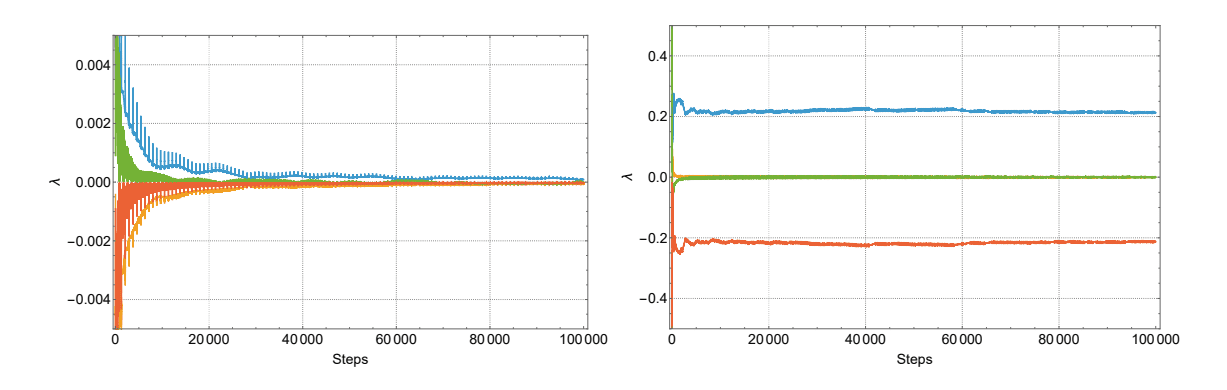
Scientists probe classical chaos by using particle geodesics and closed classical strings. While particle motion does not exhibit chaotic behaviour, the closed strings do, as evidenced by calculations of the Lyapunov exponent and analysis of the Poincaré section. Spectral analysis using random matrix theory revealed a transition from chaotic behaviour at lower energies to integrability at higher energies, indicating a flow from disorder to order.
AdS/CFT Duality and Holographic Boundaries
This collection of work covers a broad range of topics at the intersection of theoretical physics, including string theory, quantum gravity, holography, quantum chaos, and condensed matter physics. A central theme is the AdS/CFT correspondence, which connects a gravitational theory in Anti-de Sitter space to a conformal field theory on its boundary, allowing scientists to study complex systems where traditional methods fail. Quantum chaos and scrambling are major areas of focus, with researchers exploring how chaos manifests in holographic setups and how information spreads within these systems. Studies also investigate black holes in AdS space, their properties, and connections to the dual field theory, including black hole phase transitions and the information paradox.
A significant number of papers explore using the AdS/CFT correspondence to model strongly correlated electron systems, such as high-temperature superconductors. The foundational work on string theory and quantum gravity provides the theoretical framework for these holographic studies. Several papers investigate phase transitions in both gravitational and field theory contexts, often using holographic methods. A growing area focuses on the effects of disorder in holographic systems and its connection to many-body localization. This research explores how topology and geometry affect the dynamics of the dual field theory and uses Krylov complexity to characterize quantum phase transitions. Understanding how disorder affects scrambling and many-body localization in holographic models could provide insights into the behaviour of disordered quantum systems, and exploring different holographic dualities could further advance this field.
String Chaos and Holographic Information Scrambling
This research presents a comprehensive investigation of classical and quantum chaos within a five-dimensional theoretical spacetime geometry, known as a hairy AdS soliton. The team demonstrated that while particle motion within this geometry does not exhibit chaotic behaviour, the dynamics of closed strings do, as evidenced by calculations of the Lyapunov exponent and analysis of the Poincaré section. Further supporting this finding, spectral analysis using random matrix theory revealed a transition from chaotic behaviour at lower energies to integrability at higher energies, indicating a flow from disorder to order. The study extends to explore the scrambling of information within this holographic system, quantifying the rate at which information spreads using two independent holographic methods.
Researchers calculated the butterfly velocity, which defines the maximum speed at which spatial scrambling propagates, and found that this velocity is controlled by a parameter defining the soliton’s ‘hair’. The team acknowledges that their analysis focuses on the region near the soliton’s tip, representing an approximation of the infrared physics of scrambling. Future research directions include exploring the connection between phase transitions within the soliton geometry and the observed transition from integrability to chaos, as both appear to be influenced by the hair parameter. This work advances understanding of how chaos manifests in complex theoretical spacetimes and provides new insights into the holographic principle and the behaviour of information in strongly interacting systems.
👉 More information
🗞 Study of chaos and scrambling in hairy AdS Soliton
🧠 ArXiv: https://arxiv.org/abs/2509.26059