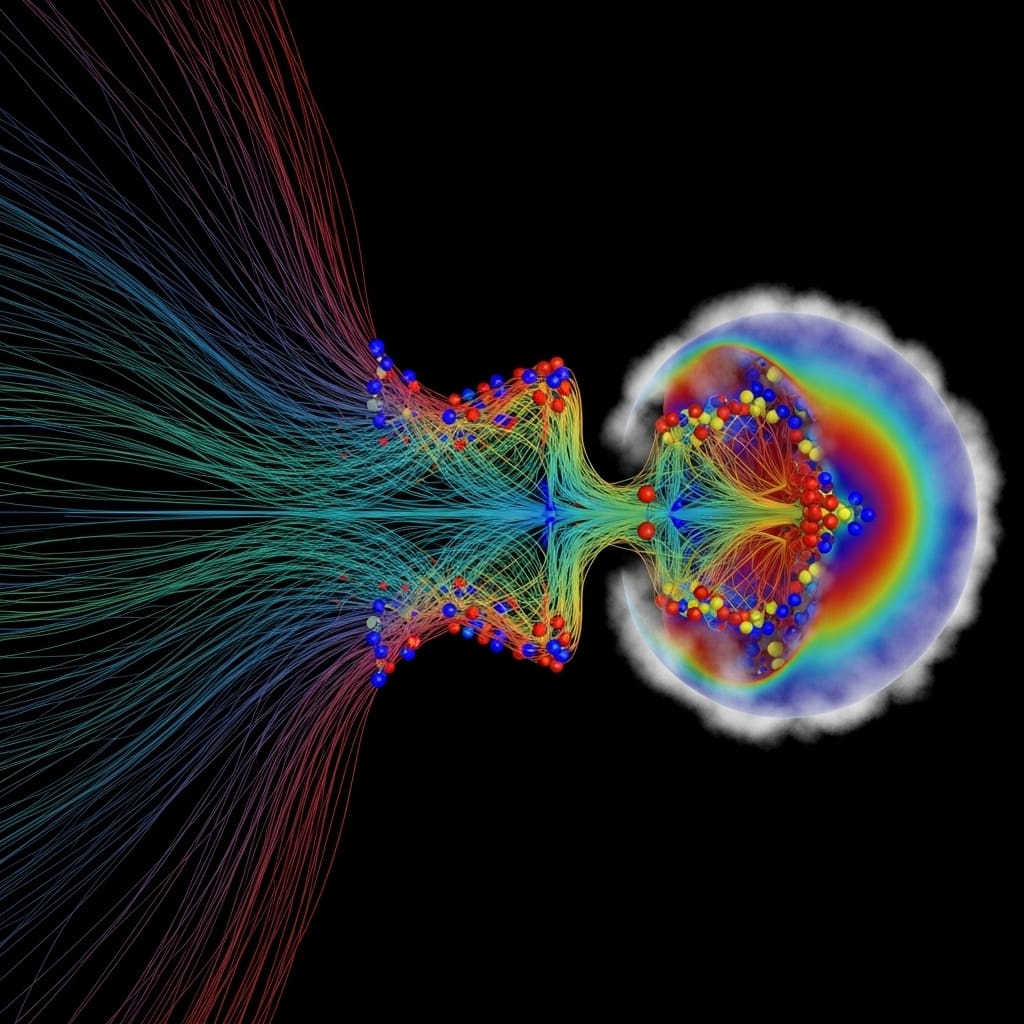
Scientists are striving to reconcile two fundamental yet disparate descriptions of hadrons within quantum chromodynamics (QCD). Edward Shuryak and Ismail Zahed, alongside their colleagues, present a unified framework bridging the gap between the static, confinement-based view and the dynamic, high-energy picture of partons. Their work, built upon the Instanton Liquid Model, constructs a ‘Hadron-Parton Bridge’ by boosting hadronic wavefunctions to the light front, generating realistic predictions for parton distributions and gravitational form factors. This innovative approach offers a coherent, multiscale understanding of hadron structure, linking spectroscopic data with observable partonic behaviour and promising to refine our comprehension of matter at its most fundamental level.
The researchers employed the Instanton Liquid Model (ILM) to describe the quantum vacuum, providing a natural setting for understanding both confinement and chiral symmetry breaking, crucial aspects of strong interaction physics. Central to their approach is the treatment of the QCD vacuum as a dynamic, topological landscape of gauge fields, akin to a liquid composed of instantons, quantum tunnelling solutions to the equations of motion.
This allows for a consistent description of hadron properties, from quarkonia and glueballs to more exotic multi-quark states. By constructing effective Hamiltonians within this instanton vacuum, the team calculated the spectra of various hadrons, demonstrating a remarkable agreement with experimental observations and lattice QCD results. Furthermore, the framework extends to the high-energy regime by mapping the static potential derived from the ILM onto a light-front framework. This allows for the calculation of parton distribution functions and other observables relevant to deep inelastic scattering and heavy-ion collisions.
The researchers highlight the importance of Poisson duality, connecting instantons with magnetic monopoles, and explore the implications for understanding the topological structure of the vacuum. This work not only provides a deeper understanding of hadron structure but also offers a novel perspective on the interplay between confinement, chiral symmetry breaking, and the emergence of mass in quantum chromodynamics. The detailed analysis, including appendices with derivations and comparisons to lattice QCD, positions this research as a significant contribution to the field of strong interaction physics.
Light-front Hamiltonians from instanton-induced QCD dynamics
Unified Framework Connecting Rest-Frame and Light-Front Descriptions
Scientists engineered a unified framework connecting rest-frame and high-energy light-front descriptions of hadrons, building upon multiple prior studies. The research harnessed the Instanton Liquid Model (ILM) to represent essential nonperturbative features of the QCD vacuum, subsequently deriving effective interactions for mesons, baryons, and multiquark states, crucially, these interactions describe how particles interact with each other. Wave functions were then constructed in hyperspherical coordinates and boosted to the light front, a specific frame of reference used in high-energy physics, to accurately model particle behaviour at extreme energies. The study pioneered light-front Hamiltonians incorporating both perturbative and instanton-induced dynamics, adopting a Wilsonian approach to provide realistic nonperturbative inputs for parton distribution functions (PDFs), distribution amplitudes (DAs), generalised parton distributions (GPDs), quasi-distributions, and gravitational form factors at a defined low scale.
This innovative technique allows for the prediction of hadron properties across a broad energy range, bridging the gap between theoretical calculations and experimental observations. Researchers established a connection to perturbative QCD by matching gradient-flow-renormalized operators and light-front wave functions to the standard scheme, ensuring consistency with established theoretical frameworks. Experiments employed perturbative DGLAP and ERBL evolution to connect these predictions to experimentally accessible regimes, enabling direct comparison with data from particle colliders. The approach achieves a consistent description of spectra and partonic structure for quarkonia, glueballs, light mesons, baryons, tetraquarks, pentaquarks, and higher multiquark hadrons, demonstrating its broad applicability.
Particular emphasis was placed on the energy-momentum tensor and mechanical properties of hadrons, which emerged naturally from the same dynamical ingredients used throughout the calculations. This work reveals a clear continuity between hadronic spectroscopy and partonic observables, offering a coherent multiscale picture of hadron structure rooted in the underlying dynamics of QCD. The technique delivers a comprehensive framework for understanding hadrons, linking their static properties to their internal partonic structure and providing a foundation for future investigations into the strong force, a fundamental force of nature. The framework’s ability to consistently describe both spectra and partonic structure represents a significant methodological advance in quantum chromodynamics.
Constructing Wave Functions and Light-Front Transformations
Hadrons unified via. The researchers employed the Instanton Liquid Model to represent the nonperturbative aspects of the QCD vacuum, subsequently constructing wave functions for various hadronic states, mesons, baryons, and multiquark combinations, and transforming them to the light front. This approach yields light-front Hamiltonians incorporating both perturbative and instanton-driven dynamics, offering realistic, nonperturbative inputs for quantities like parton distribution functions, distribution amplitudes, and gravitational form factors at a defined energy scale. By matching operators and wave functions, the framework establishes a connection to perturbative QCD, allowing predictions to be evolved to experimentally accessible energy regimes using established techniques like DGLAP and ERBL evolution.
Spectral Predictions for Complex Multiquark Hadrons
The model successfully describes the spectra and partonic structure of quarkonia, glueballs, and increasingly complex multiquark hadrons, consistently capturing their energy-momentum tensor and mechanical properties. The authors acknowledge that their calculations rely on approximations within the Instanton Liquid Model and the truncation of many-body interactions. Future research will focus on refining these approximations and extending the framework to incorporate more complex hadronic systems and dynamical effects. This achievement demonstrates a coherent, multiscale understanding of hadron structure, firmly grounded in the fundamental dynamics of QCD, and offers a pathway to bridge the gap between static properties and dynamic behaviour of these composite particles.
🗞 The Hadron-Parton Bridge, From the QCD Vacuum to Partons
🧠 ArXiv: https://arxiv.org/abs/2601.15085
See today’s quantum computing news on Quantum Zeitgeist for the latest breakthroughs in qubits, hardware, algorithms, and industry deals.