The demand for highly coherent light sources operating at telecommunication wavelengths is driving innovation in quantum technologies, and researchers are now reporting a significant advance in this field. Andrew N. Wakileh from Queen’s University, alongside Dan Dalacu, Philip J. Poole, and colleagues at the National Research Council of Canada, demonstrate the creation of exceptionally high-quality quantum dots capable of emitting near-transform-limited light. This work details a refined growth process for indium arsenide/indium phosphide dots, resulting in sources exhibiting remarkably narrow linewidths, down to a mean of only millielectronvolts, and a single-photon purity exceeding 99%. These findings represent a crucial step towards realising practical, scalable quantum networks and devices that rely on ultra-low-loss fibre optic connections.
High-Quality Quantum Dots for Enhanced Light Emission
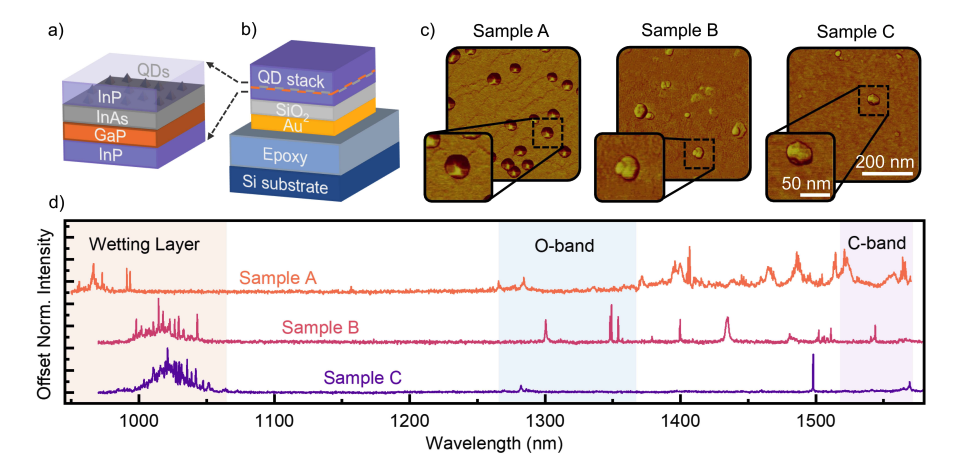
Scientists engineered a novel growth process using chemical beam epitaxy to create high-quality InAs/InP quantum dots, crucial for developing telecommunications technology operating within the 1530, 1565nm range. This modified Stranski-Krastanov scheme allows for the generation of highly symmetric dots with aspect ratios exceeding 0. 8 and densities ranging from 2 to 22 µm⁻², achieving near-transform-limited linewidths. The team meticulously characterised these structures, revealing fine-structure splittings as low as 25 ±4 μeV and a single-photon purity exceeding 99. 4%, confirming the exceptional quality of the fabricated dots.
To overcome challenges associated with low photon collection efficiency, researchers developed a sophisticated technique involving the fabrication of a weak optical cavity. This involved flipping the sample and bonding it to a silicon carrier wafer, then removing the original substrate, a process that increased photon collection by a factor of 7. 1. Modelling indicated a Purcell modification of less than 10%, ensuring minimal impact on the intrinsic dot lifetimes. Polarization-resolved micro-photoluminescence measurements identified neutral excitons and biexcitons within individual quantum dots, revealing orthogonal linear polarizations for each complex.
Detailed analysis yielded saturation powers of 8. 9 µW, 16. 4 µW, and 22. 9 µW for the neutral exciton, charged exciton, and biexciton, respectively, values typical across the sample. These measurements, combined with cross-correlation measurements, provide a comprehensive understanding of the quantum dot emission characteristics and confirm their potential for advanced photonic applications.
Indium Arsenide Quantum Dots Emit Telecom Light
Researchers have achieved a significant breakthrough in the development of high-quality quantum dots capable of emitting light at telecommunication wavelengths, crucial for building advanced quantum networks and devices. The team successfully grew indium arsenide quantum dots on an indium phosphide substrate using a modified chemical beam epitaxy technique, demonstrating a novel approach to decouple the quantum dots from the underlying material and suppress unwanted material exchange during growth. This innovative method allows for precise control over dot density, ranging from 2 to 22 quantum dots per μm², and yields highly symmetric structures with aspect ratios exceeding 0. 8.
Optical characterisation of these quantum dots revealed exceptionally fine-structure splittings as low as 25 ±4 μeV, confirming the high quality of the emitted light. Importantly, measurements of single-photon purity yielded a value of 0. 012 ±0. 007, indicating a strong source of individual photons. Using a specialized etalon instrument and rigorous modelling, the team determined an upper limit for the mean linewidths of these quantum dots to be only 12.
1 ±6. 7 times the transform limit, with the best performing dots achieving an astonishing 2. 8 ±1. 8 times the transform limit. This represents a substantial improvement over previous results, which typically exhibited linewidths exceeding 50 times the transform limit, and even surpasses the best reported value of 4 times the transform limit achieved with complex enhancement techniques. The introduction of a gallium phosphide interlayer during growth proved critical, effectively decoupling the quantum dots and preventing surface roughening, leading to reproducible emission spectra and identifiable excitonic complexes. These findings pave the way for scalable quantum technologies and long-distance quantum communication systems, offering a promising platform for future advancements in the field.
Narrow Linewidth Quantum Dots for Telecommunications
This work demonstrates a modified growth process for creating high-quality indium arsenide quantum dots within an indium phosphide matrix, specifically designed to emit light in the telecommunications C-band. By introducing a gallium phosphide interlayer, the researchers achieved improved control over the quantum dot formation, resulting in structures with high symmetry and densities ranging from 2 to 22 per square micrometer. These dots exhibit exceptionally narrow linewidths, a crucial property for efficient and reliable light emission. The team measured the linewidths of these quantum dots and, accounting for the effects of excitation power, determined an upper limit for the low-power linewidths of only 12.
1 times the transform limit, with the narrowest transition measured at 2. 8 times the transform limit. This represents a significant improvement compared to other quantum dot approaches and brings these emitters closer to the performance needed for complex optical networks and devices.
🗞 Approaching transform-limited linewidths in telecom-wavelength transitions of ungated quantum dots
🧠 ArXiv: https://arxiv.org/abs/2509.02320