Understanding how complex systems settle into equilibrium after a sudden change is a fundamental challenge in physics, and researchers now investigate this process in a model system of interacting particles. Domenico Giuliano, Reinhold Egger, Bidyut Dey, and Andrea Nava, from institutions including the Heinrich-Heine-Universität Düsseldorf and the University of Calabria, explore the behaviour of a theoretical system known as the Gross-Neveu model following a rapid alteration to its governing parameters. Their work reveals that while certain properties of the system quickly stabilise, consistent with established theories of thermalisation, others require a connection to an external environment to reach equilibrium. These findings demonstrate the nuanced ways in which many-body systems relax after a disturbance, highlighting the importance of considering both internal dynamics and external influences when modelling complex physical phenomena.
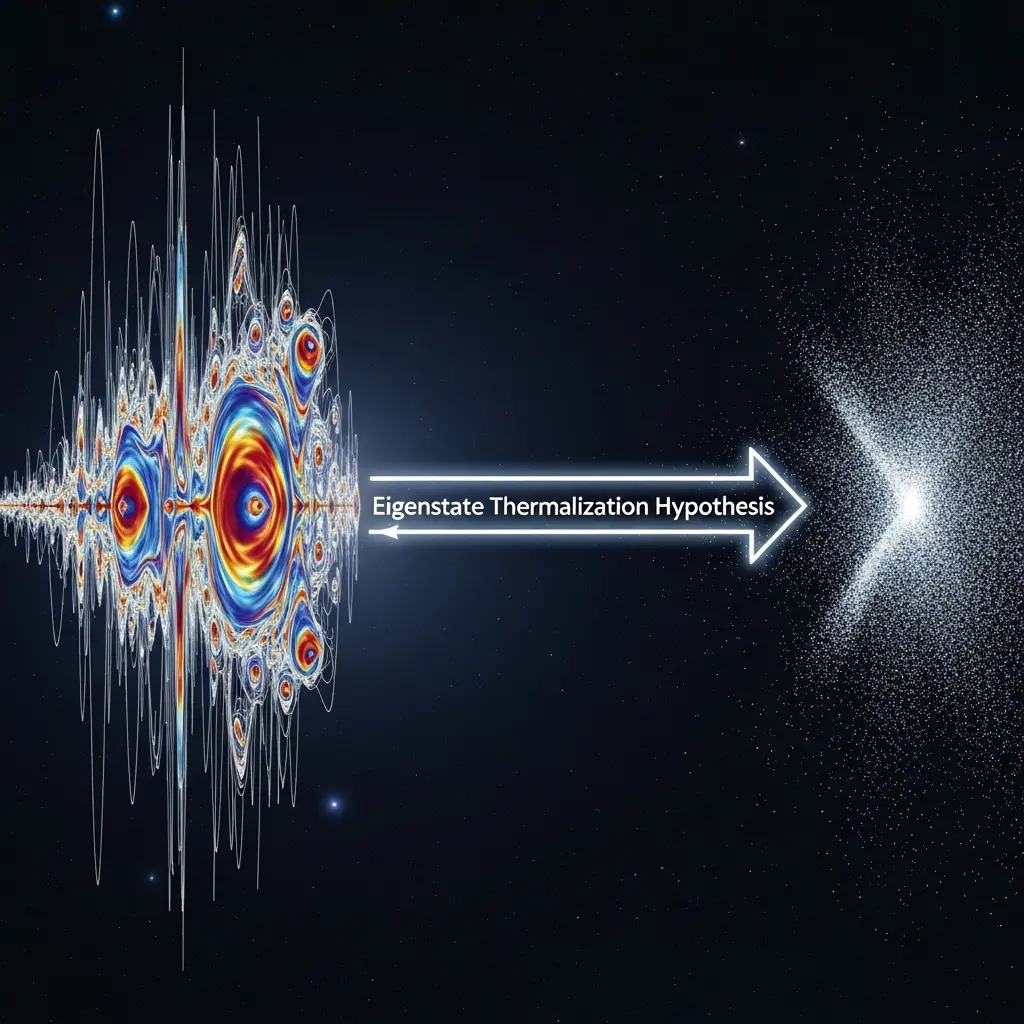
Through numerical simulations, the team described the system’s evolution and quantified the influence of this coupling. Results demonstrate that a closed system exhibits oscillations and revivals in its order parameter, indicating a periodic return to its initial state, while in the thermodynamic limit, the order parameter reaches a stationary post-quench value consistent with the eigenstate thermalization hypothesis.
Driven Dissipative Many-Body Quantum Systems
This research represents a comprehensive investigation into non-equilibrium quantum dynamics, many-body physics, and condensed matter systems. The work focuses on understanding the behavior of quantum systems driven away from equilibrium, often through sudden changes or interactions with their surroundings. A central theme is the study of systems containing a large number of interacting particles, and how these interactions give rise to emergent properties. The research also explores open quantum systems, those interacting with an environment, and how this interaction affects their evolution. Key areas of investigation include quantum quenches and the resulting dynamics, alongside dissipation and relaxation, the loss of quantum coherence due to environmental interactions.
Furthermore, the work delves into topological phases of matter, materials exhibiting unique properties due to their electronic structure. The research demonstrates a strong theoretical focus, drawing on concepts from quantum mechanics, condensed matter physics, statistical mechanics, and quantum information theory. This work has potential applications in areas such as quantum computing, materials science, and condensed matter physics.
Quench Dynamics and System-Environment Coupling Revealed
Scientists investigated the relaxation dynamics of a one-dimensional quantum model following a sudden change in its parameters. Through numerical simulations, the team described the system’s evolution, considering the influence of interactions with its surrounding environment. Results demonstrate that a closed system exhibits oscillations and revivals in its order parameter, indicating a periodic return to its initial state. However, in the thermodynamic limit, the order parameter reaches a stationary post-quench value, consistent with the eigenstate thermalization hypothesis. Experiments revealed that finite system sizes experience suppressed revivals with even a small degree of interaction with the environment.
Crucially, the team found that correlation matrix elements only equilibrate when there is a non-zero coupling to the environment, indicating that full thermalization requires interaction with its surroundings. This research highlights the critical role of system-environment coupling in post-quench relaxation dynamics, influencing both oscillations and the equilibration of correlations. These findings provide insight into correlated quantum many-body systems and demonstrate the importance of considering dissipation effects.
Relaxation, Equilibrium, and Environmental Coupling
This research investigates the relaxation dynamics of a quantum system following a sudden change in its parameters, a process known as a quench. By modeling a specific quantum model, the team numerically describes how the system evolves over time, considering the influence of interactions with its surrounding environment. The results demonstrate that a closed system exhibits oscillations and revivals in its order parameter, eventually settling into a stable state consistent with the eigenstate thermalization hypothesis. However, achieving full equilibrium, where all correlations stabilize, requires a degree of coupling between the system and its environment.
The study highlights the subtle interplay between system interactions, environmental coupling, and the approach to equilibrium in quantum many-body systems. The team’s findings suggest that the rate at which correlations stabilize can be slower than the relaxation of the order parameter, indicating a more complex path to full thermalization. The authors believe the underlying principles apply broadly to other quantum systems.
🗞 Post-quench relaxation dynamics of Gross-Neveu lattice fermions
🧠 ArXiv: https://arxiv.org/abs/2511.02618