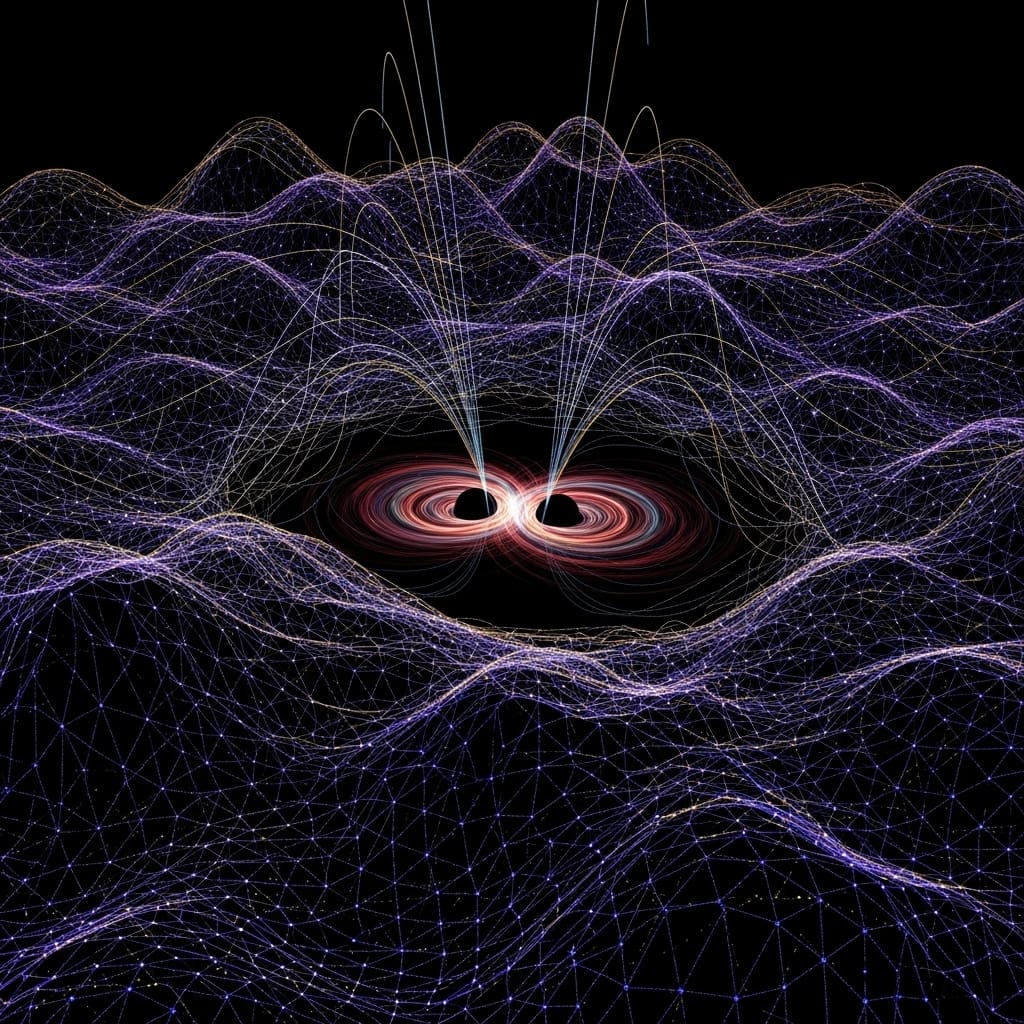
Scientists are refining our understanding of black hole entropy with new research into corrections to the Bekenstein-Hawking area formula, potentially bridging the gap between theoretical physics and gravitational wave observations. Rohit Das, Parthasarathi Majumdar, and Debadrita Mukherjee, all from the School of Physical Sciences at the Indian Association for the Cultivation of Science, investigate these ‘inverse area’ corrections within the framework of F(R) gravity , a modification of Einstein’s general relativity , utilising the Wald formula and insights from Jacobson, Kang and Myers. Their work establishes constraints on the parameters of F(R) gravity by demanding consistency with the Hawking Area Theorem, validated by recent gravitational wave detections of binary black hole mergers, offering a crucial test of alternative theories of gravity and a deeper insight into the fundamental nature of black holes.
This innovative approach allows for a more precise determination of black hole entropy, particularly for those with vast horizon areas, and introduces constraints on the parameters defining F(R) gravity, a modified theory of gravity, based on observational data from gravitational waves. For comparative purposes, the study also computed inverse area corrections for quantum black holes using a modified Wheeler’s “It from Bit” approach, incorporating tenets of Loop Quantum Gravity .
The core of this breakthrough lies in applying the Wald entropy function, a powerful tool for computing black hole entropy in modified gravity theories, and extending it through the Jacobson, Kang, and Myers modification, integrating the conserved N other current over any two-dimensional cross-section of the horizon. This allows researchers to estimate inverse power corrections to the area formula for entropy in stationary spherical black holes within modified gravity theories with greater accuracy. By focusing on spherically symmetric, static black hole solutions in F(R) gravity, the team demonstrated that for large horizon areas, the Wald-Jacobson-Kang-Myers entropy function expands as a Taylor series in inverse powers of the horizon area, with coefficients directly linked to derivatives of F(R) with respect to the Ricci scalar, R, evaluated at R=0. Identifying the leading term with the BHAF for F(R) gravity, the remaining terms represent corrections inversely proportional to the black hole entropy.
Crucially, the study establishes a direct link between these entropy corrections and gravitational wave observations of binary black hole coalescences, validating Hawking’s Area Theorem. Requiring absolute consistency between the calculated corrections and these observations imposes stringent constraints on the parameters of F(R) gravity, effectively narrowing down the possible forms of this modified gravity theory. The research demonstrates that these corrections can be resummed into a concise form, further refining the restrictions on F(R) parameters implied by consistency with gravitational wave data. This methodology provides a novel means of testing modified gravity theories using astrophysical observations, moving beyond traditional tests based on solar system dynamics.
Furthermore, the team calculated the first sub-leading inverse area correction to the BHAF using quantum general relativity, leveraging Wheeler’s “It from Bit” argument and incorporating principles from Loop Quantum Gravity. This comparison between classical and quantum calculations provides valuable insights into the origins of entropy corrections and their potential connection to underlying quantum gravitational effects. The work opens avenues for exploring the interplay between classical modifications of gravity and quantum gravity, potentially leading to a more complete understanding of black hole thermodynamics and the fundamental nature of spacetime. The study pioneered a methodology utilising a Taylor expansion of the Wald-Jacobson-Kang-Myers Entropy function in inverse powers of the horizon cross-sectional area, enabling the identification of coefficients with derivatives of F(R) with respect to R at R|S = 0.
Crucially, the researchers identified JaN = ∇b 2 ∂L ∂Rabcd (∇dξc), allowing them to define the N other charge as QabN = 2 ∂L ∂Rabcd ∇dξc, and ultimately formulate the Wald entropy function as Sbh = ∫S d2a ∂L ∂Rabcd lablcd, where lab ≡∇aKb represents the gradient of the Killing vector field on the 2-spherical horizon cross-section. To assess corrections, the research restricted attention to spherically symmetric, static black hole solutions of F(R) gravity, integrating over 2-spheres S. For large horizon areas, corresponding to astrophysical black holes observed in gravitational wave events, the expansion of the entropy function yielded coefficients directly related to derivatives of F(R) with respect to R at R|S = 0. Requiring absolute consistency between these corrections and gravitational wave observational results, specifically validating the Hawking Area Theorem for binary black hole coalescences, imposes significant constraints on the parameters defining F(R) gravity. Experiments revealed that the coefficient of inverse area corrections directly links to the parameters governing F(R) gravity, establishing a crucial connection between theoretical predictions and observational data.
The team measured these corrections by applying the Wald entropy function, generalised to integrate the conserved N other current over two-dimensional horizon cross-sections, a technique proving particularly useful for estimating inverse power corrections to the area formula. For spherically symmetric, static black holes in F(R) gravity, the Wald-Jacobson-Kang-Myers Entropy function expands as a Taylor series in inverse horizon area when considering large cross-sections representative of astrophysical black holes observed in gravitational wave events. Results demonstrate that identifying the leading term of this expansion with the BHAF for F(R) gravity transforms the remainder into a series of inverse powers of black hole entropy. Applying an absolute consistency criterion, aligning theoretical corrections with gravitational wave observations of binary black hole coalescences, restricts higher-order derivatives of F(R) with respect to the Ricci scalar at zero, effectively defining parameters of the modified gravity theory.
The study further shows that these correction terms can be resummed, yielding a concise form for the restrictions on F(R) parameters implied by consistency with gravitational wave observations. For comparative purposes, scientists computed inverse area corrections for quantum black holes using Wheeler’s ‘It from Bit’ approach, modified by tenets of Loop Quantum Gravity. Measurements confirm that this approach provides a valuable benchmark against which to assess the classical corrections derived from F(R) gravity. The breakthrough delivers a powerful methodology for constraining modified gravity theories using observational data from gravitational waves, potentially refining our understanding of black hole physics and the fundamental laws governing the universe. This work establishes a rigorous framework for testing theoretical models against the precise measurements obtained from gravitational wave astronomy, opening new avenues for exploring the nature of gravity itself.
👉 More information
🗞 Inverse Area Corrections to Black Hole Entropy Area Formula in F(R) Gravity and Gravitational Wave Observations
🧠 ArXiv: https://arxiv.org/abs/2601.13863