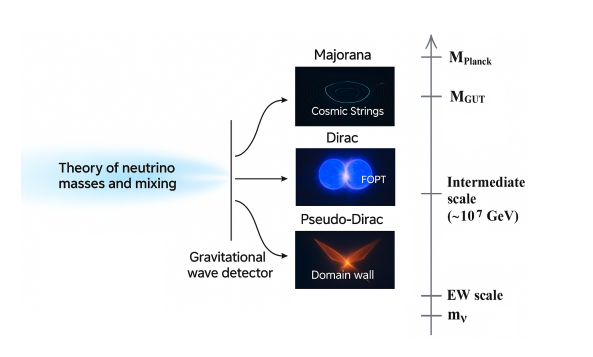
The fundamental nature of neutrinos and the origin of their remarkably small masses represent a long-standing puzzle in particle physics, with implications for our understanding of symmetries governing the universe. Sudip Jana, Sudip Manna, and Vishnu P. K investigate whether distinctive gravitational wave signals can reveal whether neutrinos behave as Dirac, Majorana, or pseudo-Dirac particles, exploring scenarios where the interactions creating neutrino mass are not artificially weak. Their work demonstrates that each neutrino type predicts a unique gravitational wave spectrum, offering a potential pathway to distinguish between these possibilities through future observations. Specifically, the team shows that Majorana neutrinos generate broad, flat gravitational wave signals, Dirac neutrinos produce sharply peaked signals, and pseudo-Dirac neutrinos create signals with distinctive kink-like features, providing a compelling link between particle physics and cosmology.
Neutrino Mass Mechanism and Supernova Signals
Supernova Gravitational Waves Distinguishing Neutrino Mass Mechanisms
Supernova Signals Constraining Neutrino Mass Mechanisms
This research investigates whether observations of gravitational waves from core-collapse supernovae can distinguish between different mechanisms for generating neutrino mass, specifically the Majorana, Dirac, and pseudo-Dirac scenarios. The team calculates the neutrino angular power spectrum, which varies depending on the neutrino mass mechanism, and assesses its detectability, incorporating neutrino oscillations and interactions within the supernova environment. This work establishes a clear connection between neutrino mass mechanisms and observable gravitational wave signals, offering a new way to probe the fundamental nature of neutrinos through multi-messenger astronomy.
Neutrino Mass and Gravitational Wave Signatures
Extending Standard Models to Reveal Neutrino Symmetries
Investigating Neutrino Symmetries in Standard Model Extensions
Researchers investigate whether distinctive gravitational wave signatures can illuminate the nature of neutrino masses and their underlying symmetries, particularly in scenarios where Yukawa couplings are not unnaturally small. They consider an extension to the Standard Model, incorporating a B − L gauge symmetry, which determines the neutrino nature and the scale of spontaneous symmetry breaking. Within this framework, the team explores potential observational consequences arising from phase transitions in the early universe, specifically focusing on the production of stochastic gravitational waves, modeling these transitions using field theory techniques to calculate parameters such as the transition temperature and energy release.
First Order Transitions and Gravitational Wave Properties
Detecting Signals from Cosmic Phase Transitions
Detecting Gravitational Waves from Cosmic Phase Transitions
Research focuses on calculating the energy released during first-order phase transitions and the resulting gravitational wave spectrum, including the electroweak and Higgs phase transitions. The formation and collapse of domain walls, which can also produce gravitational waves, are also investigated. Stochastic gravitational wave backgrounds and the potential for detection with current and future observatories like LISA and Pulsar Timing Arrays are explored, often requiring physics beyond the Standard Model, including new scalar fields and potential dark matter candidates. Detecting gravitational waves from these transitions can provide valuable information about physics beyond the Standard Model, allowing for discrimination between different theoretical models.
Neutrino Properties Revealed Through Gravitational Waves
Future Searches Unlocking Fundamental Neutrino Properties
Future Gravitational Wave Searches Unveiling Neutrino Properties
Scientists have demonstrated that future gravitational wave searches have the potential to reveal fundamental properties of neutrinos, specifically their mass and underlying symmetries. Researchers investigated scenarios where neutrinos are either Majorana, Dirac, or pseudo-Dirac particles, predicting distinctive gravitational wave spectra for each case. Majorana neutrinos would produce a relatively flat gravitational wave signal, while Dirac neutrinos would generate a pronounced peak due to a first-order phase transition. Pseudo-Dirac neutrinos are predicted to exhibit a characteristic double-peaked structure arising from the annihilation of domain walls combined with a first-order phase transition. These predicted gravitational wave signatures could be distinguishable by next-generation observatories, offering a unique window into the origin of neutrino masses and the symmetries governing their nature.
🗞 Gravitational Wave Signature and the Nature of Neutrino Masses: Majorana, Dirac, or Pseudo-Dirac?
🧠 ArXiv: https://arxiv.org/abs/2509.10456