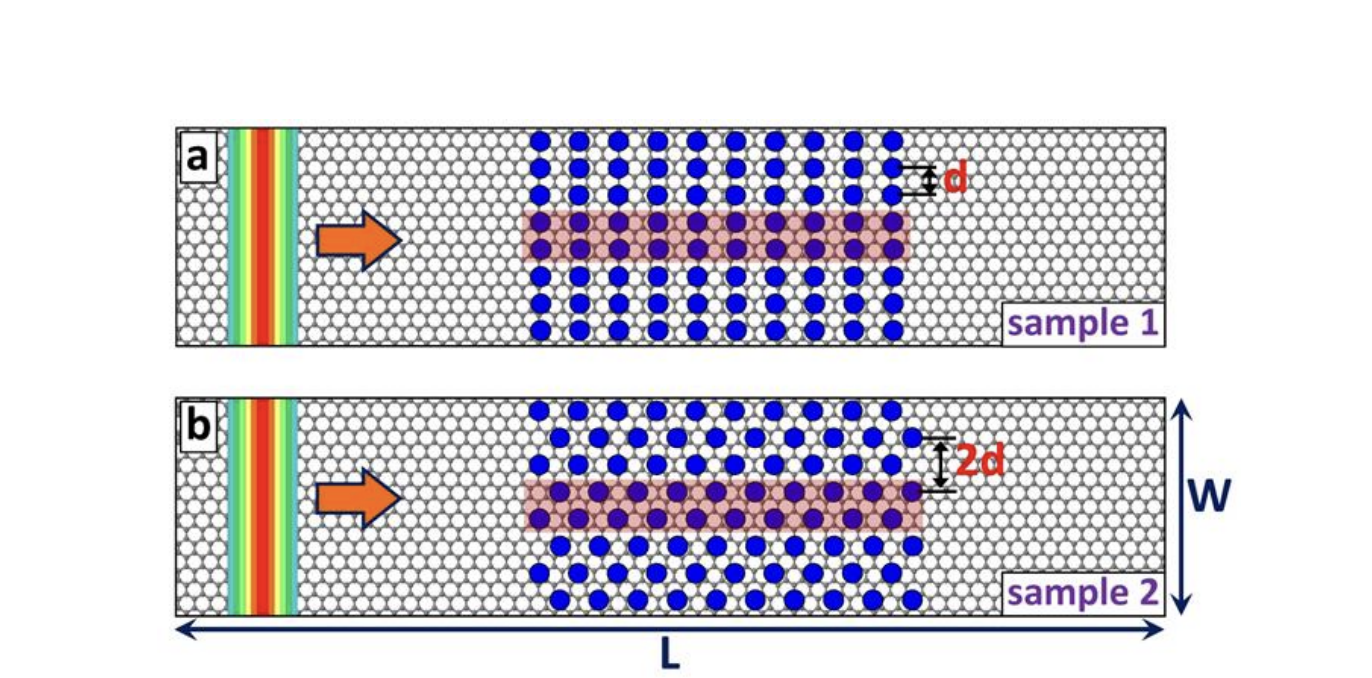
The behaviour of electrons moving through graphene, a material with exceptional conductive properties, forms the basis of many emerging technologies, and understanding how these electrons interact with imperfections within the material is crucial for optimising device performance. G. M. Milibaeva, H. T. Yusupov, and D. G. Berdiyorova, alongside Y. Rakhimova, M. Yusupov, and A. Chaves, investigate this interaction by modelling the propagation of electron waves through graphene containing regularly patterned obstacles. Their work reveals a surprising and counterintuitive relationship between the number of these obstacles and the ease with which electrons pass through the material, demonstrating that transmission does not simply decrease with fewer obstacles, but instead exhibits a complex, non-monotonic pattern. This discovery provides a new understanding of electron behaviour in patterned graphene and opens up possibilities for designing advanced electronic devices with precisely controlled and tunable transport characteristics.
Graphene Electron Transport Around Barrier Defects
This research investigates how the arrangement of potential barriers within graphene affects electron movement, specifically examining how removing barriers impacts transmission. Scientists used a theoretical model to simulate electron wave propagation, comparing square and triangular barrier arrangements and systematically removing rows to create defects. The results reveal a surprising relationship: initially, removing barriers decreases transmission, but further removal unexpectedly increases it, a phenomenon consistent across both lattice arrangements. This non-linear behavior demonstrates that simply creating more open space in graphene does not always improve electron transport; there appears to be an optimal level of obstruction.
The team found that triangular arrangements cause more electron scattering than square arrangements. Barrier size also plays a crucial role, with larger barriers having a greater impact on the system’s sensitivity to defects. Through time-dependent simulations, researchers observed how electron waves evolve, gaining insights into scattering and dispersion. The initial removal of barriers increases scattering and reduces transmission, but further removal can partially restore transmission by creating wider pathways. This research highlights the potential for designing graphene structures to control electron transport, crucial for developing advanced electronic devices. Understanding how defects affect electron flow can help engineers optimize the performance of graphene-based transistors, sensors, and other devices. This study contributes to a deeper understanding of electron behavior in low-dimensional materials like graphene, paving the way for new innovations in nanoelectronics.
Graphene Wave Packet Dynamics with Circular Barriers
Scientists investigated how electron waves, known as wave packets, move through graphene containing circular potential barriers arranged in square and triangular patterns. They employed a theoretical model and computational technique to simulate electron behavior within these engineered landscapes. The graphene sheet, measuring approximately one micron in length, contained barriers with varying sizes, and researchers introduced defects by systematically removing rows of barriers to mimic imperfections or deliberate design features. The method models electron waves as Gaussian functions, simulating their propagation through the graphene sheet. To efficiently solve the equations governing electron behavior, scientists used a technique that separates the kinetic and potential energy terms, allowing for calculations in both real and reciprocal spaces. Simulations were performed with precise time steps, and transmission probabilities were computed by analyzing the likelihood of an electron reaching a specific location after interacting with the barriers.
Graphene Wave Packets and Barrier Geometry Effects
Researchers investigated how electron waves propagate through graphene containing circular potential barriers arranged in both square and triangular patterns. The results demonstrate a surprising relationship between the number of barrier rows and electron transmission: initially, transmission decreases as rows are removed, but then unexpectedly increases with further elimination of barriers. This counterintuitive behavior highlights the complex interplay between electron wave dynamics and the spatial arrangement of potential scatterers. The study examined systems with barrier spacing of 16 nanometers, utilizing two representative radii to assess the influence of obstacle size on electron wave evolution.
Researchers introduced defects by removing one or two rows of barriers, mimicking imperfections or deliberate design features within the patterned landscape. These defects enhanced scattering interactions and modulated the interference patterns observed during electron wave propagation. Analysis of transmission probabilities revealed that the introduction of these defects significantly alters the flow of electrons through the graphene sheet. This finding suggests that precise control over the arrangement of potential barriers is crucial for tailoring the electronic properties of graphene, offering new possibilities for graphene-based nanoelectronic devices.
Graphene Transport, Unexpected Barrier Effects Revealed
This research demonstrates that the transmission of electron waves through graphene structures with circular potential barriers exhibits a complex, non-linear relationship with the removal of barriers. Specifically, the team found that initially decreasing the number of barrier rows reduces transmission, but further removal unexpectedly increases it, a phenomenon observed in both square and triangular lattice arrangements. This behavior arises from the interplay between electron wave dynamics and the engineered spatial arrangement of potential barriers, as confirmed through time-resolved analysis. The study highlights the potential for designing graphene-based devices with tunable transport properties by carefully controlling the structural arrangement of potential barriers.
The researchers acknowledge that the current model employs a simplified representation of graphene and that real materials will exhibit additional complexities. Future work could explore the impact of different barrier shapes, material imperfections, and the inclusion of many-body effects to refine the model and further optimize device performance. These findings contribute to a growing understanding of electron transport in low-dimensional materials and pave the way for novel electronic devices based on graphene.
🗞 Wave Packet Propagation through Graphene with Square and Triangular Patterned Circular Potential Scatterers
🧠 ArXiv: https://arxiv.org/abs/2510.01102