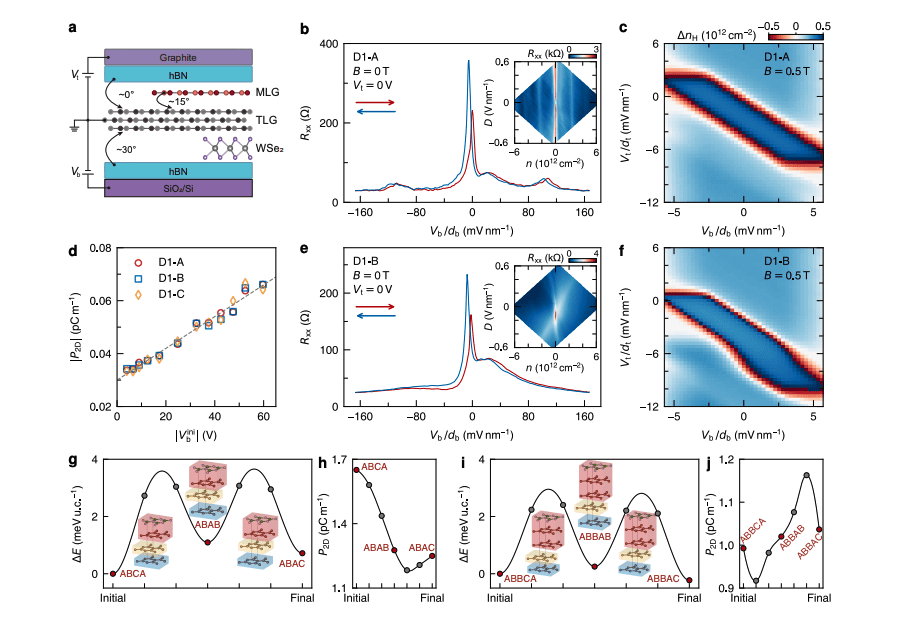
The emergent properties of layered two-dimensional materials continue to yield unexpected phenomena, with recent research demonstrating the spontaneous emergence of ferroelectricity—a state where material exhibits a spontaneous electric polarisation—within non-magnetic moiré superlattices. These structures, formed by stacking graphene and hexagonal boron nitride, exhibit complex interactions at the interface, leading to behaviours not observed in the individual components. A collaborative team, comprising Siqi Jiang, Renjun Du, Jiawei Jiang, and colleagues from the National Laboratory of Solid State Microstructures at Nanjing University, alongside Lei Qiao and Wei Ren from Shanghai University, Kenji Watanabe and Takashi Taniguchi from the National Institute for Materials Science in Japan, and Kai Chang and Hongxin Yang from Zhejiang University, detail these findings in their article, “The interplay of ferroelectricity and magneto-transport in non-magnetic moiré superlattices”. Their work reveals a surprising enhancement of ferroelectric polarisation by applied magnetic fields, persisting even at room temperature, and demonstrates how this polarisation subsequently influences the electronic transport properties of the material, suppressing quantum oscillations and modifying Hall states. This interplay offers potential avenues for developing novel two-dimensional memory and logic devices.
The emergence of spontaneous electric polarization, termed ferroelectricity, within graphene/hexagonal boron nitride (hBN) moiré superlattices represents a notable development in condensed matter physics. This phenomenon occurs without the need for traditional ferroelectric materials, which typically rely on the displacement of ions to generate polarization. Instead, ferroelectricity arises from the precise stacking arrangement within the moiré superlattice, a periodic structure formed when graphene and hBN layers are slightly misaligned. This arrangement creates a periodic potential that redistributes charge, resulting in spontaneous electric polarization.
The observed ferroelectricity is fundamentally an electronic mechanism, differing significantly from conventional ferroelectricity which is typically ionic. Conventional ferroelectric materials exhibit polarization due to the displacement of positively and negatively charged ions within their crystal structure. In contrast, this new form of ferroelectricity arises from the redistribution of electrons within the graphene layer, driven by the periodic potential of the moiré superlattice. This distinction is crucial, as it suggests the possibility of achieving ferroelectricity in materials where ionic displacement is limited or undesirable.
Application of a magnetic field demonstrably enhances the magnitude of the observed polarization. This coupling between the electronic structure and the magnetic field suggests a potential for controlling and manipulating the polarization through external magnetic stimuli. Importantly, this enhancement persists at room temperature, a critical factor for practical applications, as many ferroelectric materials require cryogenic cooling to maintain their properties.
The ferroelectric polarization significantly alters the material’s transport characteristics. Specifically, the polarization suppresses the appearance of Shubnikov-de Haas oscillations, quantum oscillations observed in the conductivity of certain materials at low temperatures and high magnetic fields. This suppression indicates that the polarization disrupts the formation of Landau levels, the quantized energy levels responsible for these oscillations. Furthermore, Hall effect measurements reveal alterations in the material’s behaviour, suggesting changes in both carrier density and mobility due to the presence of the polarization. The Hall effect measures the voltage produced across a conductor when a magnetic field is applied perpendicular to the current flow, providing information about the charge carriers and their movement.
The discovery opens avenues for developing novel nanoscale devices. The polarization could serve as the basis for data storage in memory devices, with different polarization states representing binary information. It also offers the potential for creating new logic gates, where polarization switching controls the flow of current. Moreover, the coupling between polarization and magnetic fields suggests the possibility of creating magnetoelectric devices, which convert between electrical and magnetic signals, with applications in sensors and actuators. The ability to achieve ferroelectricity in a two-dimensional material with sensitivity to external fields presents a versatile platform for future research and technological innovation.
👉 More information
🗞 The interplay of ferroelectricity and magneto-transport in non-magnetic moiré superlattices
🧠 DOI: https://doi.org/10.48550/arXiv.2507.00745