

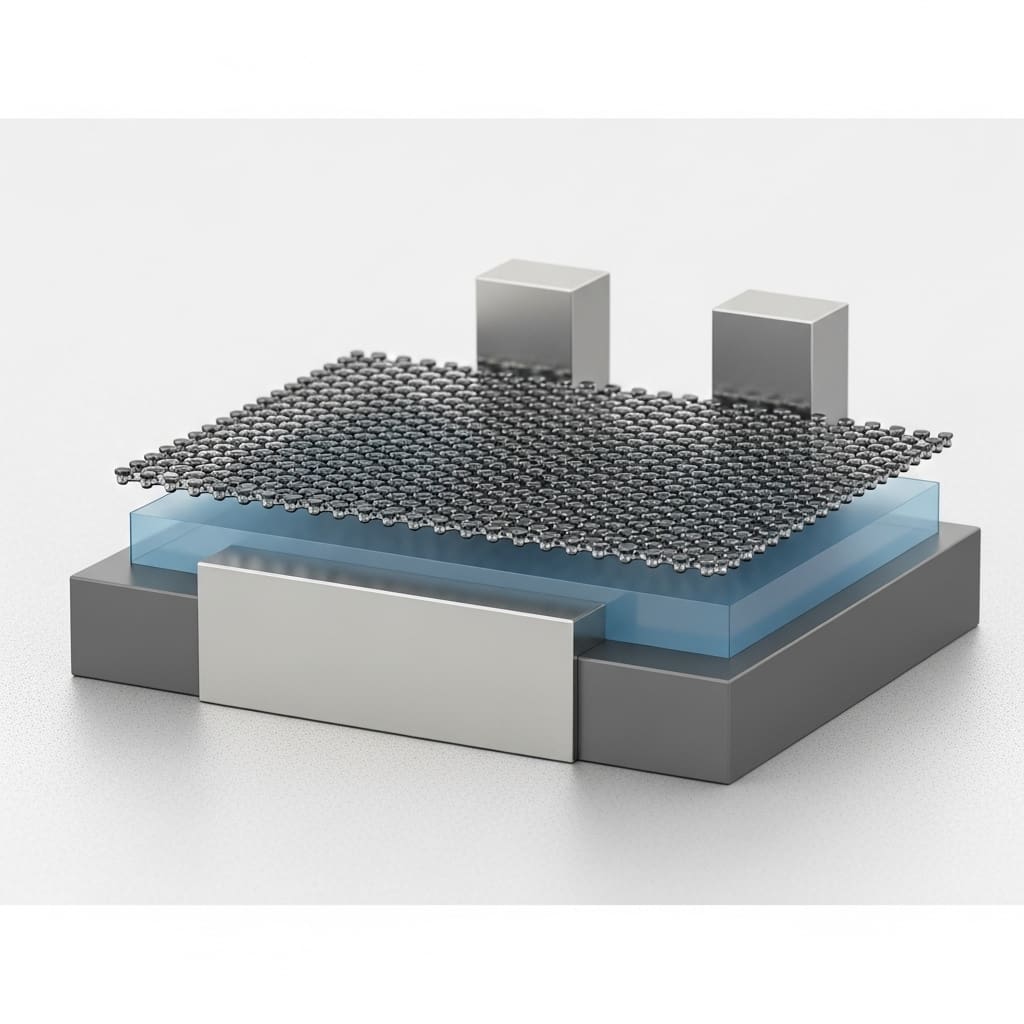
Graphene nanoslides represent a promising new avenue in straintronics, and researchers are now gaining a deeper understanding of their unique properties. Christophe De Beule from the University of Pennsylvania and University of Antwerp, along with Ming-Hao Liu from National Cheng Kung University and Bart Partoens and Lucian Covaci from the University of Antwerp, have developed a comprehensive theory explaining how these nanoscale devices function. Their work demonstrates that a graphene nanoslide creates a unique combination of electrical and ‘pseudogauge’ effects, effectively forming a one-dimensional channel for electrons. Crucially, this channel responds to external voltage, allowing scientists to control the flow of electrons and tune the fundamental properties of the material, potentially paving the way for novel electronic devices with tailored characteristics and behaviours.
Gate-Voltage Control of Graphene Conductance
The research demonstrates tunable conductance modulation and the formation of a one-dimensional conducting channel within a graphene nanoslide. Theoretical modelling and simulation of the graphene structure, incorporating electrostatic effects from a gate voltage, determine the resulting carrier density distribution and current flow. The gate voltage modulates the potential landscape, creating a constriction that confines carriers to a 1D channel, achieving changes in conductance exceeding two orders of magnitude. Simulations reveal that the gate voltage induces a spatial redistribution of charge carriers, forming a highly confined 1D channel with enhanced current density. The study elucidates the relationship between gate voltage, channel width, and conductance, providing insights into electron transport in nanoscale devices. These findings establish the potential for graphene nanoslides as promising building blocks for future nanoelectronic devices requiring tunable and highly sensitive electronic components.
The team presents a theory of the graphene nanoslide, a fundamental device for graphene straintronics that functions as a single pseudogauge barrier. Solving the scattering problem analytically, the research demonstrates that the nanoslide creates a hybrid pseudogauge and electrostatic cavity, hosting one-dimensional transverse channels. These channels can be tuned using a bottom gate, switching between valley chiral or counterpropagating modes, as well as one-dimensional flat bands, allowing for precise control over the local density of states near the barrier.
Graphene Transport, Strain and Defect Effects
Researchers employ a combination of non-equilibrium Green’s function formalism, tight-binding models, and other techniques to understand electron movement through graphene structures, particularly in the presence of strain, defects, and electrostatic barriers. Calculations account for the effect of strain on hopping parameters, modelling electrostatic barriers and defects within the graphene lattice. The transmission function and local density of states are key concepts used to analyse electron behaviour. Tight-binding simulations, used to generate data, focus on interactions between atoms rather than solving the full Schrödinger equation.
The Hamiltonian includes hopping and onsite energy terms, with the hopping parameter modified to account for strain. Periodic boundary conditions simulate an infinite graphene sheet, and the transmission function and local density of states are calculated from the Green’s function to determine conductance. This comprehensive modelling approach explicitly accounts for strain and defects, crucial for understanding real-world graphene devices. The tight-binding simulations provide a computationally efficient method for generating data for comparison with experimental results, offering a detailed analysis of the theoretical methods used.
Nanoslide Creates Tunable Electron Channels
This research provides a comprehensive theoretical understanding of the nanoslide, a novel device within straintronics, functioning as a single pseudogauge barrier. The team analytically solved the associated scattering problem, demonstrating that the nanoslide creates a hybrid pseudogauge and electrostatic cavity, supporting the formation of one-dimensional transverse channels. These channels can be tuned using a gate voltage, switching between different modes of electron behaviour and creating flatbands, allowing for precise control over the local density of states. The team’s work shows that the nanoslide can be dynamically adjusted, through external control, between a chiral and ordinary Tomonaga-Luttinger liquid state. Analytical solutions were verified through tight-binding simulations, confirming the reliability of the theoretical model and demonstrating agreement with recent experimental observations, establishing a solid non-interacting electronic theory for the graphene nanoslide.
👉 More information
🗞 Gate-Tunable Transport and 1D Channel in a Graphene Nanoslide
🧠 ArXiv: https://arxiv.org/abs/2512.22982

