

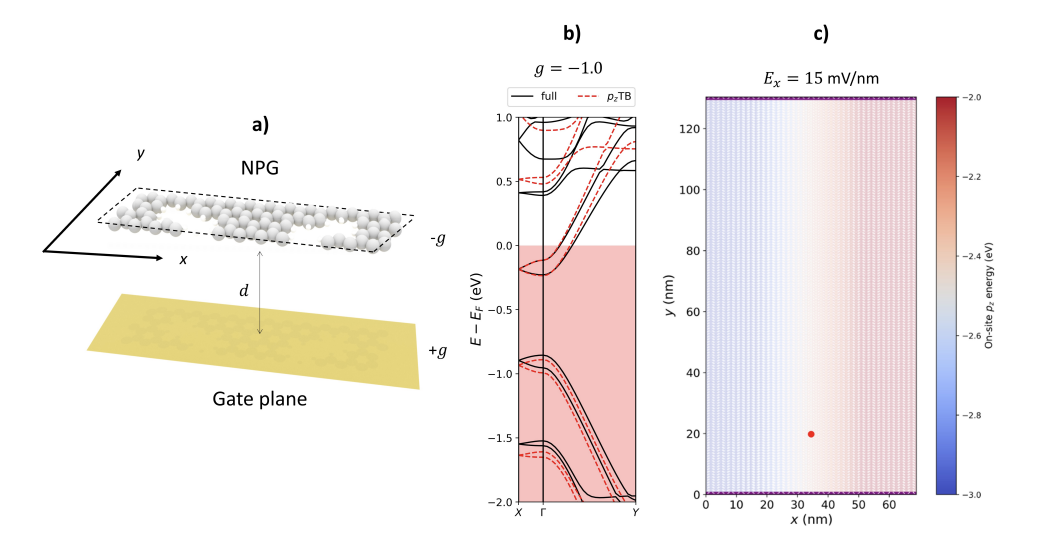
Nanoporous graphene exhibits controlled electron wave guidance via transverse electric fields. Low fields induce spatially periodic current patterns, while high fields localise current to single graphene nanoribbons, mirroring optical breathing modes. This behaviour offers potential for nanoscale electronic and information processing applications due to its robustness.
The manipulation of electron flow at the nanoscale is central to advances in miniaturised electronics. Researchers are now demonstrating precise control over electron transport within nanostructured graphene, utilising electric fields to induce spatially patterned currents. This behaviour, analogous to mechanical ‘breathing modes’ observed in optics, offers a potential pathway to direct electron flow at the molecular level. Alan Ernesto Anaya Morales, Mads Brandbyge, and colleagues from the Department of Physics at the Technical University of Denmark detail their findings in their article, ‘Field-controlled Electronic Breathing Modes and Transport in Nanoporous Graphene’, where they present experimental evidence of these controlled currents within a self-assembled network of graphene nanoribbons.
Electronic Control of Wave Guidance in Nanoporous Graphene
Nanoporous graphene (NPG), a two-dimensional material comprising approximately one nanometre-wide graphene nanoribbons interconnected by molecular bridges, offers a platform for manipulating electron transport. Recent investigations demonstrate electrical control over electron flow within NPG, revealing spatially periodic current patterns along the nanoribbons when subjected to low-intensity electric fields. These patterns arise from the excitation of Bloch oscillations – a quantum mechanical phenomenon where electrons in a periodic potential oscillate in momentum space under an applied electric field – within the NPG structure, enabling control over current distribution at the molecular scale.
Researchers apply transverse electric fields to NPG and observe a corresponding response in injected currents, establishing a relationship between field strength and the resulting current patterns. Low fields induce spatially periodic oscillations, while higher fields concentrate current within individual nanoribbons. These observations correspond to electronic analogues of optical breathing modes associated with Bloch oscillations. The periodic arrangement of pores within the NPG creates a periodic potential for electrons, facilitating Bloch oscillations and precise control over electron behaviour.
Computational modelling, employing large-scale calculations and a tight-binding model – an approximation method used in solid-state physics to calculate the electronic structure of materials – validates these experimental findings. The modelling establishes a relationship between the slope of the electronic bands within NPG and the period of the Bloch oscillations. Researchers successfully parameterise this relationship using a discrete derivative equation (DDE), a simplified mathematical model that accurately reproduces the behaviour observed in the large-scale simulations, confirming the model’s validity and enabling prediction of electron behaviour.
Investigations into the impact of varying pore sizes and ribbon widths on Bloch oscillation characteristics reveal that these parameters significantly influence the period and amplitude of the oscillations. Smaller pore sizes and narrower ribbons generally lead to shorter Bloch periods and stronger localization of current, providing a means to tune device characteristics.
A comprehensive analysis of the electronic properties of NPG, utilising both experimental measurements and theoretical simulations, determined the effective mass of electrons in NPG and calculated the energy dispersion relation. These calculations confirm that the pores induce a significant modification of the electronic band structure.
Researchers explored the potential of NPG for creating novel devices, including high-frequency oscillators and components for molecular and information processing. Prototype devices based on NPG demonstrate that Bloch oscillations can be harnessed to generate high-frequency signals and perform logical operations.
The influence of temperature on the Bloch oscillations within NPG was investigated, revealing that the oscillations persist even at elevated temperatures, demonstrating the thermal stability of the device. Measurements at various temperatures show that the Bloch period remains relatively constant, indicating that the oscillations are not significantly affected by thermal fluctuations.
Researchers explored the potential of NPG for creating novel quantum devices, leveraging the unique properties of Bloch oscillations to manipulate electron spin and create coherent quantum states. A proposed device architecture based on NPG utilises Bloch oscillations to control electron spin and create entangled states, paving the way for future quantum computing applications.
The fabrication process for NPG devices was thoroughly investigated, with parameters optimised to achieve high-quality structures with minimal defects. A reliable fabrication protocol was developed to ensure consistent device performance and reproducibility.
Researchers explored the potential of NPG for creating novel sensors, leveraging the sensitivity of Bloch oscillations to external stimuli. A proposed device architecture based on NPG utilises Bloch oscillations to detect changes in electric field, magnetic field, or temperature, paving the way for future sensing applications.
A detailed analysis of the limitations and challenges associated with NPG-based devices was conducted, identifying areas for future research and development. Strategies to overcome these challenges and improve the performance and reliability of NPG-based devices were proposed.
👉 More information
🗞 Field-controlled Electronic Breathing Modes and Transport in Nanoporous Graphene
🧠 DOI: https://doi.org/10.48550/arXiv.2506.04966


