

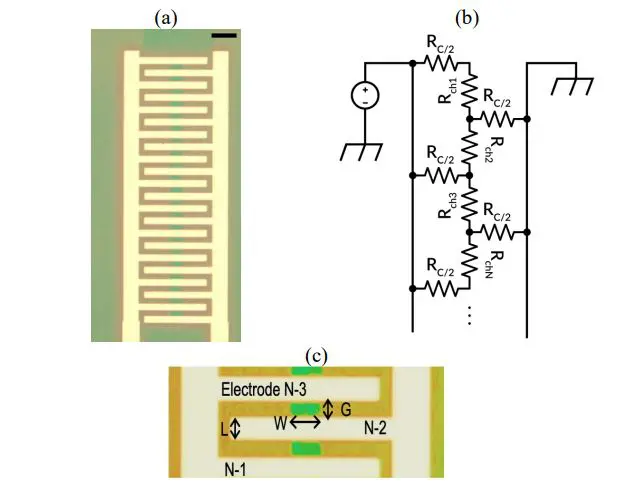
Graphene’s potential in advanced sensing devices hinges on minimising unwanted noise, and a new study investigates how the design of electrodes impacts performance. Georgia Samara, Christoforos Theodorou, Alexandros Mavropoulis, and colleagues explore the low-frequency noise and random telegraph noise in single-layer graphene micro ribbons with different electrode configurations. Their work demonstrates that carefully adjusting both the width of the graphene ribbons and the geometry of the interdigitated electrodes significantly influences the signal-to-noise ratio in these devices. These findings offer crucial guidelines for optimising fabrication processes and maximising the sensitivity of future graphene-based electronics, paving the way for more effective sensors and devices.
Scientists fabricated and experimentally examined graphene micro-ribbons of various widths and with different interdigitated electrode designs, focusing on their low-frequency noise behavior. Measurements revealed a characteristic 1/f noise spectrum and distinct noise characteristics depending on the graphene ribbon width and electrode geometry. This research investigates how these structural parameters influence low-frequency noise, specifically random telegraph noise attributed to surface traps, providing insights into optimizing graphene-based sensors by controlling trap density and distribution through careful design and fabrication.
Graphene Micro-Ribbon Fabrication via Electron Beam Lithography
Scientists engineered a sophisticated fabrication process to create high-performance electronic devices based on single-layer graphene and interdigitated electrodes. The study began by growing single-layer graphene on copper foil using chemical vapor deposition, subsequently transferring the material onto a silicon dioxide substrate coated with poly(methyl methacrylate). Researchers then employed a wet-transfer process, etching the copper foil and removing the PMMA layer using UV exposure and a solvent mixture, ensuring a pristine graphene surface. To prepare the surface, scientists utilized furnace annealing in hydrogen before patterning graphene micro-ribbons with electron beam lithography and oxygen plasma etching.
Nine distinct devices were fabricated, each combining different graphene ribbon widths, 50, 100, and 200μm, with interdigitated electrodes featuring varying inter-electrode spacings of 8, 15, and 25μm. The aluminum lift-off process defined the final interdigitated electrode topology on top of the graphene micro-ribbons, creating a network of electrodes for sensitive measurements. An optical microscope captured images of the completed devices, and an electrical equivalent circuit modeled the device’s behavior, accounting for graphene and contact resistances. Electrical characterization involved precise Current-Voltage measurements performed with a semiconductor parameter analyzer and a wafer prober.
To investigate noise characteristics, scientists implemented a specialized setup for random telegraph noise measurements, integrating a low-noise current amplifier, a source-measure unit, and a digital oscilloscope. This configuration detected and analyzed subtle current fluctuations, providing insights into trap activity within the graphene. The team systematically applied logarithmic current sweeps ranging from 1 to 100μA during measurements, meticulously recording the corresponding voltage to characterize device performance.
Graphene Geometry Controls Low-Frequency Noise
This research delivers a comprehensive analysis of low-frequency noise in graphene-based devices, revealing how geometrical design significantly impacts signal quality. Scientists fabricated devices consisting of interdigitated electrodes on single-layer graphene micro-ribbons, systematically varying both the width of the graphene ribbons and the spacing between the electrodes. Through meticulous experimentation, the team measured current-voltage characteristics, low-frequency noise, and random telegraph noise signals from nine distinct device configurations. Results demonstrate a clear relationship between device geometry and noise performance.
Current-voltage measurements confirmed expected electrical behavior, while detailed analysis of low-frequency noise revealed a 1/f spectral dependence, indicative of trap activity within the graphene. Crucially, the team discovered that adjusting the width of the graphene micro-ribbons and the inter-electrode spacing directly influences the signal-to-noise ratio. Measurements show that optimizing these geometrical parameters can maximize the signal-to-noise ratio, a critical factor for sensitive sensing applications. Further investigation using random telegraph noise analysis provided insights into the underlying trap mechanisms contributing to the observed noise. This work establishes a direct link between the electronic properties of these devices and their physical design, offering valuable guidelines for future fabrication efforts. By carefully controlling the geometry of the interdigitated electrodes and graphene ribbons, scientists can engineer devices with enhanced signal quality and improved performance for a wide range of sensing technologies.
Graphene Noise Links Geometry, Conductance, Interfaces
This research presents a detailed investigation into graphene-based devices consisting of interdigitated electrodes and micro-ribbons, revealing key insights into their low-frequency noise characteristics. The team demonstrated that the geometry of these devices, specifically the width of the micro-ribbons and the electrode design, significantly influences the signal-to-noise ratio, offering guidelines for optimizing device fabrication. Through analysis of random telegraph noise signals, researchers identified up to three distinct noise levels originating from traps located at the interfaces between the graphene and surrounding materials. Furthermore, the study established a correlation between device conductance and the amplitude of random telegraph noise, indicating that higher conductance levels generally result in lower normalized noise amplitudes. This finding is valuable for both minimizing noise in sensor applications and, conversely, for exploiting noise as a sensing mechanism where high noise levels are desirable.
🗞 Impact of interdigitated electrodes design on the low frequency and random telegraph noise of single-layer graphene micro ribbons
🧠 ArXiv: https://arxiv.org/abs/2512.11644


