

The fundamental interactions between tiny magnetic moments, known as spins, underpin a wide range of technologies, from data storage to advanced computing, and understanding their behaviour is crucial for progress in these fields. Beatriz Viña-Bausá from Universidad Autónoma de Madrid, Antonio T. Costa from Physics Center of Minho and Porto Universities, and Joao Henriques from Universidade de Santiago de Compostela, alongside their colleagues, now report a remarkable discovery concerning these interactions within the two-dimensional material graphene. The team demonstrates unexpectedly strong magnetic coupling between spins separated by distances exceeding ten nanometres, significantly surpassing previous observations in similar systems. This achievement, made possible through precise manipulation of individual hydrogen atoms on graphene and detailed analysis of their magnetic properties, opens new avenues for designing materials with tailored magnetic behaviour and controlling spin interactions at the atomic scale.
Magnetic interactions between localized spins-1⁄2 play a central role in quantum magnetism, spin-based quantum computing, and quantum simulation. The range and strength of these interactions determine the emergent quantum phenomena and dictate the performance of potential quantum technologies. Researchers investigate these interactions in a variety of materials, seeking to understand and ultimately control them for practical applications. This work focuses on understanding the mechanisms governing magnetic coupling in specific molecular systems, with the goal of designing materials exhibiting tailored magnetic properties.
Hydrogen Adsorption and Magnetic Coupling on Graphene
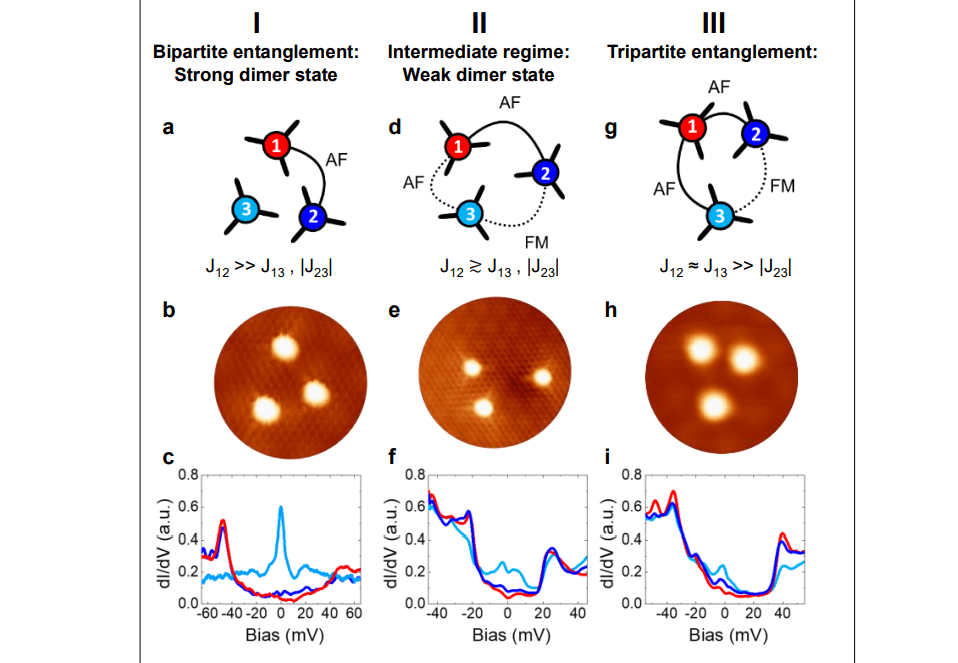
Scientists demonstrate the ability to manipulate and tune magnetic interactions between hydrogen atoms adsorbed on graphene at the atomic scale, aiming to understand their nature and potentially build scalable architectures for spintronics or other magnetic devices. The research confirms a decaying exchange coupling with increasing distance between hydrogen atoms, consistent with observations in other materials, and provides a quantitative comparison of coupling strengths and distances across various systems. Mapping and calculations visualize the magnetic moments and spectral density of specific arrangements, revealing the delocalization of magnetic moments and providing insights into the nature of the excitations. Experiments on trimer configurations demonstrate the ability to manipulate these structures and observe changes in the spin excitation spectrum, confirming control over the magnetic interactions.
Theoretical modeling using the Heisenberg model provides good qualitative agreement with experimental data, helping to understand the underlying magnetic interactions. Crucially, the research demonstrates the scalability of this approach, creating larger arrangements of hydrogen atoms that exhibit collective coupling with multiple inelastic excitation features. Sequential removal of atoms leads to significant changes in the spectra, confirming the tunability of the system. The researchers critically analyze their models and discuss potential areas for future research, demonstrating a thorough and rigorous approach.
Long-Range Magnetic Coupling in Hydrogenated Graphene
Scientists have demonstrated remarkably strong exchange interactions between localized spins, achieving couplings of 3 meV at separations exceeding 10 nanometers, surpassing all previously studied systems. This breakthrough stems from investigations into pairs and trimers of spin-1/2 particles created by attaching individual hydrogen atoms to graphene using a scanning tunneling microscope. The work reveals that these interactions can be either ferromagnetic or antiferromagnetic, depending on the relative arrangement of the hydrogen atoms on the graphene lattice. Researchers selectively positioned hydrogen atoms on graphene to induce localized magnetic moments, leveraging the fact that each attached atom contributes a spin-1/2 moment due to an unpaired electron.
By carefully controlling the placement of these atoms, the team created pairs exhibiting distinct magnetic behaviors, confirmed through both experimental measurements and large-scale mean-field Hubbard calculations. Specifically, when hydrogen atoms are adsorbed on opposite sublattices of the graphene, they couple antiferromagnetically, forming a singlet ground state with a total spin of zero. Conversely, when positioned on the same sublattice, the coupling becomes ferromagnetic, resulting in an open-shell triplet ground state with a total spin of one. Experiments on antiferromagnetically coupled pairs revealed clear energy-symmetric steps in the differential conductance, indicative of spin excitations transitioning from the singlet ground state to a triplet excited state.
These measurements were corroborated by mean-field Hubbard calculations, which confirmed the antiferromagnetic ground state through visualization of atomic magnetization. Similarly, ferromagnetic pairs also exhibited inelastic features, aligning with the calculated magnetization patterns. The team further observed unique spectral features in the ferromagnetic case, linked to fluctuations in the occupation of hydrogen-induced zero modes, demonstrating a complex interplay between electronic structure and magnetic interactions.
Tunable Magnetic Interactions Between Hydrogen Atoms
This research demonstrates robust and tunable magnetic interactions between individual hydrogen atoms chemisorbed on graphene, achieving exchange couplings of 3 meV at separations exceeding 10 nanometers, surpassing previously known systems. Through precise atomic manipulation and inelastic electron tunneling spectroscopy, scientists directly mapped these interactions, revealing that the coupling can be either ferromagnetic or antiferromagnetic depending on the arrangement of the hydrogen atoms on the graphene lattice. The ability to control these interactions extends to spin trimers, where collective spin excitations emerge when pairwise couplings are comparable, establishing a platform for engineering designer spin Hamiltonians. These findings establish a powerful method for creating and studying atomic-scale magnetic systems, offering potential advancements in both fundamental materials science and quantum technologies. Future work will focus on combining this precise control with tunable carrier density and integrating superconducting proximity effects, potentially leading to the investigation of exotic quantum phases at the intersection of magnetism and superconductivity, and paving the way for new directions in quantum materials design and simulation.
👉 More information
🗞 Ultra-long-range spin coupling in graphene revealed by atomically resolved spin excitations
🧠 ArXiv: https://arxiv.org/abs/2511.06887

