Researchers are increasingly focused on understanding electron behaviour in monolayer graphene, a material with significant potential for future electronic devices. Karuppuchamy Navamani from KPR Institute of Engineering and Technology, and colleagues, have investigated the relationship between voltage-driven charge density and energy quantization within Dirac dynamics. This work addresses a fundamental need for improved descriptors linking disorder to charge puddles, which directly impact graphene’s electrical conductivity. By proposing four postulates and employing a novel differential entropy (h)-ruled wavevector (k) mechanics approach, the study maps energy quantization and explores the Klein paradox, a phenomenon relevant to ultrafast dynamics in Dirac systems. The findings reveal a key interaction potential-density of states relationship, generalising electron dynamics in both unbounded and bounded systems and offering new insights into electronic transport mechanisms.
Scientists have developed a new method to map energy quantization in Dirac materials, offering a pathway to better understand and control electron behaviour in these advanced systems. This work focuses on monolayer graphene, a two-dimensional material exhibiting unique electronic properties stemming from its Dirac electrons, particles that behave as if they have no mass.
The research establishes a direct link between externally applied voltage and the resulting energy levels within the graphene, revealing how charge density influences electron dynamics. By employing a novel approach based on differential entropy and wavevector mechanics, researchers have quantified the relationship between interactive potential and the density of states, a crucial parameter governing electrical conductivity.
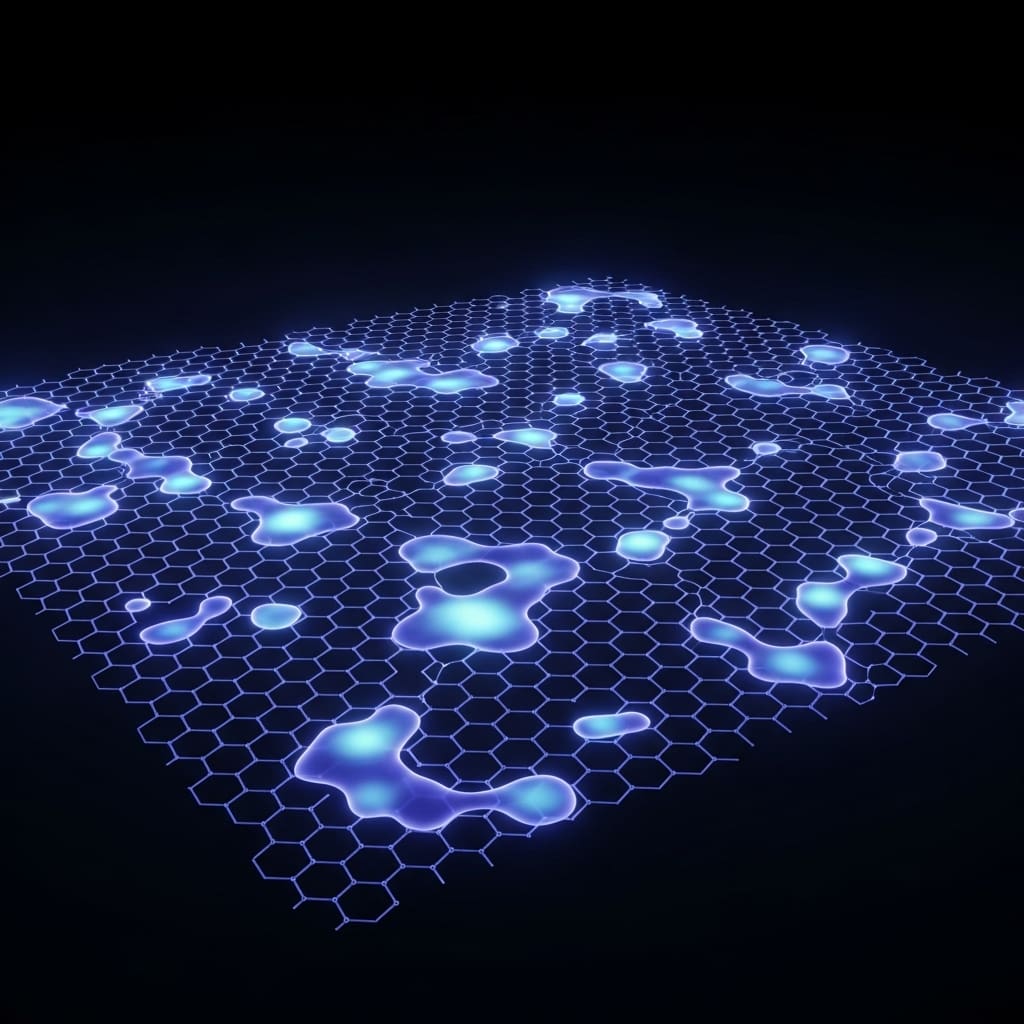
The study builds upon observations of electron-hole puddles forming near the charge neutrality point in graphene, where the number of electrons and holes are equal. These puddles arise from inherent disorder within the material and are sensitive to external electric fields. Through a series of postulates grounded in prior experimental and theoretical findings, the team proposes an entropy-guided wavevector propagation approach to describe electronic transport.
This framework introduces “h-ruled k” and “h-ruled N” relations, generalizing electron dynamics in both confined and unbounded Dirac systems. The core finding demonstrates that energy shifts between quantum states follow a precise relationship, scaling with the voltage-driven potential energy contribution factor to the third power.
This quantization mapping procedure, conducted under varying voltage conditions, provides insights into the interplay between interaction potential and density of states within graphene. The developed model not only clarifies the behaviour of electrons in graphene but also offers a generalised framework applicable to other Dirac materials, potentially impacting the design of next-generation electronic, thermoelectric, and quantum devices.
The ability to precisely control and predict electron behaviour at the nanoscale opens avenues for creating more efficient and versatile technologies. The research highlights the importance of understanding ultrafast electron-hole kinetics in these materials, paving the way for innovations in areas such as high-speed electronics and energy storage.
Voltage-dependent carrier dynamics and entropy-scaled density of states in monolayer systems
Calculations reveal that doubling the carrier energy requires 8V, or that N-multiply times the carrier energy necessitates N3-multiply applied voltage. This relationship, observed through differential entropy-ruled charge transport and wavevector mechanics, defines the energy state and wavevector under varying voltages for potentially bounded monolayer systems at 0.4K.
The research establishes a direct correlation between applied voltage and carrier dynamics via the exponential weighting of differential entropy, demonstrating how the existence of degeneracy modifies Gaussian wave packet dynamics. Specifically, the study quantifies the energy shift from lower to excited states, finding that the number of states, N(k), obeys the relation N(k)=N(U)3, where N(U) represents the voltage-driven potential energy contribution factor.
The Dirac density of states (DOSP) is redefined as entropy changes occurring at intervals of 1.5193×107cm-1 wavevector, with a corresponding change in entropy per unit energy change of ∆E= ħvF∆k= 1eV, where ħvF=6.582×10⁻¹⁰ eV.m. These values provide a precise descriptor for electronic transport materials.
Analysis of the data, summarised in Table 2, shows that for a given gate voltage, the carrier energy, wavevector, relative differential entropy, and charge density can be calculated. For instance, at a threshold voltage of 1V, the carrier energy is 30.868 meV, the wavevector is 4.689×10⁷m-1, the relative differential entropy is 0, and the charge density is 7×1010cm-2.
The applied voltage contribution to the DOSP is described as dEN/dhS= eVg, which indicates the populated electron-hole puddles around the Dirac point. Furthermore, the work demonstrates that in bounded electronic systems of relativistic massless Fermions, the Klein paradox is invalid, or experiences a breakdown.
The study highlights that kinetic energy only significantly contributes in ultrapure monolayer graphene or ideal Dirac materials, where the applied voltage directly influences carrier dynamics. The relationship between energy state and potential energy is expressed as EN(k) = NEi∝N3eVi, revealing how the required potential well for quantum state existence scales with applied voltage.
Mapping Dirac Electron Energy Quantisation via Differential Entropy and Wavevector Mechanics
A differential entropy-ruled wavevector (k) mechanics approach forms the basis of this work, designed to map energy quantization for Dirac electrons in monolayer graphene. This methodology leverages the empirical relationship between voltage-driven charge density and the propagation of wavevectors, offering a novel means to study electronic transport.
The research postulates four key observable descriptions derived from earlier reports, enabling a precise investigation of electronic behaviour alongside the Klein paradox, a phenomenon relevant to ultrafast dynamics in Dirac systems. Central to the study is the concept of Density of States Proportion (DOSP), defined as the change in differential entropy per unit energy, or, equivalently, energy-scaled entropy.
This quantity serves as a proxy for conventional density of states when multiplied by charge density, providing insight into the interaction potential and its influence on linear energy dispersion. By examining the one-to-one variation between differential entropy and energy, the study elucidates how interaction potentials impact electronic transport in Fermionic systems.
The methodology extends beyond simple observation by employing a quantization mapping procedure under varying voltage-driven potential boundary conditions. This allows for the observation of energy shifts from lower to excited states, governed by the relation N(k)=N(U)^3, where N(U) represents the voltage-driven potential energy contribution.
Through this process, the research characterizes compressible and incompressible states within the graphene, modifying them with applied potential energy and classifying transport as localized hopping, delocalized band conduction, or an intermediate state. The derived DOSP factor is then used to quantify changes in normal DOS due to external effects such as voltage, electric field, doping, and thermodynamics, ultimately contributing to a unified understanding of charge transport.
The Bigger Picture
Scientists have long sought a robust way to describe electron behaviour within the uniquely relativistic environment of graphene. The material’s Dirac-like electronic structure promises extraordinary properties, but realising them is hampered by inherent disorder and the resulting ‘puddles’ of charge that disrupt smooth electron flow.
This work offers a novel approach, framing electron dynamics not simply as wave propagation, but as guided by principles of differential entropy. It’s a shift in perspective that attempts to directly link the microscopic disorder to macroscopic conductivity, a connection that has proved stubbornly elusive.
The significance lies in moving beyond simply observing these charge puddles, to modelling their influence on energy levels with a new set of postulates. By relating voltage-driven charge density to wavevector mechanics through entropy, the research proposes a quantifiable link between interactive potential and the density of states.
This could accelerate the design of graphene-based devices, allowing engineers to predict and mitigate the effects of imperfections. However, the model relies on empirical relationships and, while internally consistent, requires further validation against a wider range of experimental conditions. The extent to which this entropy-guided approach can account for more complex interactions, or be scaled to larger, more realistic graphene structures, remains an open question.
Future work might focus on incorporating temperature effects or exploring the model’s predictive power in heterostructures combining graphene with other two-dimensional materials. Ultimately, the goal is not just to understand electron behaviour in graphene, but to harness it, and this approach offers a potentially powerful new tool in that endeavour.
👉 More information
🗞 Quantization Mapping on Dirac Dynamics via Voltage-Driven Charge Density in Monolayer Graphene: A Klein Paradox and Entropy-Ruled Wavevector Mechanics Study
🧠 ArXiv: https://arxiv.org/abs/2602.11604