

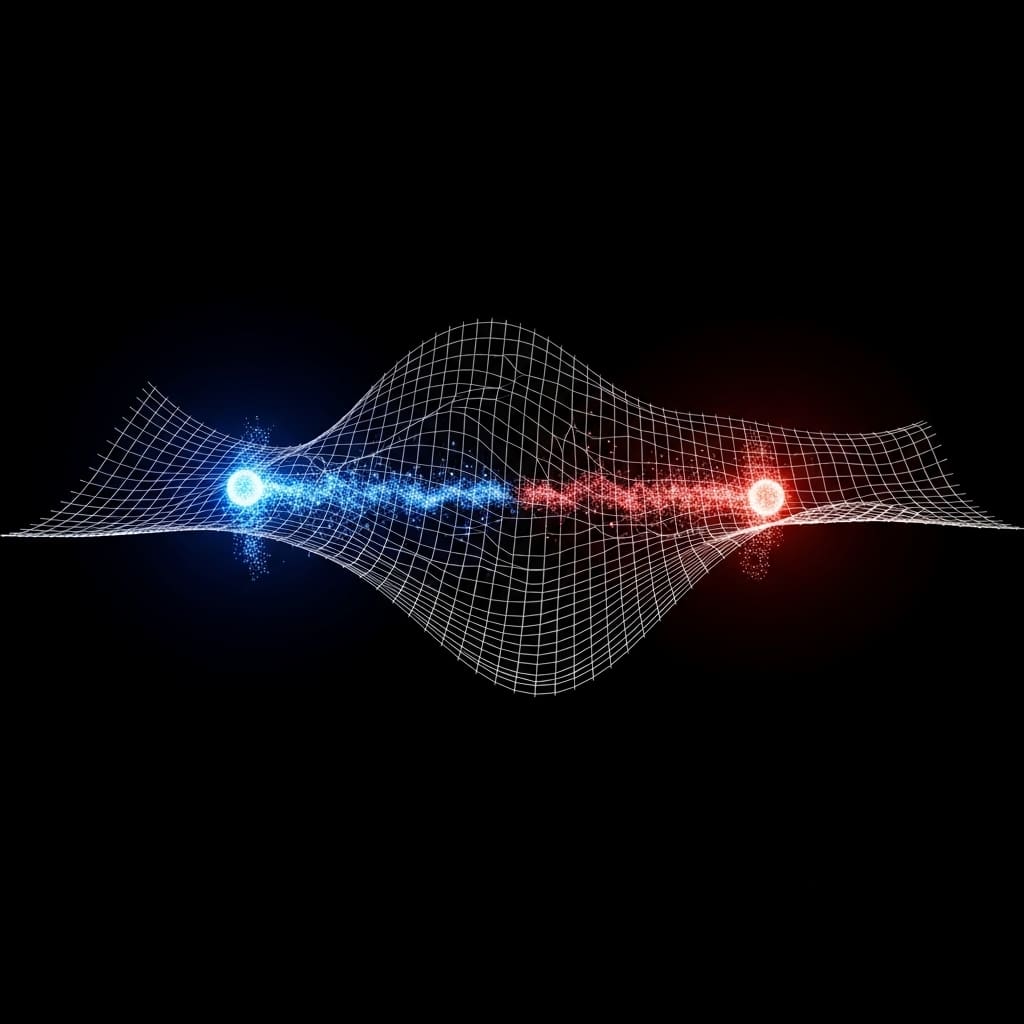
Researchers are increasingly focused on harnessing the unique properties of Kekulé-distorted graphene for advanced electronic and optoelectronic devices. In a new study, Sita Kandel and Godfrey Gumbs, both from the Department of Physics at Hunter College and The Graduate School and University Center of the City University of New York, detail how high-frequency electromagnetic fields can control electron and exciton transport within this material. Their findings demonstrate near-perfect exciton transmission across potential barriers, a phenomenon not observed in single electrons, and reveal that irradiation fundamentally alters exciton behaviour. This work is significant because it opens avenues for manipulating valleytronics and optimising energy spectrums for practical applications, potentially leading to novel devices based on coherent exciton transport.
The unusual electronic structure of Kekulé-distorted graphene, characterised by exceptionally low effective masses for both electrons and holes, leads to nearly perfect transmission of excitons through potential barriers regardless of their angle of incidence, a form of the Klein parado.
Researchers calculated the exciton binding energy, a crucial parameter governing how tightly bound the electron-hole pair is, to understand how quantum tunneling is affected by the composite particle’s mass and energy. Irradiation with circularly polarized light fundamentally modifies exciton formation, coherence, and transport, resulting in behaviours markedly different from those observed in conventional Dirac materials. This ability to tune the energy spectrum and transport properties through Floquet engineering, the use of periodic light fields, suggests potential applications in advanced optoelectronic devices. Furthermore, the folding of energy valleys within the material enables feasible intervalley coupling, opening avenues for manipulating valley-based electronics, or valleytronics. The study meticulously examines how a high-frequency driving electromagnetic field influences both the tunneling and blocking of electrons and excitons by a potential barrier, providing insights into the fundamental physics governing these interactions. By investigating the dynamics of these particles, this work establishes a foundation for designing novel materials and devices with tailored electronic and optical characteristics. Transmission of excitons through a symmetric potential barrier in Kekulé-distorted graphene approaches perfection, with nearly complete transmission observed regardless of the angle of incidence. Detailed calculations reveal that the exciton binding energy, crucial for understanding quantum tunneling of electron-hole pairs, is fundamentally modified by irradiation with circularly polarized light. The small effective masses of electrons and holes within the energy spectrum of Kekulé-distorted graphene facilitate this near-perfect exciton transmission, particularly for any angle at which excitons impinge upon the potential barrier. The research further establishes that the mass of the composite electron-hole pair, measured at the centre of mass, and its binding energy are key determinants of tunneling probability. A numerical method underpinned the investigation of electron and exciton behaviour within Kekulé-distorted graphene, overcoming the complexity of analytically solving the governing equations. The study focused on simulating the transmission and reflection of charged particles and neutral excitons as they encounter a potential barrier, determining transmission and reflection coefficients (t+, t−, r+, r−) to model particle behaviour at the barrier interface. To dissect the influence of valley mixing, the research meticulously calculated valley-resolved angular transmission probabilities, denoted as T++ and T+−, quantifying the probability of intravalley versus intervalley transmission after traversing the barrier. The total transmission (T) and reflection (R) were then determined by summing the respective contributions from each valley. This detailed analysis was crucial, as Kekulé distortion, a specific lattice deformation, can bring valleys closer in reciprocal space, enabling intervalley scattering that is forbidden in pristine graphene. Simulations were performed for potential barrier widths of 300a, 600a, 1200a, and 2400a, where ‘a’ represents the lattice constant of graphene (2.46Å), with a fixed incident particle energy of εY = 0.028eV and a potential barrier height of V0 = 3εY. A Kekulé parameter, ∆0, was introduced to control the degree of lattice distortion, using values of 0.2 for the distorted graphene and 0 for pristine graphene for comparative analysis. Polar plots were generated to visualise the angular dependence of transmission, revealing how particle behaviour changes with the angle of incidence. Scientists have long sought to manipulate the flow of electrons and excitons, quasiparticles representing bound electron-hole pairs, within materials, a pursuit central to advances in optoelectronics and potentially, valleytronics. This work, focusing on Kekulé-distorted graphene subjected to electromagnetic irradiation, reveals a surprising asymmetry in how these particles behave at potential barriers. While excitons demonstrate near-perfect transmission, seemingly defying conventional quantum mechanics through a form of the Klein paradox, electrons are significantly hindered, their tunneling suppressed by both the material’s distortion and the applied radiation. Graphene, with its unique Dirac-like electronic structure, offered a promising platform, but imperfections and the need for precise control over particle behaviour presented significant hurdles. This research demonstrates that manipulating the way particles experience a barrier, through high-frequency electromagnetic fields, can be as important as the barrier itself. The observed exciton behaviour hints at the possibility of designing materials where composite particles behave fundamentally differently from their constituent electrons, opening up new avenues for device functionality. However, the study is limited to a specific material configuration and irradiation scheme. The precise mechanisms underlying the suppressed electron transmission require further investigation, and scaling these effects for practical applications remains a challenge. Future work might explore how these principles apply to other two-dimensional materials, or investigate the potential for tailoring the electromagnetic field to achieve even greater control over exciton transport. Ultimately, this research demonstrates a new level of finesse in directing the quantum dance of electrons and excitons, a crucial step towards realising genuinely novel electronic devices.
👉 More information
🗞 Floquet Control of Electron and Exciton Transport in Kekulé-Distorted Graphene
🧠 ArXiv: https://arxiv.org/abs/2602.11119


