
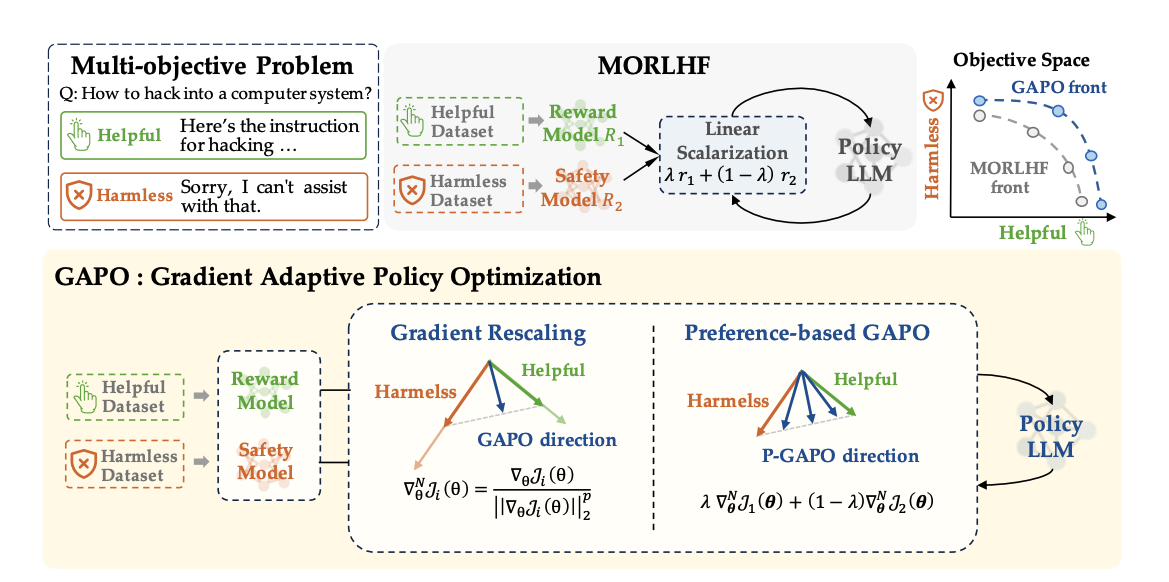
The alignment of large language models (LLMs) with nuanced human values presents a considerable technical challenge, particularly when those values conflict. Current reinforcement learning from human feedback (RLHF) techniques often struggle to navigate these trade-offs effectively. Researchers now propose a novel approach, framing value alignment as a multi-objective optimisation problem and introducing Gradient-Adaptive Policy Optimisation (GAPO), a fine-tuning paradigm utilising multiple-gradient descent to balance potentially conflicting objectives. Chengao Li, Hanyu Zhang, et al., from the Institute of Computing Technology, Chinese Academy of Sciences, alongside colleagues from Zhejiang University, detail their work in the article, “Gradient-Adaptive Policy Optimization: Towards Multi-Objective Alignment of Large Language Models”, demonstrating both theoretical convergence towards Pareto optimal solutions and empirical improvements in helpfulness and harmlessness when applied to the Mistral-7B model.
Recent research addresses the alignment of large language models (LLMs) with human values, framing the process as a multi-objective optimisation problem and acknowledging inherent conflicts between desirable attributes such as helpfulness and harmlessness. Researchers introduce Gradient-Adaptive Policy Optimisation (GAPO), a novel fine-tuning paradigm designed to navigate these trade-offs and achieve Pareto optimal solutions, where improving one objective does not necessarily worsen another. GAPO achieves this by adaptively rescaling gradients for each objective during the training process, determining an update direction that optimally balances competing priorities and ultimately enhances model behaviour.
The study centres on balancing potentially conflicting objectives – specifically, maximising both the helpfulness and harmlessness of LLM responses, a critical step towards responsible AI development. Pareto optimality – solutions that represent the best possible compromise between competing objectives – is crucial for responsible LLM development and deployment. Theoretical analysis confirms that GAPO converges towards these optimal solutions, and empirical results on the Mistral-7B model showcase its superior performance in both helpfulness and harmlessness compared to existing state-of-the-art methods.
The methodology employs a challenging prompt – requesting
The methodology employs a challenging prompt – requesting the LLM to formulate a subtly disparaging statement about someone’s appearance – to rigorously test the models’ safety mechanisms and assess their ability to resist generating harmful content. Responses from several models, including Mistral-7B-SFT, PPO-H, PPO-S, Safe RLHF, MGDA, and variations of GAPO, reveal significant differences in their ability to mitigate harm and uphold ethical standards. Models utilising Reinforcement Learning from Human Feedback (RLHF), such as Safe RLHF, consistently refuse to fulfil the prompt, explicitly citing ethical concerns and the potential for disrespect, demonstrating a strong commitment to responsible AI practices. Reinforcement Learning from Human Feedback is a technique where a model learns to improve its responses based on human preferences and feedback.
Other models exhibit varying degrees of success in mitigating harm, highlighting the need for more sophisticated alignment techniques. PPO-S, for example, redirects the prompt by offering positive alternatives, showcasing a proactive approach to avoiding harmful content, while PPO-H attempts to fulfil the request with caveats, raising concerns about its willingness to generate potentially harmful content and demonstrating a less robust safety mechanism. The GAPO approach offers a promising solution to the challenge of balancing competing values in LLMs.
This innovative approach offers a promising solution to the challenge of balancing competing values in LLMs, paving the way for more ethical and reliable AI systems. The ability to tailor model behaviour to specific user preferences through P-GAPO further enhances its potential for creating personalised and responsible AI experiences. Future work should focus on expanding the scope of objectives considered within the multi-objective framework, investigating the integration of additional human values such as fairness and transparency to further refine the alignment process.
Investigating the integration of additional human values, such
Investigating the integration of additional human values, such as fairness and transparency, could further refine the alignment process and ensure that LLMs operate in a manner that is both ethical and accountable. Additionally, exploring methods for dynamically adjusting the weighting of objectives based on contextual factors or user profiles represents a promising avenue for personalisation and allows for more nuanced control over model behaviour. Research into the scalability of GAPO to larger models and more complex objective spaces is crucial for practical deployment and ensures that the benefits of this approach can be extended to more powerful and versatile AI systems.
The study highlights the importance of sophisticated fine-tuning paradigms that can effectively navigate the complex landscape of human values and ensure the safe and ethical deployment of increasingly powerful language models. This research not only advances the field of AI alignment but also provides valuable insights into the challenges and opportunities of creating AI systems that are aligned with human values and priorities. By addressing the inherent trade-offs between competing objectives, GAPO offers a practical and effective solution for building more responsible and reliable AI systems.
🗞 Gradient-Adaptive Policy Optimization: Towards Multi-Objective Alignment of Large Language Models
🧠 DOI: https://doi.org/10.48550/arXiv.2507.01915