

Next-generation cellular networks demand increasingly sophisticated signal processing to maximise spectral efficiency, yet translating theoretical advances into practical systems remains a significant challenge. Abhishek Kumar Singh and Kyle Jamieson, from Princeton University, address this gap with MMGaP, a novel approach to multi-user MIMO detection and precoding. This research achieves, for the first time, the implementation of these complex algorithms on commodity graphics processing units (GPUs), offering a pathway to substantially improved performance in real-world 5G networks. Demonstrating a significant breakthrough, MMGaP boosts both uplink and downlink throughput by as much as 100 Mbps per user in a typical cellular scenario, and importantly, operates at line-rate, meeting the stringent timing demands of modern wireless systems. This work paves the way for more efficient and higher-capacity mobile communications by bridging the gap between theoretical potential and practical implementation.
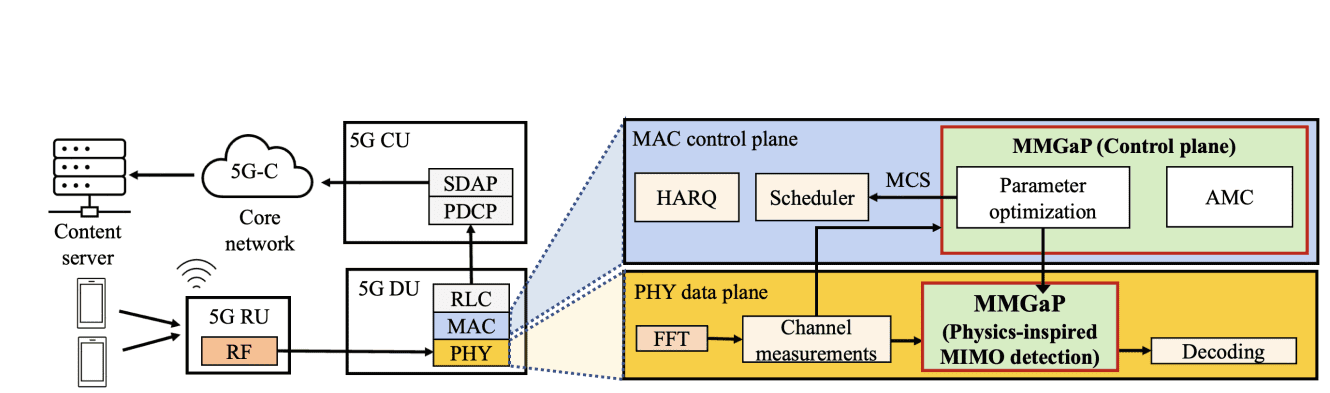
To address this, scientists have developed MMGaP, a novel method for processing signals in next-generation cellular networks. MMGaP realizes large Multiple-Input Multiple-Output (MIMO) processing algorithms on commodity hardware for the first time, utilizing bare-metal CUDA kernels that scale effectively on large GPU processing platforms and can be integrated as TensorFlow modules. The team integrates MMGaP with NVIDIA’s software-defined, GPU-accelerated 5G platform and evaluates its performance against current state-of-the-art methods.
MMGaP Solves Combinatorial Optimization Problems
Scientists are exploring the use of Coherent Ising Machines (CIMs) to solve complex combinatorial optimization problems. MMGaP is a system built on CIMs, employing numerical integration and matrix-vector multiplication to find solutions. A key challenge lies in balancing the accuracy and efficiency of the numerical integration process that governs the CIM’s behaviour. Researchers focus on the CIM-CAC equations, which describe the dynamics of the system, and investigate how the integration interval and the frequency of matrix-vector multiplication affect the solution’s accuracy and stability. The team discovered that a smaller integration interval generally leads to more accurate results but requires more computation.
Similarly, more frequent matrix-vector multiplication updates can improve accuracy but also increase computational cost. Through extensive testing, they found that an integration interval of 0. 02 combined with a matrix-vector multiplication frequency of 2 provides an optimal balance between accuracy and computational efficiency. This configuration minimizes the probability of divergence and maintains a low error rate in the final solution. These findings suggest that careful selection of integration parameters is crucial for achieving accurate and efficient solutions using CIMs, and can improve the performance of MMGaP and other CIM-based systems.
MMGaP Achieves Practical 5G MIMO Throughput Gains
Scientists have achieved a significant breakthrough in next-generation cellular radio access networks by developing MMGaP, a novel method for processing signals in the physical layer. This work addresses a critical gap between theoretical spectral efficiency gains and the actual throughput achievable by practical systems. Experiments demonstrate that MMGaP substantially improves throughput in a 5G cellular network. In a scenario with 100MHz of radio bandwidth, eight antennas at the base station, and eight concurrent users, the team measured an approximate 50 Mbps per user improvement in uplink throughput and a 100 Mbps per user increase in downlink throughput across a wide range of signal-to-noise ratios.
Further tests with larger MIMO configurations, specifically 16 antennas and 16 users, revealed that MMGaP delivers more than 50 Mbps higher uplink throughput per user. The team meticulously measured the execution time of MMGaP on various NVIDIA GPUs, confirming its ability to operate at line-rate and meet the stringent timing requirements of state-of-the-art 5G systems. Microbenchmarking revealed that MMGaP’s data decomposition approach, dividing processing tasks among GPUs, is highly effective, with execution times scaling inversely with the number of GPUs employed. With sufficient GPU resources, MMGaP can maintain line-rate operation for large 5G systems utilizing 100MHz bandwidth at 30 KHz subcarrier spacing, and 50MHz bandwidth at 15 KHz subcarrier spacing. Researchers also assessed the deployment cost, estimating that a 5G system utilizing MMGaP with 30 NVIDIA A100 GPUs would incur an approximate 20% increase in expenditure compared to the overall cost of a 5G cell site, based on FCC estimates. This cost is further mitigated by the potential for bulk-order discounts on GPUs for base station manufacturers.
MMGaP Achieves 5G Throughput Gains on GPUs
MMGaP represents a significant advance in multi-user MIMO detection for next-generation cellular networks. This research successfully implements a physics-inspired algorithm on commodity GPU hardware, achieving substantial improvements in both uplink and downlink throughput compared to conventional linear MIMO detectors. In a typical 5G scenario, the team demonstrated throughput gains of approximately 50 Mbps per user in the uplink and 100 Mbps per user in the downlink, and further improvements were observed with larger antenna configurations. The achievement lies in the development of a scalable GPU-based detector that meets the processing demands of modern 5G systems, offering an alternative to established methods that have dominated the field for over two decades. MMGaP’s ability to efficiently decompose data and operate in parallel across multiple GPUs demonstrates its potential for practical implementation and wider adoption. This work establishes the practicality of physics-inspired MIMO detection, validating performance gains previously predicted by simulations and paving the way for further exploration of this promising approach.
👉 More information
🗞 MMGaP: Multi-User MIMO Detection and Precoding using GPU-assisted Physics-inspired Computation
🧠 ArXiv: https://arxiv.org/abs/2510.01579


