Magnetohydrodynamic (MHD) simulations are crucial for understanding a wide range of astrophysical phenomena, but they demand significant computational resources, particularly for three-dimensional problems. Michael Haahr from the Institute of Theoretical Astrophysics, University of Oslo, Troels Haugbølle from the Niels Bohr Institute, University of Copenhagen, and colleagues, now demonstrate a substantial performance boost for these simulations through a novel implementation within the DISPATCH framework. The team achieves this speed-up by leveraging the power of modern graphics processing units (GPUs) using a technique called directive-based programming, which allows code to be easily adapted to run on different hardware. Their approach delivers nearly ten-fold acceleration in large-scale 3D tests, and importantly, establishes a pathway for structuring astrophysical codes to efficiently utilise GPU acceleration while maintaining accuracy and portability.
The work details the challenges encountered, optimizations implemented, and resulting performance improvements, demonstrating the effectiveness of their approach and highlighting the potential for hybrid CPU/GPU computing. The research builds upon existing work in MHD simulations, astrophysical modeling, and high-performance computing, providing a thorough explanation of implementation details and reporting substantial speedups. The paper is well-structured and acknowledges limitations, demonstrating a critical assessment of the work and a strong understanding of relevant literature, emphasizing the practical aspects of GPU acceleration within a complex framework. While detailed, the paper could benefit from visual aids to illustrate architecture or performance results, and some concepts are repeated. Overall, this is a well-written and technically sound research paper that represents a valuable contribution to computational astrophysics, showcasing the potential of hybrid CPU/GPU computing for tackling complex scientific problems.
GPU Parallelism Accelerates MHD Simulations
Researchers adopted an innovative approach to simulating magnetohydrodynamic (MHD) phenomena, maximizing computational speed through parallel processing. Recognizing the limitations of traditional methods, they implemented a solution that distributes calculations across many graphics processing units (GPUs) simultaneously, contrasting with conventional simulations that rely primarily on central processing units (CPUs). The core idea was to reorganize the computational domain into independent “patches”, allowing each to be updated asynchronously and efficiently on available GPUs. A key innovation lies in grouping these patches into “bunches” for collective updating, minimizing overhead and streamlining the process, enabling faster simulation times.
The team undertook substantial code refactoring to achieve this, demonstrating that a carefully redesigned codebase can unlock substantial performance gains on both GPU and CPU architectures. This involved adapting existing numerical methods, specifically a flux-based finite-volume approach, to take full advantage of the parallel processing capabilities of GPUs. The researchers employed sophisticated Riemann solvers, including the HLL and HLLD methods, to accurately model fluid discontinuities and magnetic field interactions. These solvers were extended with a constrained transport formulation to ensure the magnetic field remains divergence-free, a critical requirement for maintaining the physical validity of the simulation.
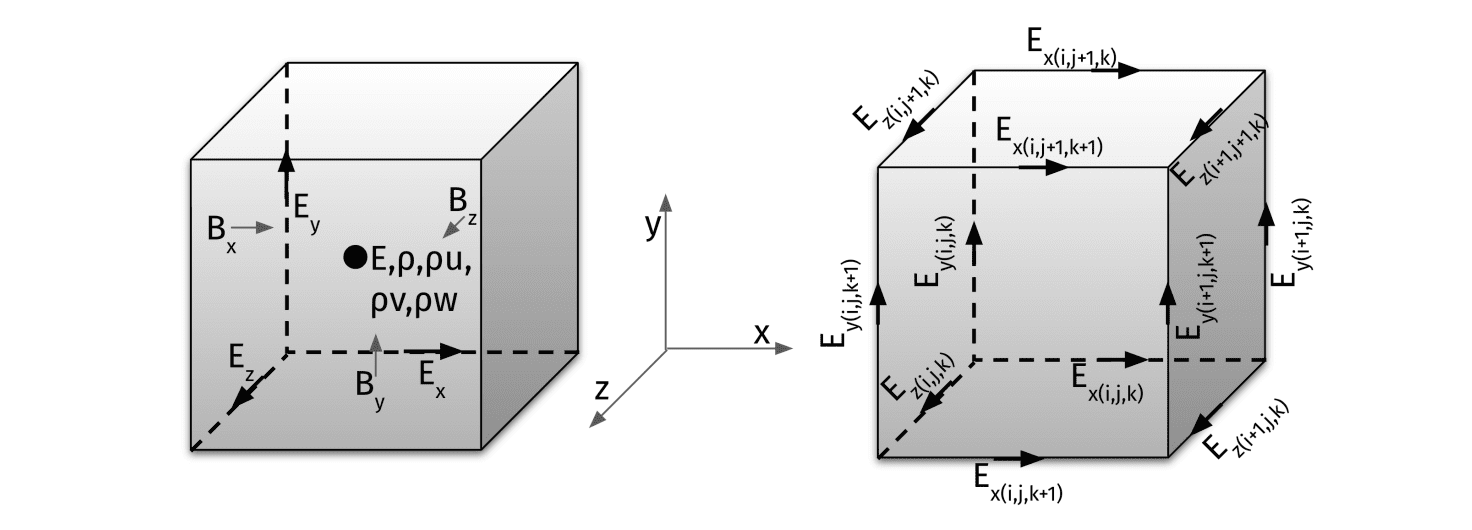
The HLLD solver, in particular, was refined to better capture complex phenomena at interfaces, utilizing six distinct regions to model the fluid state. This careful attention to numerical accuracy, combined with the parallel processing architecture, allows for highly detailed and efficient simulations of astrophysical plasmas. To maintain stability and accuracy, the team implemented a staggered grid approach for the electric and magnetic fields, ensuring that the fundamental laws of electromagnetism are satisfied. This involved carefully updating the magnetic fields using constrained transport, a technique that guarantees the solenoidal constraint is upheld throughout the simulation. By combining these advanced numerical methods with a highly optimized parallel processing framework, the researchers achieved significant speedups, demonstrating the potential of GPU acceleration for tackling complex astrophysical problems.
👉 More information
🗞 GPU accelerated MHD in the DISPATCH framework using directive-based programming
🧠 ArXiv: https://arxiv.org/abs/2508.09568