
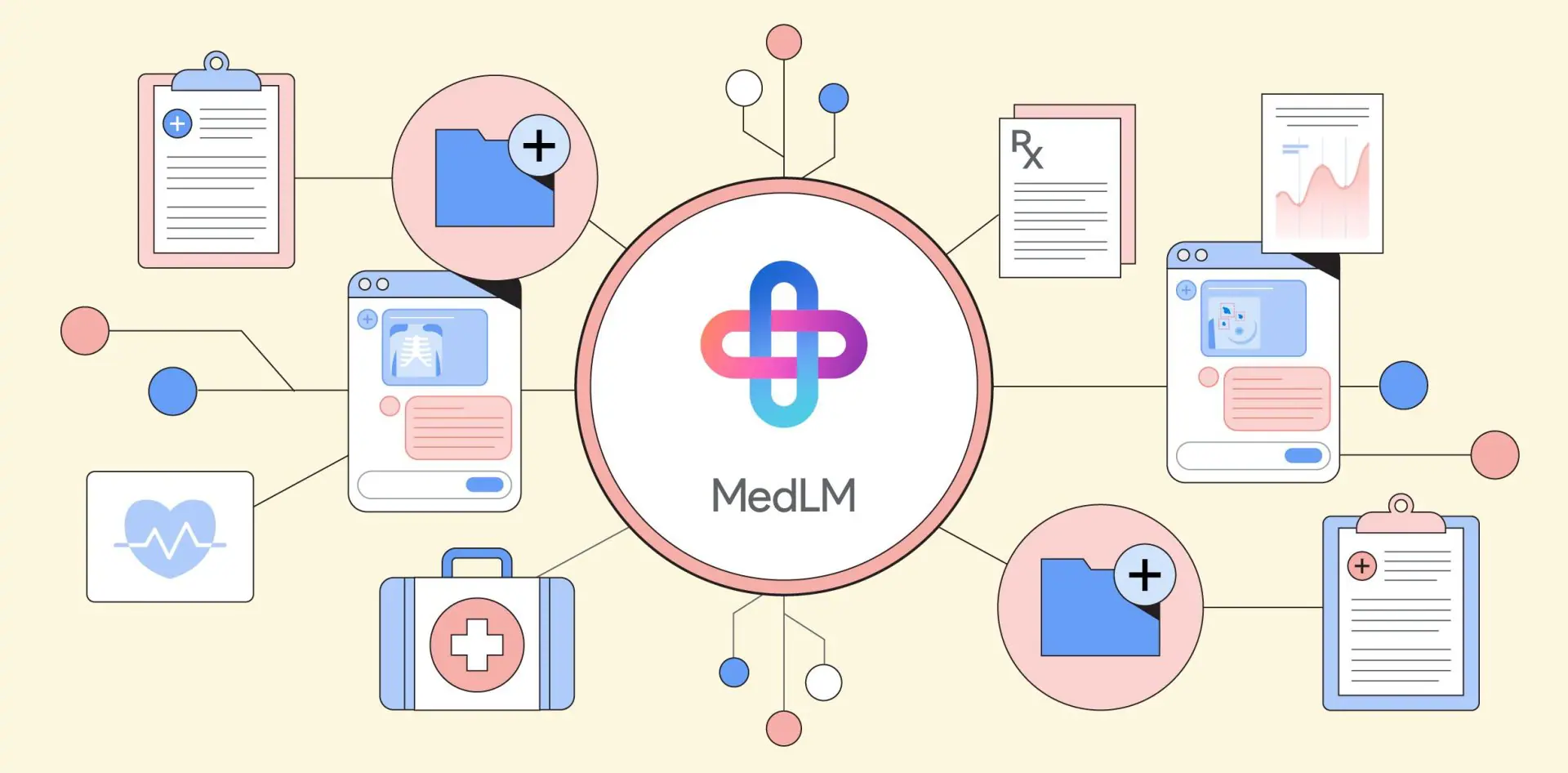
Google Research has introduced MedLM, a family of AI models fine-tuned for healthcare industry use cases. MedLM, built on Med-PaLM 2, is available to Google Cloud customers in the US and in preview in other markets. The models are designed to assist healthcare organizations with tasks ranging from summarizing conversations to searching through medications. Companies including HCA Healthcare, BenchSci, Accenture, and Deloitte are integrating MedLM into their solutions to improve areas such as medical documentation, pre-clinical research, healthcare access, and provider search. The development of MedLM aims to enhance efficiency, accuracy, and patient care in the healthcare industry.
Introduction to MedLM: AI for Healthcare
Google Research has been making significant strides in the field of artificial intelligence (AI) for healthcare, following their initial research into medically-tuned large language models (LLMs) with Med-PaLM in 2022 and 2023. The team has now introduced MedLM, a family of foundation models fine-tuned for healthcare industry use cases. MedLM is currently available to Google Cloud customers in the United States and is in preview in certain other markets worldwide.
MedLM Models and Their Applications
MedLM comprises two models built on Med-PaLM 2, designed to cater to the diverse needs of healthcare organizations. These organizations are exploring AI for a range of applications, from basic tasks to complex workflows. The first MedLM model is larger and designed for complex tasks, while the second is a medium model, fine-tuned for scaling across tasks. The development of these models has been informed by specific healthcare and life sciences customer needs, such as answering a healthcare provider’s medical questions and drafting summaries. In the future, Google plans to bring Gemini-based models into the MedLM suite to offer even more capabilities.
MedLM in Practice: HCA Healthcare and Augmedix
HCA Healthcare has been piloting a solution to help physicians with their medical notes in four emergency department hospital sites. Physicians use an Augmedix app on a hands-free device to create accurate and timely medical notes from clinician-patient conversations in accordance with the Health Insurance Portability and Accountability Act (HIPAA). Augmedix’s platform uses natural language processing, along with Google Cloud’s MedLM on Vertex AI, to instantly convert data into drafts of medical notes. With MedLM, the automated performance of Augmedix’s ambient documentation products will increase, and the quality and summarization will continue to improve over time.
BenchSci: Improving Pre-Clinical Research and Development
BenchSci is integrating MedLM into its ASCEND platform to improve the speed and quality of pre-clinical research and development. ASCEND is an AI-powered evidence engine that produces a high-fidelity knowledge graph of more than 100 million experiments, decoded from hundreds of different data sources. The integration of MedLM aims to enhance the accuracy, precision, and reliability of the platform, boosting the identification, classification, ranking, and discovery of novel biomarkers.
Collaborations with Accenture and Deloitte
Google has also teamed up with Accenture to help healthcare organizations use generative AI to improve patient access, experience, and outcomes. Accenture’s Solutions.AI for Processing for Health interprets structured and unstructured data from multiple sources to automate manual processes, like reading clinical documents, enrollment, claims processing, and more. Using Google Cloud’s Claims Acceleration Suite, MedLM, and Accenture’s Solutions.AI for Processing, new insights can be uncovered, leading to better patient outcomes.
In addition, Deloitte and Google Cloud are exploring how generative AI can help improve the member experience and reduce friction in finding care through an interactive chatbot. Deloitte, Google Cloud, and healthcare leaders are piloting MedLM’s capabilities to make it easier for care teams to discover information from provider directories and benefits documents.
The Future of MedLM
As Google continues to bring the transformative potential of generative AI to healthcare, they are focused on enabling professionals with a safe and responsible use of this technology. They are working in close collaboration with practitioners, researchers, health and life science organizations, and the individuals at the forefront of healthcare every day. The team is excited by the progress they’ve seen in just one year and are looking forward to the progress and potential ahead as they continue to push forward breakthrough research in health and life sciences.
“With MedLM, the automated performance of Augmedix’s ambient documentation products will increase, and the quality and summarization will continue to improve over time. These products can save time, reduce burnout, increase clinician efficiency, and improve overall patient care. The addition of MedLM also makes it easier to affordably scale Augmedix’s products across health systems and support an expanding list of medical subspecialties such as primary care, emergency department, oncology, and orthopedics.”
BenchSci’s ASCEND platform is an AI-powered evidence engine that produces a high-fidelity knowledge graph of more than 100 million experiments, decoded from hundreds of different data sources. This allows scientists to understand complex connections in biological research, presenting a thorough grasp of empirically validated and ontologically derived relationships, including biomarkers, detailed biological pathways, and interconnections among diseases. The integration of MedLM works to further enhance the accuracy, precision and reliability, and together with ASCEND’s proprietary technology and data sets, it aims to significantly boost the identification, classification, ranking, and discovery of novel biomarkers — clearing the path to successful scientific discovery.
Aimed at healthcare process improvement, Accenture’s Solutions.AI for Processing for Health interprets structured and unstructured data from multiple sources to automate manual processes that were previously time-consuming and prone to error, like reading clinical documents, enrollment, claims processing, and more. This helps clinicians make faster, more informed decisions and frees up more time and resources for patient care. Using Google Cloud’s Claims Acceleration Suite, MedLM, and Accenture’s Solutions.AI for Processing, new insights can be uncovered — ultimately leading to better patient outcomes.
Deloitte, Google Cloud, and healthcare leaders are piloting MedLM’s capabilities to make it easier for care teams to discover information from provider directories and benefits documents. These inputs will then help contact center agents better identify best-fit providers for members based on plan, condition, medication and even prior appointment history, getting people faster access to the precise care they need.
“As we bring the transformative potential of generative AI to healthcare, we’re focused on enabling professionals with a safe and responsible use of this technology. That’s why we’re working in close collaboration with practitioners, researchers, health and life science organizations, and the individuals at the forefront of healthcare every day. We’re excited by the progress we’ve seen in just one year — from building the first LLM to obtain a passing score (>60%) on U.S. medical-licensing-exam-style questions (published in Nature), to advancing it to obtain an expert level score (86.5%), to applying it in real-world scenarios through a measured approach. As we reflect on 2023 — and close out the year by expanding MedLM access to more healthcare organizations — we’re excited for the progress and potential ahead and our continuing work on pushing forward breakthrough research in health and life sciences.”
Summary
Google has introduced MedLM, a set of artificial intelligence models specifically fine-tuned for healthcare applications, which are now available to Google Cloud customers in the United States. The models, which have been developed in response to specific healthcare needs, are being used by healthcare organisations for a range of tasks, from summarising conversations to searching through medications, with the aim of improving efficiency and patient care.
- Google Research has introduced MedLM, a set of AI models fine-tuned for healthcare industry use cases.
- MedLM is built on the foundation of Med-PaLM 2 and is available to Google Cloud customers in the US and in preview in other markets worldwide.
- The MedLM suite includes two models designed to cater to different needs within healthcare organizations.
- The first model is larger and designed for complex tasks, while the second is a medium model that can be fine-tuned and scaled across tasks.
- MedLM has been tested with several companies, including HCA Healthcare, BenchSci, Accenture, and Deloitte.
- HCA Healthcare has been using MedLM in conjunction with the Augmedix app to create accurate and timely medical notes.
- BenchSci is integrating MedLM into its ASCEND platform to improve the speed and quality of pre-clinical research and development.
- Accenture is using MedLM to help healthcare organizations improve patient access, experience, and outcomes.
- Deloitte and Google Cloud are exploring how MedLM can improve the member experience and reduce friction in finding care through an interactive chatbot.
- Google Research plans to bring Gemini-based models into the MedLM suite in the coming months to offer even more capabilities.