Google scientists are making progress towards building near-perfect encoded qubits, a crucial step towards creating practical quantum computers. Currently, error rates in quantum computing are around one in a thousand, but to be useful, they need to be reduced to one in a trillion. The recent announcement of their Willow Chip has excited the world’s technologists for its performance against classical algorithms.
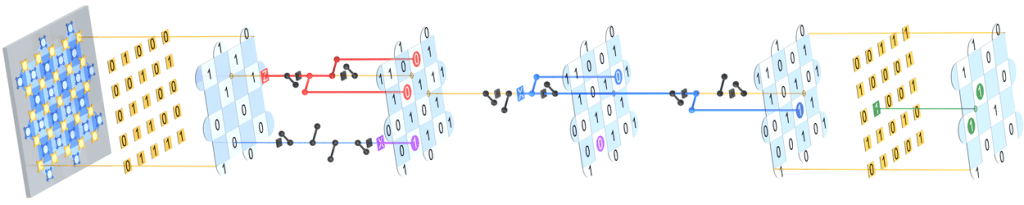
Researchers are using repetition codes, which focus on bitflip errors, to test error correction limits. In experiments on Willow, a quantum computer, they achieved nearly 10 billion error correction cycles without seeing an error. However, when trying to push the encoded error rate lower, it plateaued, and the reason is still under investigation.
Meanwhile, scientists are also working on making error-corrected quantum computers faster. Even superconducting quantum computers, like those developed by Google, have measurement times that are about a microsecond long, much slower than classical operations. Researchers demonstrated real-time decoding of measurement information alongside the device, but it’s still not fast enough. The next step is to scale up the system to realize near-perfect quantum computing, but this will require significant engineering advancements.
The key takeaway is that small improvements in the device are amplified exponentially once you pass the error correction threshold. This means that even modest advances in device quality can lead to significant enhancements in error-corrected quantum computing.
One of the most exciting aspects of this research is the demonstration of repetition codes, which focus solely on bitflip errors but do so far more efficiently than surface codes. By running experiments with repetition codes, the researchers have achieved nearly 10 billion error correction cycles without seeing an error. This level of control over a quantum system is truly remarkable.
However, there’s still much work to be done. The researchers have hit an “error floor” of around 10^(-10) logical errors per cycle, which they’re currently investigating and confident they can fix. Additionally, the speed of error-corrected quantum computers remains a significant challenge. Even with real-time decoding of measurement information, the decoder delay time can still slow down operations.

Looking ahead, the researchers pose several critical questions relevant to future error-corrected quantum computers. Can we build a near-perfect encoded qubit? Can we make error-corrected quantum computers fast? The answers to these questions will depend on continued advances in device quality, error correction techniques, and classical software.
The article concludes by emphasizing the immense engineering challenge ahead, but also the staggering progress made so far. With exponential improvements offered by quantum error correction, we may need fewer than expected 20x steps to reach large-scale quantum algorithms.
The researchers invite collaboration from the broader community to accelerate progress, offering open-source software and educational resources, including a new free Coursera course dedicated to quantum error correction. As a science journalist, I’m excited to continue covering these developments and exploring the vast potential of quantum computing.
External Link: Click Here For More