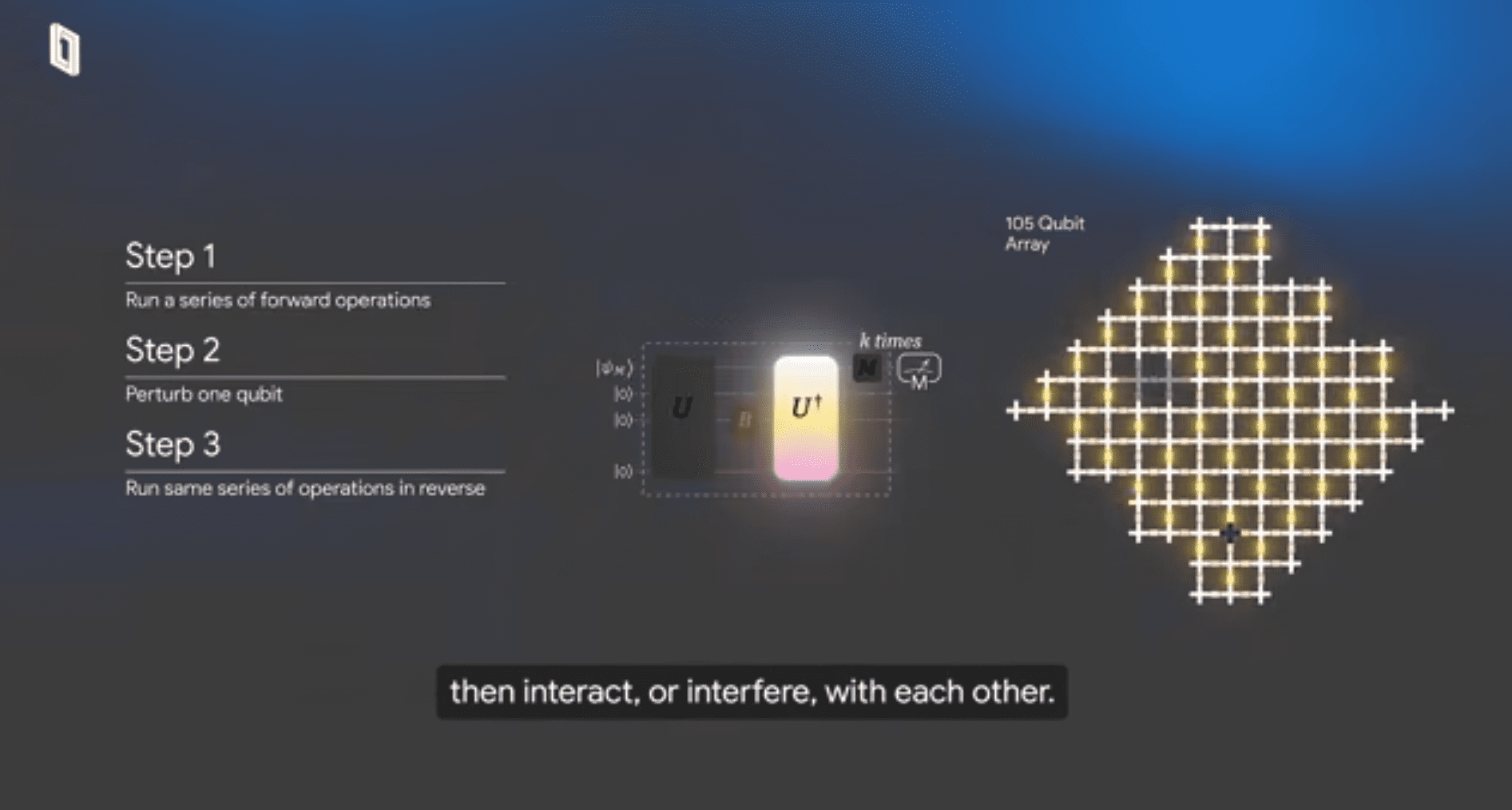
Hartmut Neven from Google Quantum AI announced a breakthrough in quantum computing, demonstrating the first-ever algorithm to achieve verifiable quantum advantage on hardware. The Quantum Echoes algorithm, running on Google’s Willow quantum chip, surpasses the capabilities of even the world’s fastest classical supercomputers by a factor of 13,000. This achievement marks a significant step toward real-world applications, allowing for the computation of molecular structures with unprecedented speed and precision. Building on six years of breakthroughs and a 2019 demonstration of quantum supremacy, this new technique promises to drive discoveries in fields like medicine and materials science, offering a level of detail previously unattainable.
Quantum Advantage Achieved with Quantum Echoes Algorithm
Google Quantum AI has achieved a significant milestone, demonstrating verifiable quantum advantage with its newly developed Quantum Echoes algorithm. The company announced that this algorithm, run on the Willow quantum chip, surpasses the capabilities of even the world’s fastest classical supercomputers. This breakthrough represents a crucial step toward practical applications for quantum computing, moving beyond theoretical possibilities toward tangible results in areas like materials science and medicine. Hartmut Neven from Google Quantum AI emphasized the importance of this achievement for real-world impact.
The Quantum Echoes algorithm tackles a complex computational problem known as the out-of-order time correlator (OTOC). According to the published research in Nature, the Willow chip completed the calculation 13,000 times faster than the best classical algorithm running on a leading supercomputer. Vadim Smelyanskiy from Google Quantum AI explained that this speedup stems from the algorithm’s ability to efficiently learn the structure of complex systems, from molecules to more exotic phenomena like black holes. This efficiency is a direct result of the advancements in error suppression achieved with the Willow chip late in 2024, addressing a long-standing challenge in quantum computation.
Building on this success, Google Quantum AI is exploring how Quantum Echoes can be applied to solve problems with practical relevance. A separate proof-of-principle experiment showcased the potential for quantum computation of molecular geometry via many-body nuclear spin echoes. This suggests a pathway towards designing new materials and discovering novel drugs with unprecedented precision. The company anticipates that continued refinement of the Quantum Echoes algorithm and hardware will unlock even greater computational power, paving the way for breakthroughs across a wide range of scientific disciplines.
Willow Chip’s Role in Verifiable Quantum Computing
The Willow quantum chip proved instrumental in achieving this verifiable quantum advantage, specifically through its enhanced error suppression capabilities. According to the company, the chip’s architecture dramatically reduces the impact of decoherence, a major hurdle in quantum computing, allowing for significantly longer and more complex computations. This improvement wasn’t merely incremental; it enabled the successful execution of the Quantum Echoes algorithm with a level of precision previously unattainable, paving the way for reliable results. The ability to maintain quantum coherence for extended periods is a crucial step toward building practical, fault-tolerant quantum computers.
Building on this foundational capability, the Willow chip’s design facilitated the demonstration of a 13,000x speedup over the best classical algorithms running on a state-of-the-art supercomputer. Vadim Smelyanskiy from Google Quantum AI emphasized that this isn’t simply about faster processing, but about solving problems that are fundamentally intractable for classical machines. The Quantum Echoes algorithm, implemented on Willow, allowed researchers to compute the structure of a molecule with unprecedented accuracy and speed. This accomplishment stems from the chip’s optimized qubit connectivity and control, allowing for efficient implementation of complex quantum circuits.
Hartmut Neven from Google Quantum AI highlights that this breakthrough moves beyond theoretical demonstrations and begins to unlock the potential for real-world applications. The successful execution of Quantum Echoes on Willow offers a proof-of-principle for simulating complex quantum systems, with implications for materials science, drug discovery, and fundamental physics. The company announced that ongoing research focuses on scaling up the Willow architecture and exploring new algorithms that can leverage its unique capabilities, with the ultimate goal of creating quantum computers that can solve currently unsolvable problems.
Real-World Applications of Quantum Enhanced NMR
Building on this achievement, Google Quantum AI is now focusing on applying the Quantum Echoes algorithm to practical problems in nuclear magnetic resonance (NMR) spectroscopy. This enhanced NMR capability promises to revolutionize fields like materials science and drug discovery by enabling the precise determination of molecular structures with unprecedented speed and accuracy. According to the company, the algorithm significantly accelerates simulations of molecular interactions, potentially reducing computation times from weeks to mere hours for complex systems. This speed increase will allow researchers to explore a vastly larger chemical space, accelerating the identification of novel materials and pharmaceutical candidates.
Vadim Smelyanskiy from Google Quantum AI explained that the algorithm’s power stems from its ability to efficiently calculate many-body nuclear spin echoes, a crucial process for interpreting NMR data. Traditional methods struggle with the exponential increase in computational complexity as the size of the molecule grows, but Quantum Echoes circumvents this limitation. In a separate proof-of-principle experiment, the team demonstrated the successful quantum computation of molecular geometry using these many-body nuclear spin echoes, showcasing a critical step towards real-world applicability. This approach allows for the simulation of more intricate molecular dynamics, providing insights into reaction mechanisms and material properties previously inaccessible to classical computation.
Hartmut Neven from Google Quantum AI emphasized that this isn’t simply about faster computation; it’s about unlocking new scientific possibilities. The ability to accurately model molecular structures will have a profound impact on areas like catalyst design, allowing researchers to create more efficient and sustainable chemical processes. Furthermore, the precise determination of protein structures could accelerate drug discovery by enabling the rational design of molecules that bind to specific targets. The company anticipates that continued development of this technology will pave the way for a new era of computational chemistry and materials science, driving innovation across multiple industries.
This achievement, surpassing classical capabilities with the Quantum Echoes algorithm, marks a pivotal moment for quantum computing and beyond. According to Hartmut Neven from Google Quantum AI, this breakthrough builds on years of dedicated research and represents a tangible step towards practical applications. The implications extend beyond quantum computing to fields like medicine and materials science, potentially accelerating discovery through enhanced molecular modeling.
For industries relying on complex simulations, this represents a new paradigm, offering computational power previously unattainable. Vadim Smelyanskiy from Google Quantum AI emphasizes this development could enable researchers to tackle previously intractable problems. This verifiable quantum advantage, demonstrated by the Willow chip, paves the way for quantum computers that drive real-world progress, moving beyond theoretical potential to deliver impactful results.