

Google has acquired Intrinsic, the Alphabet-founded robotics platform specializing in AI-enabled industrial automation, to accelerate the deployment of artificial intelligence in the physical world. Established in 2021, Intrinsic has developed a platform designed to simplify the building, deployment, and operation of robotics applications for manufacturing and logistics, experiencing significant growth in AI for robotics over the past two years. The integration will leverage Google’s Gemini models and Cloud capabilities, with close collaboration with Google DeepMind, while Intrinsic will continue to evolve as a distinct group within Google. “Actualizing the value of AI in the physical world means making AI easy to integrate, and highly reliable to use without robotics or AI expertise,” and this acquisition aims to rapidly transition AI from research into practical, real-world production applications.
Intrinsic Platform Enables Versatile Industrial Robotics Applications
By integrating with Google’s Gemini models and Cloud infrastructure, the platform aims to accelerate the transition of AI from research into practical industrial applications, focusing on use cases in manufacturing and logistics. Physical AI, described as the convergence of software and hardware, enables robots to perform valuable real-world tasks such as testing solar panels, assembling server trays, or handling heavy components like EV batteries. AI empowers robots with adaptive intelligence, allowing them to perceive, reason, and react to dynamic changes in their environment—for example, autonomously navigating and adjusting to variations on an assembly line. Intrinsic’s approach mirrors Android’s function for mobile devices, providing a universal platform for developing applications across diverse robotic systems, cameras, sensors, and AI models.
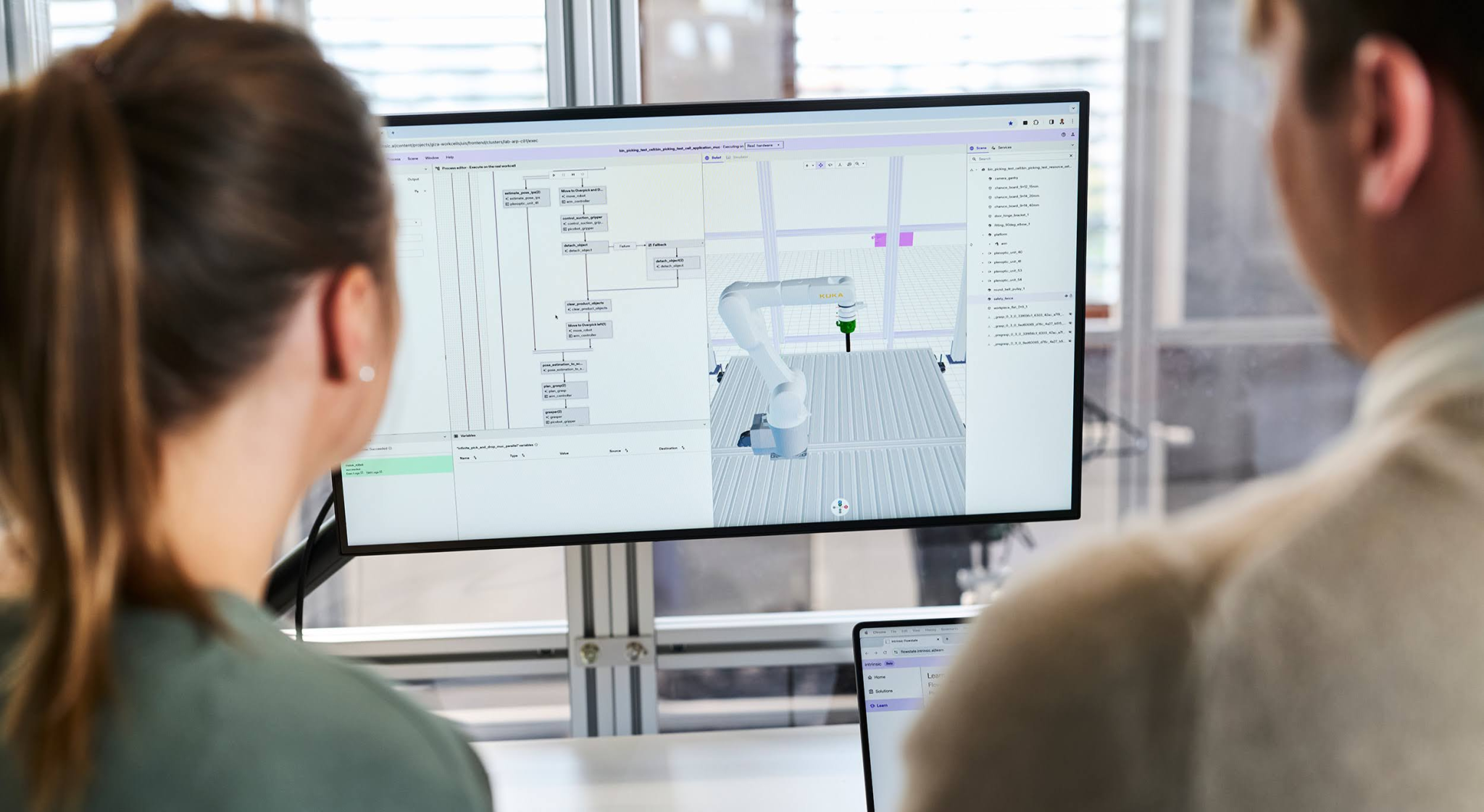
The platform’s web-based development environment, Flowstate, and simulation engine facilitate application building through reusable “building blocks of robotic behaviors” called skills, which can be manually developed or AI-enabled. “Whether the goal is to identify complex parts for assembly, auto-generate code for efficient robot motions, or delicately handle parts using force sensors,” these capabilities streamline task completion, and Intrinsic claims applications can be launched “from simulation right through to real world production, in a fraction of the time it usually takes.”
Flowstate Development Environment Simplifies Robotic Skill Creation
Currently, industrial robotics application development presents significant hurdles, demanding extensive programming expertise and time-intensive processes for even basic tasks; businesses seeking automation often face lengthy integration periods and high costs before realizing benefits from robotic systems. Intrinsic addressed this challenge with Flowstate, a web-based development environment and simulation engine designed to streamline application building for robots, cameras, sensors, AI models, and associated hardware. This platform allows developers to concentrate on problem-solving rather than underlying infrastructure, mirroring the function of Android for mobile application development, and supporting app creation across diverse robotic systems. Capabilities within Flowstate enable tasks such as complex part identification for assembly, automated code generation for efficient robot movements, and delicate part handling using force sensors, all contributing to unlocking solutions for complex automation challenges.
System integrators and automation companies, including market leaders like Foxconn, are already revising their expectations for industrial robotics through adoption of the Intrinsic platform. By facilitating the rapid deployment of intelligent applications, Flowstate aims to make AI integration easier and more reliable, even for those without deep robotics or AI expertise, accelerating the transition from research to real-world production. This is further enhanced by close collaboration with Google DeepMind, Gemini, and Cloud, promising to accelerate the practical application of AI in automation.
Actualizing the value of AI in the physical world means making AI easy to integrate, and highly reliable to use without robotics or AI expertise.
Intrinsic


