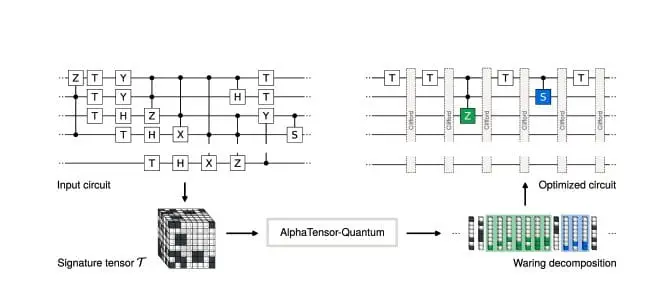
Google DeepMind and Quantinuum have developed AlphaTensor-Quantum, a method that optimizes quantum circuits, specifically minimizing the number of T gates needed. This is a key challenge in creating fault-tolerant quantum computers. AlphaTensor-Quantum uses deep reinforcement learning and leverages domain-specific knowledge about quantum computation. It outperforms existing methods for T-count optimization and can automate the optimization of relevant quantum circuits, potentially saving hundreds of research hours. The method could significantly accelerate discoveries in quantum computation.
Quantum Circuit Optimization with AlphaTensor
The development of fault-tolerant quantum computers is a significant challenge in the field of quantum computing. One of the key hurdles is circuit optimization, particularly minimizing the number of T gates, which are the most expensive gates in fault-tolerant quantum computation. This article presents AlphaTensor-Quantum, a method based on deep reinforcement learning that optimizes T-count and tensor decomposition. Unlike existing methods, AlphaTensor-Quantum can incorporate domain-specific knowledge about quantum computation and leverage gadgets, which significantly reduces the T-count of the optimized circuits.
The Challenge of Quantum Computation
Quantum computation offers a fundamentally new approach to solving computational problems. It has potential applications in various fields, including cryptography, drug discovery, materials science, and high energy physics. However, fault-tolerant quantum computation introduces some expensive components that significantly impact the overall runtime and resource cost. Therefore, it is crucial to minimize the use of these components to enable the execution of large computations that address real-world problems.
The Role of T Gates in Quantum Computation
To implement any quantum algorithm, universal quantum computers require a combination of two types of quantum gates: Clifford and non-Clifford gates. Non-Clifford gates, such as the T gate, are required to achieve universality. However, they are notoriously harder to implement than Clifford gates because fault-tolerant quantum computation requires error correction schemes, which require distilling magic states, a process with high spacetime cost. Consequently, the cost of a quantum algorithm in the fault-tolerant era is arguably dominated by the cost of implementing the non-Clifford gates.
AlphaTensor-Quantum for T-count Optimization
AlphaTensor-Quantum is an extension of AlphaTensor, a method that finds low-rank tensor decompositions using deep reinforcement learning. It tackles the problem from the tensor decomposition point of view and is able to find efficient algorithm implementations with low T-count. AlphaTensor-Quantum addresses three main challenges: optimizing the symmetric tensor rank, extending to large tensor sizes, and incorporating domain knowledge that falls outside of the tensor decomposition framework.
The Power of AlphaTensor-Quantum
AlphaTensor-Quantum has proven to be a powerful method for finding efficient quantum circuits. On a benchmark of arithmetic primitives, it outperforms all existing methods for T-count optimization. For the relevant operation of multiplication in finite fields, which has applications in cryptography, AlphaTensor-Quantum finds an efficient quantum algorithm with the same complexity as the classical Karatsuba’s method. It also optimizes quantum primitives for other relevant problems, demonstrating its ability to effectively optimize circuits of interest in a fully automated way. This approach can significantly accelerate discoveries in quantum computation by saving the numerous hours of research invested in the design of optimized circuits.