

Nonlinear dynamical systems present a significant challenge to scientists attempting to predict their behaviour, and traditional methods often struggle when these systems exhibit multiple stable states. Ivan Novikau and Ilon Joseph, both from Lawrence Livermore National Laboratory, address this limitation by developing a globally applicable version of the Carleman linear embedding method. Their work introduces three distinct techniques that overcome the convergence issues of the standard method by partitioning the system’s state space into multiple regions, dynamically adjusting the size of these regions, or employing a precomputed grid of linearizations. This achievement extends the applicability of the Carleman method to previously intractable problems, enabling more accurate and efficient simulations of complex chaotic systems and offering a powerful new tool for understanding nonlinear dynamics.
Globalizing Carleman Embedding for Nonlinear Systems
Researchers have advanced the Carleman linear embedding method, a technique used to simplify the analysis of nonlinear systems, by addressing its limitations when applied to systems with multiple stable states. The team proposes and tests three distinct versions of a global piecewise Carleman embedding, designed to extend the method’s applicability to complex dynamics. This approach identifies stable and unstable structures associated with fixed points, then constructs a piecewise embedding that aligns with these features, allowing the nonlinear system to be approximated by a series of linear subsystems within specific regions of the system’s state space. The research demonstrates that these globalized Carleman embeddings significantly improve convergence and accuracy for a wider range of nonlinear dynamical systems, including those exhibiting multiple fixed points and chaotic behaviour.
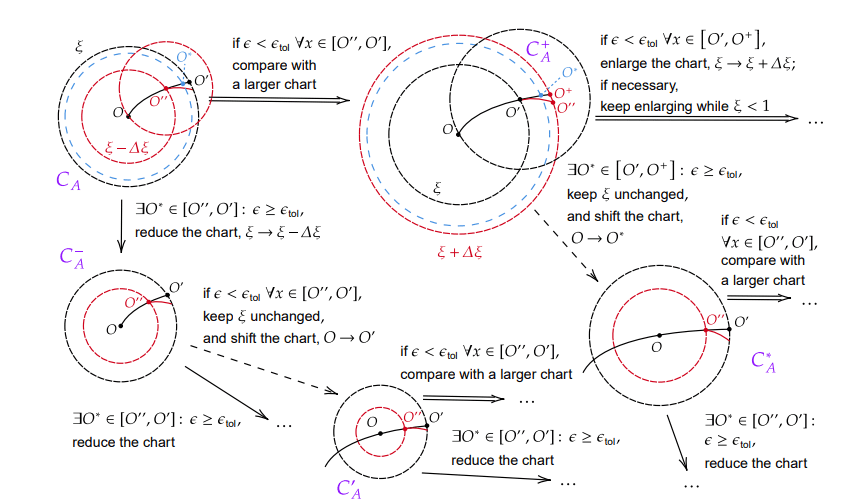
The embedding technique divides the system’s state space into multiple regions, carefully controlling convergence by adjusting the centre and size of each embedding region. One method switches between local linearization regions of fixed size when a trajectory reaches a boundary, reconstructing the embedding within a newly created chart. A second method dynamically adapts chart size, improving accuracy in regions containing multiple fixed points. A third method partitions the state space using a static grid with precomputed linearization charts, suitable for certain applications.
Koopman Operator Theory for Dynamical Systems
A collection of research focuses on dynamical systems, machine learning, and control theory, with a strong emphasis on Koopman operator theory and its applications. This body of work explores methods for analysing, predicting, and controlling complex systems, spanning theoretical foundations to practical applications in areas like robotics, plasma physics, and fluid dynamics. Many papers directly address Koopman operator theory, its extensions, and its use in various applications. These papers cover the fundamentals of the Koopman operator, its properties, and its relationship to traditional dynamical systems analysis.
They also explore extensions using deep learning approaches to approximate the operator, and investigate theoretical properties such as the existence and uniqueness of Koopman eigenfunctions, global linearization, and connections to topology. Applications include control, estimation, and prediction of dynamical systems, with further research exploring deep learning approaches to learn Koopman representations and demonstrating applications in high-energy-density simulations and robotics. Related work discusses Carleman linearization and its use in control and estimation. Beyond Koopman operator theory, research provides broader context for understanding interconnected dynamical systems, and reviews active learning in robotics, a technique for efficiently learning control policies.
Applications span diverse fields, including plasma physics, where researchers analyse and control plasma behaviour, and fluid dynamics, where they decompose and model fluid flows. Work in robotics focuses on control and learning, detailing an application to electrical wire explosions. Key takeaways highlight Koopman operator theory as a powerful tool for analysing and controlling nonlinear dynamical systems, allowing for the lifting of nonlinear systems into infinite-dimensional linear spaces where traditional linear control techniques can be applied. Machine learning, particularly deep learning, plays an increasingly important role in approximating the Koopman operator, essential for dealing with high-dimensional and complex systems. The field is rapidly evolving, with new theoretical results and applications emerging, and there is a strong emphasis on bridging the gap between theory and practice.
Adaptive Carleman Embedding Stabilizes Chaotic Systems
Researchers have successfully extended the Carleman embedding technique, enhancing its accuracy when simulating nonlinear systems with multiple fixed points, even those exhibiting chaotic behaviour. By partitioning the system’s state space into multiple linearization charts, the team stabilized the method for problems previously intractable using standard Carleman linearization. Three distinct approaches were developed, each employing a piecewise strategy to manage the complexity of nonlinear dynamics.
The researchers tested an adaptive technique that dynamically adjusts the size of the linearization charts, minimizing numerical error or accelerating simulation speed based on analysis of the nonlinear terms. Conversely, a non-adaptive version, utilizing fixed chart sizes, proved faster with comparable precision when the minimal distance between fixed points was known. Numerical tests confirm that the globalized Carleman approach maintains bounded errors even for chaotic systems featuring strange attractors. While the adaptive methods eliminate the need for prior knowledge of fixed point locations, they require accurate detection of transitions between linearization charts.
The authors acknowledge that the accuracy of the method depends on both the truncation of the maximum monomial order and the chosen convergence radius or tolerance settings. They highlight the non-adaptive piecewise technique as the most promising candidate for developing a globalized Carleman quantum algorithm, though realizing an efficient quantum implementation remains an open question. The team notes that the adaptive version’s increased nonlinear operations make it less suitable for quantum computing applications.
👉 More information
🗞 Globalizing the Carleman linear embedding method for nonlinear dynamics
🧠 ArXiv: https://arxiv.org/abs/2510.15715


