

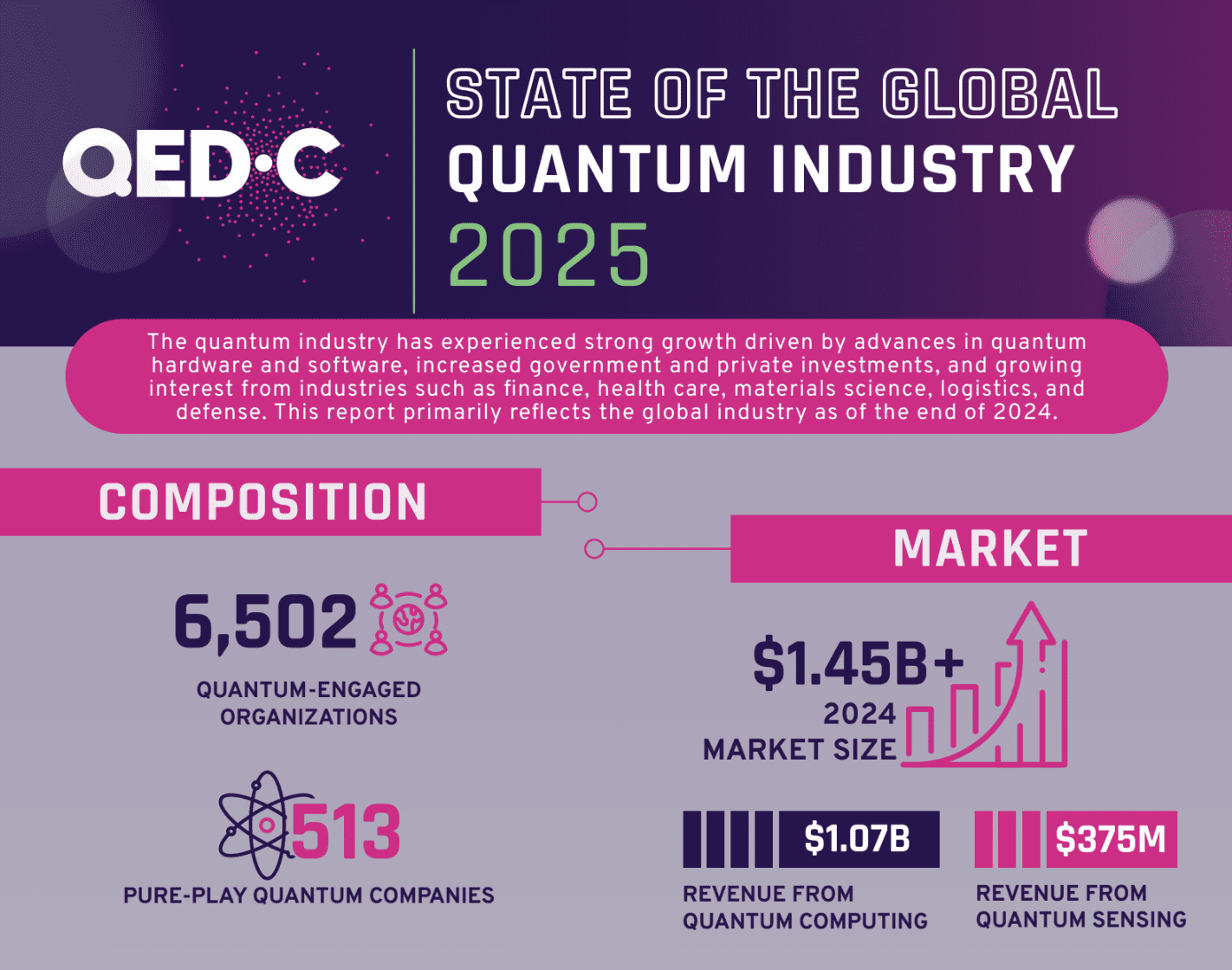
According to the Quantum Economic Development Consortium (QED-C)’s 2025 State of the Global Quantum Industry Report, the global quantum industry generated $1.45 billion in revenue in 2024. The report highlights significant growth across key sectors, including a surge in quantum job openings and record-high private investments.
China led public investment and patent filings, while the U.S., U.K., Germany, Canada, and France accounted for most pure-play quantum companies. Revenue from quantum computing reached $1.07 billion, with sensing contributing an additional $375 million. Both sectors are projected to grow significantly by 2027. The report also provides insights into the global quantum workforce, which stands at 14,517 professionals, and tracks investments totalling $44.5 billion in public funding and $2.6 billion in private venture capital.
Global Quantum Industry Revenue in 2024
The global quantum industry generated $1.45 billion in revenue in 2024, according to the Quantum Economic Development Consortium (QED-C) report. This figure reflects significant contributions from quantum computing and sensing sectors, with quantum computing accounting for $1.07 billion and quantum sensing contributing $375 million. The report highlights that quantum computing revenue is growing at an average rate of 27% annually, projected to reach $2.2 billion by 2027. Similarly, quantum sensing revenue is expanding at 25% per year, with expectations to surpass its current value in the coming years.
The growth in these sectors underscores the increasing commercialization and application of quantum technologies across various industries. The QED-C report emphasizes the importance of continued investment and innovation to sustain this momentum and further develop the global quantum industry.
Snapshot of the Global Quantum Workforce
The global quantum workforce among pure-play quantum companies was estimated at 14,517 professionals as of 2024, reflecting a growing demand for skilled workers. Job and internship openings related to quantum technology reached 7,400 in 2024, marking a 55% increase from 2021, indicating a significant expansion in opportunities within the industry.
Europe & Central Asia and North America accounted for most of these openings, underscoring their prominence in the global quantum sector. The workforce distribution revealed that engineering roles constituted the largest segment at 25%, followed by information technology, research, and business development, each representing approximately 12% of the workforce. This breakdown highlights the diverse skill sets required to drive advancements in quantum technologies.
The report’s focus on the quantum workforce provides critical data for stakeholders to track growth and address potential labour shortages in the global quantum industry.
Quantum Investment Trends: Public and Private Funding
The Quantum Economic Development Consortium (QED-C) report reveals significant trends in both public and private funding within the global quantum industry. Governments worldwide contributed $3.1 billion over the past year, bringing total public funding to $44.5 billion. China emerged as the leading nation in quantum patent filings, accounting for more than 50% of all related patents between 2020 and 2024, a figure four times higher than that of the U.S.
In the private sector, quantum venture capital (VC) investments rebounded strongly in 2024 after a dip in 2023. The U.S. led these investments, followed closely by the U.K. and Australia. This resurgence underscores the growing confidence in quantum technologies’ commercial potential and their role in driving future technological advancements.
The report highlights that sustained investment from both public and private sectors is critical to maintaining momentum in the global quantum industry, emphasizing its potential to drive technological advancements and economic growth across various sectors.
Public funding for quantum technologies reached $44.5 billion globally, with China leading in quantum patent filings, accounting for over half of all related patents between 2020 and 2024.
More information
External Link: Click Here For More


