
The Global Innovation Forum 2026 (GIF 2026) marked a significant milestone at this year’s Consumer Electronics Show in Las Vegas. It became the first CES networking event built entirely on cross-national collaboration. The Seoul Business Agency (SBA) organized the forum with national institutions from seven countries. It brought together an impressive roster of startups from Korea, Canada, France, Switzerland, Israel, Japan, and Taiwan. Each startup was vying for recognition in a high-stakes IR pitching competition.
The Seoul Business Agency is a small business support organisation under the Seoul Metropolitan Government. It is dedicated to revitalising the startup ecosystem and discovering promising startups. The agency orchestrated this multinational gathering. The event featured not only the pitching competition. It also included a networking dinner attended by over 200 global venture capitalists and media representatives. Additionally, there was a panel discussion with national pavilion representatives that explored the state of startup ecosystems worldwide. Partner organisations included Taiwan Tech Arena (TTA). Other partners were Switzerland Global Enterprise (S-GE), Israel Economic and Trade Office, Japan External Trade Organization (JETRO), Québec Government Office of Canada, and Business France.
A Dual Lens on Innovation
The competition’s judging framework reflected the multifaceted nature of startup success. As explained by Mr Shin, Director and Head of Korea for Plug and Play, the evaluation combined two distinct perspectives. Media judges assessed the compelling nature of each startup’s story. They evaluated the clarity of their messaging. They also considered their potential for social and global impact. Venture capital judges, meanwhile, focused on business fundamentals. These included market size, competitive advantage, and investment potential. Sustainability served as a key consideration.
Plug and Play’s involvement lent credibility to the proceedings. This organisation incubated notable companies including Google and PayPal. It originated at 165 University Avenue in Palo Alto. This building is often called the “Lucky Building.” Now, the organisation has grown to encompass over 60 global locations. It supports approximately 2,500 startups annually. Mr Shin emphasised that innovation rarely happens in isolation, requiring robust ecosystems to flourish—a philosophy that underpinned the entire forum.
Sustainable Displays and Ambient Intelligence
The French delegation presented Luchrome, a startup based in Pessac (Gironde) addressing the environmental toll of electronic displays. Their product represents a new generation of fully printed displays that achieve remarkable efficiency gains: ten times more energy efficient than current market offerings, three times more cost competitive, and sixty times less environmental impact by eliminating metals and scarce resources from production. The technology’s flexibility allows for customised shapes and sizes with a two-month turnaround, positioning it for applications in asset tracking and pharmaceutical cold chain monitoring. Having already secured a CES Innovation Award in the Sustainability and Energy Transition category, Luchrome exemplifies how European startups are tackling the intersection of electronics and environmental responsibility.
Japan’s ORPHE, supported by JETRO, took a different approach to innovation with their smart insole technology. Winner of a CES Innovation Award in the Sports and Fitness category, ORPHE has developed an insole that transforms everyday footwear into sophisticated biomechanics laboratories. Traditional gait analysis requires equipment costing upwards of $100,000 and is confined to laboratory settings. ORPHE’s solution embeds nine-axis motion sensors and six pressure sensors into a replaceable insole that operates continuously for over 24 hours, wirelessly charging and transmitting data when placed on its mat.
The concept of “ambient technology” emerged as a compelling theme from ORPHE’s presentation. In an era increasingly defined by AI interaction, CEO Yuya Kikukawa argued that smartwear enables communication without language, operation, or gesture—simply by wearing shoes. The technology has already found adoption across over 100 universities and hospitals, with applications ranging from detecting freezing of gait in Parkinson’s disease patients to enabling fall detection in industrial safety shoes.
From Cancer Detection to Neuromorphic Computing
The Taiwan delegation showcased a remarkable convergence of semiconductor technology, artificial intelligence, and biotechnology. Their system, designed for circulating tumour cell detection, captures and analyses cells from blood samples to assist in cancer screening, diagnosis, and monitoring of disease recurrence. Having spent a decade developing the technology to integrate cells with semiconductor chips, the team has already deployed across five countries and collaborated with Nobel Prize-level researchers in Japan. The potential to detect cancer cells before clinical symptoms appear represents a significant advancement in preventive medicine.
Israel’s POLYN Technology, operating from offices in both Israel and the UK, presented perhaps the most technically ambitious solution: biological neuromorphic chips for sensor data processing. Their Neuromorphic Analog Signal Processing (NASP) technology addresses a fundamental challenge in digital systems—the trade-off between processing latency and power consumption. By creating analogue neuromorphic chips that mirror biological neural networks, POLYN achieves microsecond latency with micro-watt power consumption. The technology generates hardware directly from software, with proprietary compilers converting digital neural network models into physical neuron structures on standard CMOS processes.
Rather than selling empty silicon, POLYN delivers complete solutions for specific applications including voice activation, smart tyre sensors for autonomous vehicles, and tactile sensors for humanoid robots. Their first silicon-implemented NASP chip launched just two months prior to the forum, with expanded voice processing capabilities expected throughout 2026.
The Spatial Computing Frontier
Canada’s Cubic Space, a Montreal-based startup led by CEO Nicholas Routhier, tackled a problem that has plagued 3D technology adoption for decades: the forty percent of users who experience eye strain, fatigue, and headaches when viewing stereoscopic content. Despite hundreds of millions of dollars invested in 3D displays and spatial computing—a market projected to reach $500 billion by 2030—poor user experience continues to undermine returns.
The company’s Adaptive Spatial Media Player represents a paradigm shift from one-size-fits-all 3D content delivery. By dynamically adapting geometry based on camera information, user characteristics, and display specifications, the software layer provides customised viewing experiences that eliminate discomfort. With four patent families already granted and nine pending across Asia, Europe, and North America, Cubic Space is positioning itself as essential middleware for the emerging spatial computing ecosystem.
Korea’s Firsthabit Takes the Crown
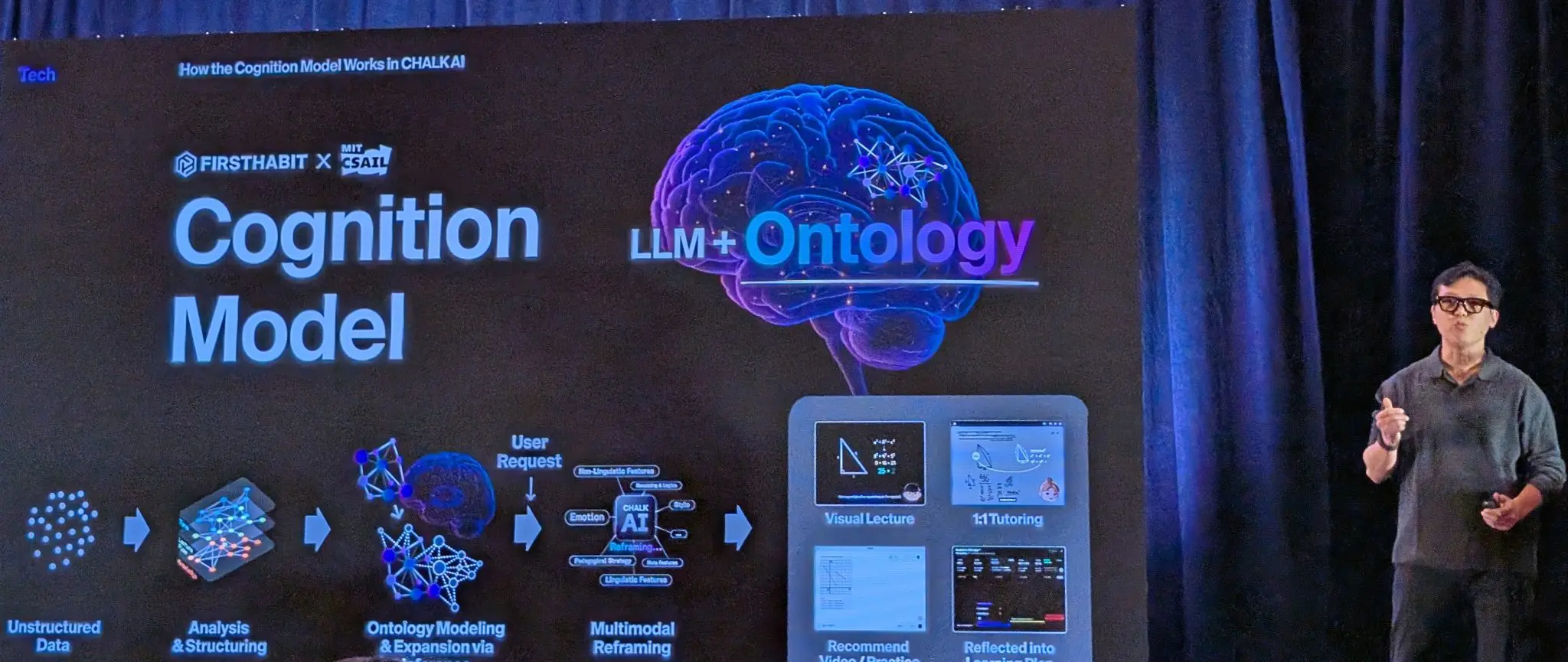
The Global Innovation Forum 2026 demonstrated that the most pressing technological challenges require solutions that transcend national boundaries. These challenges range from sustainable manufacturing to healthcare diagnostics to human-computer interaction. Korea’s Firsthabit ultimately claimed victory with CHALK, their AI-powered educational platform that represents a fundamentally different approach to learning technology. Instead of simply using AI and large language models to answer questions for students, CHALK uses a proprietary Visual LLM. It enables “Conversational Lectures,” a dialogue-based learning method. This method allows students to engage with AI tutors through 3D visual chatbots.
The platform’s effectiveness has been validated through real student trials: beta tests in Korea and Boston achieved a 76.4% completion rate in self-directed learning. This rate is over five times the industry average. Blind tests showed students using CHALK’s conversational lectures delivered 30-40% higher performance compared to top-tier academies. Firsthabit’s victory underscores a growing recognition that the most valuable AI applications in education are those that enhance rather than replace the learning process itself.
For the Seoul Business Agency and its partner institutions, the forum’s success lies not merely in identifying winners. It is in creating the connections that allow innovation ecosystems to strengthen one another. Hyunwoo Kim, President and CEO of Seoul Business Agency, stated the SBA aims to expand the event. They want it to become a representative collaboration model. This model will connect the global startup ecosystem through CES. In that spirit, GIF 2026 may prove to be the beginning of a new model for international startup collaboration at the world’s largest technology showcase.